Introduction: Why Patient Flow is the Engine of Dental Growth
Managing a successful dental practice requires shifting your perspective from that of a clinical practitioner to a business leader. At the heart of this transition lies the concept of patient flow—the strategic management of how individuals move through your practice, from the moment they discover your brand online to the completion of their treatment plans. Many practitioners confuse volume with flow, but high volume without efficiency is a recipe for burnout and lost revenue. True patient flow is "clinical revenue engineering." It is the process of optimizing your chair-time-to-revenue ratio by ensuring that every touchpoint—digital, administrative, and clinical—is friction-free. By mastering these ten strategies, you will transform your dental practice into a highly efficient ecosystem that prioritizes both patient satisfaction and long-term financial health.
Defining Patient Flow vs. Patient Volume
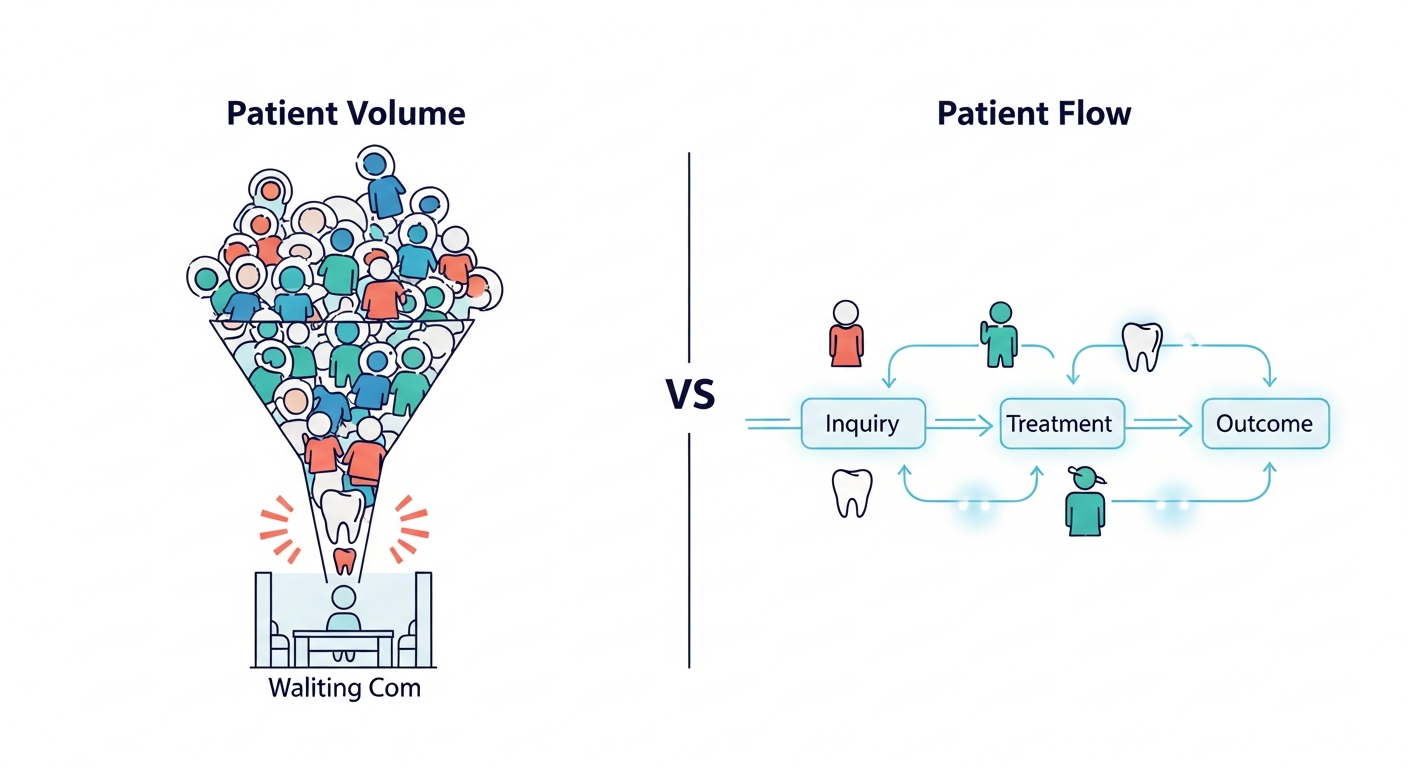 While high patient volume can lead to bottlenecks and chaos, optimized patient flow ensures a smooth, predictable journey from initial inquiry to completed treatment.
Patient volume is a vanity metric; it measures how many people walk through your door, regardless of the clinical outcome or the cost of acquisition. Patient flow, however, is a measurement of velocity and efficiency. It accounts for the entire lifecycle of the dental patient, tracking how quickly and effectively you can move a prospect from an initial inquiry to a completed, satisfied treatment outcome. A high-volume practice might be chaotic, with patients waiting in the reception area and staff scrambling to fill holes in the schedule. A practice with high patient flow is methodical, predictable, and scalable. When you prioritize flow, you reduce the time patients spend in the waiting room and maximize the number of billable units each chair generates per day.
The Relationship Between Operational Efficiency and Revenue
Your revenue is directly tied to how efficiently your team manages the practice schedule. Utilizing a patient engagement software, such as Flex Dental Solutions, can help alleviate these issues. Every empty slot or redundant administrative task represents lost potential. When operational efficiency is low, the practice incurs "hidden costs"—such as overtime pay, staff frustration, and the loss of high-value appointments due to scheduling gaps. By streamlining your internal workflows, you reduce the time between diagnostic identification and treatment delivery. This ensures that your revenue cycle is healthy, consistent, and sustainable. Essentially, efficiency is the bridge between excellent clinical care and the financial success required to sustain that care over the long term.
Strategy 1: Optimize Your Digital Front Door
Today, 70% of potential patients research a dental practice online before making a phone call. Your digital presence is the first, and often only, opportunity to make a positive impression.
Claiming and Enhancing Your Google Business Profile
Your Google Business Profile (GBP) is the most critical asset for local SEO. Ensure your information—address, phone number, and hours of operation—is accurate. Upload high-quality photos of your team and clinic to humanize your practice. The goal is to make it as easy as possible for a user to find your "contact" information or click the "book now" button directly from their search results.
Improving Search Engine Visibility for Local Keywords
To attract the right dental patient, you must target location-specific keywords. Focus your SEO efforts on phrases like "dentist in [City Name]" or "emergency dental care near me." By consistently publishing high-quality blog content related to your services, you signal to search engines that your website is an authoritative source in your local market.
Website Conversion: Turning Visitors into New Dental Patients
A website that looks good but fails to convert visitors into appointments is a missed opportunity. Your site must be mobile-responsive, fast-loading, and focused on a single call to action: scheduling. Use clear buttons that guide visitors to contact you or book a consultation immediately.
Strategy 2: Implement Frictionless Online Booking Systems
The modern consumer expects the same convenience in healthcare that they receive from retail or travel apps. If they have to wait until your office opens to speak with a human to schedule, you risk them finding a competitor who offers instant access.
Meeting the Demand for 24/7 Appointment Scheduling
Implementing an online booking system, such as Reserve with Google, that allows patients to select their own appointment times provides a significant competitive edge. This feature satisfies the patient’s desire for control and reduces the administrative burden on your front desk staff, who would otherwise spend hours on the phone manually coordinating calendars.
Reducing Friction in the Marketing Conversion Process
Every extra click or redundant form field acts as a barrier to conversion. Keep your online intake forms concise and require only the necessary information. When you remove friction, you increase the likelihood that a visitor will complete the booking process, turning a casual browser into an active patient.
Integrating Online Booking with Your Practice Management System
Automation is only effective if it syncs with your back-end operations. A robust online booking system must integrate directly with your practice management software, like Open Dental. This prevents double-booking and ensures your team has real-time visibility into the daily schedule, allowing them to manage the flow of patients effectively.
Strategy 3: Prioritize Automated Reputation Management
In the dental industry, trust is the primary currency. Before committing to a treatment plan, most patients turn to reviews to validate their decision.
The Impact of Online Reviews on Patient Trust
Positive Reviews serve as social proof that your practice delivers quality dental care. Prospective patients are far more likely to choose a provider with hundreds of five-star reviews over one with little to no online presence. Consistent, positive feedback is the single most effective way to grow your patient base through referrals.
Streamlining Feedback via Automated Patient Surveys
Don’t wait for happy patients to leave a review on their own. Use automated follow-up communication to request feedback immediately after a procedure. When you make it easy for patients to share their experience, you increase the quantity and quality of your reviews exponentially.
Responding to Reviews on Google and Yelp to Build Credibility
Responding to reviews—both positive and negative—is essential for building brand authority. A professional, empathetic response to a concern demonstrates that you value patient satisfaction and are committed to continuous improvement. It shows potential patients that if something goes wrong, you will take ownership.
Strategy 4: Empower the Front Desk Staff for Better Conversions
Your front desk is the mission control of your practice. They are not just administrative personnel; they are the gatekeepers of your patient experience.
The Art of the First Impression: Telephone Communication Skills
The quality of the initial phone call determines whether a prospective patient schedules an appointment or continues searching. Invest in training your team on communication scripts that prioritize empathy and clarity. They should be able to convey the value of your services immediately, leaving the caller feeling heard and welcomed.
Developing Effective Scripts for Handling Price Objections
Price sensitivity is a common hurdle, but it is often a proxy for a lack of perceived value. Train your team to shift the conversation from "cost" to "health investment." By providing clear explanations of the long-term benefits of the proposed dental care, your team can help patients understand why your practice is the right choice, regardless of insurance status.
Reducing the No-Show Rate Through Proactive Scheduling
A missed appointment is a hole in your schedule that cannot be easily recovered. Implement a proactive confirmation system that uses SMS and email reminders to keep appointments top-of-mind for your patients. By maintaining consistent communication, you significantly reduce no-shows and keep your daily operations running smoothly.
Strategy 5: Maximize Treatment Acceptance Rates
The largest source of "hidden" revenue in a dental clinic is often the backlog of unaccepted treatment plans. Increasing your acceptance rate is the most effective way to increase practice revenue without spending a dollar on marketing.
Improving Patient Education and Oral Health Awareness
Patients accept treatment when they fully understand the "why" behind it. Use non-clinical, simple language to explain oral health conditions. When patients understand the consequences of inaction, they become active participants in their own care rather than passive recipients of a bill.
Utilizing Dental Technologies to Visualize Treatment Plans
Seeing is believing. Utilize intraoral cameras and digital imaging to show patients exactly what is happening in their mouths. When a patient can see their own dental decay or structural issues on a screen, the diagnosis becomes undeniable, and trust in your treatment plan follows naturally.
The Psychology of Case Presentation: Building Clinical Trust
Effective case presentation is about empathy, not sales pressure. Frame your recommendations as a path to a healthier life. By listening to the patient’s concerns first and aligning your treatment plans with their personal goals, you build the clinical trust necessary for long-term patient loyalty.
Strategy 6: Remove Financial Barriers with Patient Financing
Financial anxiety is the primary reason patients decline necessary dental work. By offering solutions that make high-quality care affordable, you remove a major roadblock to growth.
Offering Flexible Payment Plans and Third-Party Financing
Partner with reputable third-party financing companies to provide patients with monthly payment options. This allows patients to undergo comprehensive treatment immediately rather than delaying care until they have saved the full amount.
Transitioning from "Insurance-Led" to "Patient-Centered" Care
Do not let insurance limitations dictate the standard of care you offer. If a procedure is necessary for health, advocate for the patient. Shift the focus toward what the patient actually needs to reach optimal oral health, rather than what their insurance policy covers.
Improving the Revenue Cycle through Transparent Cost Estimates
Surprise costs are the fastest way to erode trust. Always provide clear, written estimates before beginning any procedure. Transparency in billing creates a comfortable environment, ensuring patients feel respected and prepared when it comes time to pay.
Strategy 7: Optimize Internal Workflow Mapping
To scale your practice, you must continuously audit your internal processes to eliminate bottlenecks.
Conducting a Time–Motion Analysis of the Patient Experience
Map out the patient’s journey from the moment they walk through the door to the moment they check out. Identify "dead time"—periods where the patient is waiting unnecessarily in the reception area or in the chair. By optimizing the transition between hygiene and doctor exams, you can increase the number of patients you see daily without increasing the length of the workday.
Conclusion
Increasing patient flow is not about working harder; it is about working smarter by refining every element of your practice management. By optimizing your digital presence, implementing frictionless booking, and empowering your staff, you create an environment where high-quality dental care becomes the standard. Remember that every process, from your website’s contact form to the way you present treatment plans, impacts your bottom line. As you implement these ten strategies, focus on the human side of the equation—the relationships you build with your patients are the foundation of your success. Start by auditing your current scheduling process and identifying the primary bottleneck in your office today. By consistently refining your operations, you will not only increase your revenue but also elevate the level of care you provide, securing the long-term growth and reputation of your dental practice. Success in dentistry is a marathon, not a sprint; prioritize consistency, lead with clarity, and keep your focus on the patient experience at every turn.