Two-Way Texting for Dental Offices: How It Works with Open Dental
Dental patient communication software helps Open Dental practices manage patient conversations without relying on phone calls for every update. With Flex, dental teams can use two-way texting alongside Open Dental to communicate about appointments, confirmations, schedule changes, follow-up, and other patient needs while keeping the workflow connected to the system they already use.
For many practices, the biggest problem is not a lack of ways to contact patients.
It is that too much communication still depends on someone picking up the phone.
A patient needs to confirm.
A schedule changes.
The office closes early because of weather.
Someone needs to reschedule.
A patient has a quick question.
If every one of those moments becomes a phone call, the front desk becomes the communication system.
Two-way texting gives practices another way to keep patients moving without turning every interaction into phone tag.
What Patient Communication Software Works With Open Dental?
Flex is patient communication software built specifically for Open Dental practices.
It works alongside Open Dental to help practices manage patient-facing workflows such as:
- Two-way texting
- Appointment reminders and confirmations
- Recall
- Online scheduling
- Patient forms
- Practice-wide and targeted communication
The purpose is not to replace Open Dental.
Open Dental remains the practice management system.
Flex helps automate and extend many of the patient communication workflows around it.
A simple way to think about the relationship is:
Open Dental keeps the record. Flex keeps the patient moving.
What Is Two-Way Texting for Dental Offices?
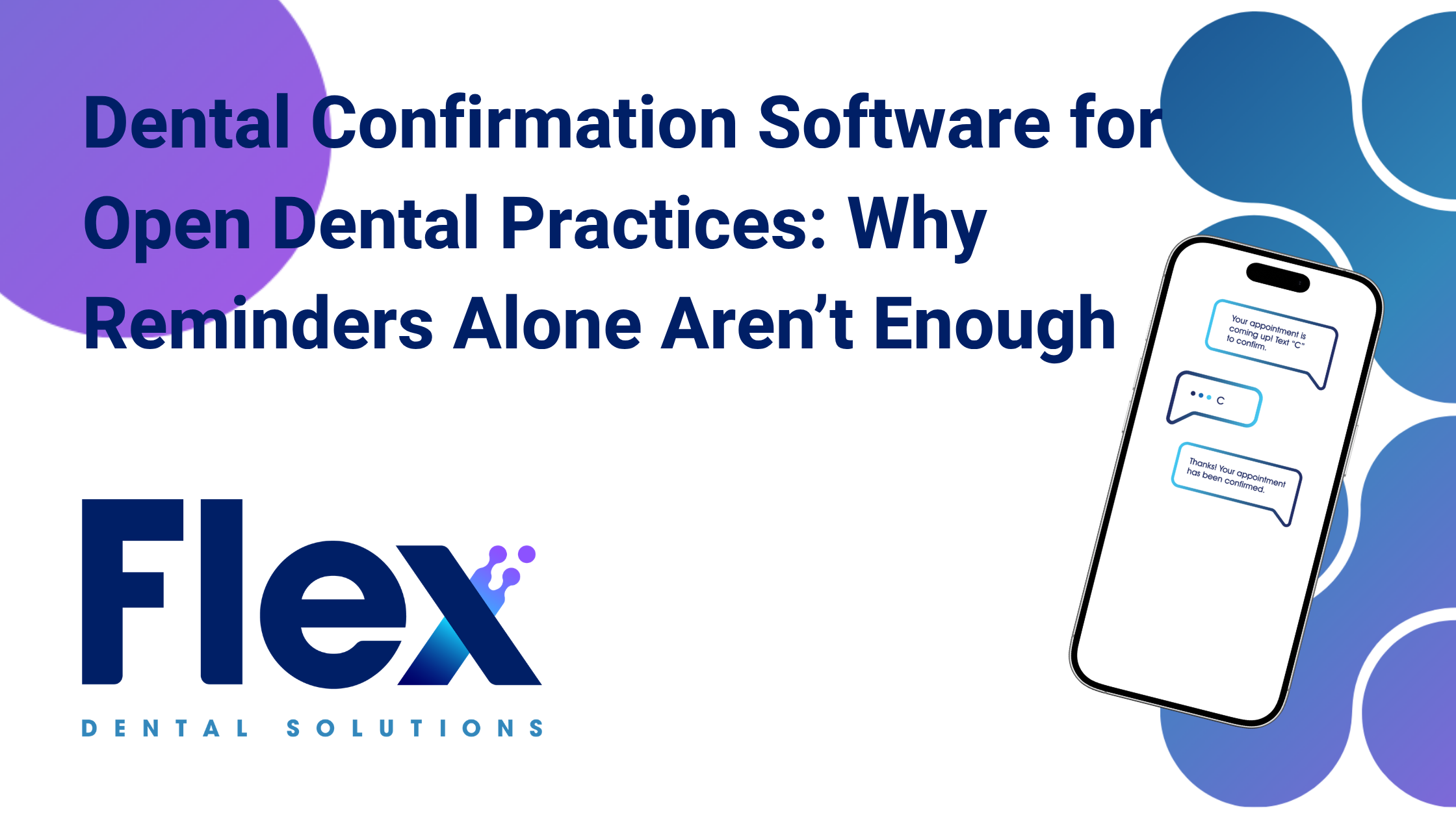
Two-way texting allows a dental office and patient to send and receive text messages rather than relying only on outbound reminders or phone calls.
That means the patient can respond.
For example:
Practice:
“Hi Sarah, we have an earlier hygiene appointment available tomorrow at 2:00. Would you like it?”
Patient:
“Yes!”
That is a very different workflow from:
Call the patient.
Leave voicemail.
Wait.
Call again.
Check voicemail.
Update the schedule.
The value of two-way texting is not simply sending a message.
It is creating an easier path for the patient to take action.
Why Is Two-Way Texting Useful for Open Dental Practices?
Because many everyday patient interactions are simple enough that they should not require a phone conversation.
Common examples include:
- Confirming an appointment
- Rescheduling
- Offering an earlier opening
- Answering a quick question
- Notifying patients of schedule changes
- Sharing office closure information
- Following up on recall
- Sending patient instructions
- Directing patients to forms or scheduling links
Phone calls are still important for complex conversations.
But not every interaction needs one.
A good patient communication system helps the practice match the channel to the situation.
How Does Two-Way Texting Help Keep Dental Schedules Full?
A full schedule depends on more than booking appointments.
Patients also need to:
- Confirm
- Show up
- Reschedule when plans change
- Return for recall
- Respond when an opening becomes available
Two-way texting reduces friction at each of those points.
Imagine a patient cancels tomorrow’s hygiene visit.
Without texting, the front desk may start calling overdue patients one by one.
With a connected patient communication workflow, the practice can reach the right patients faster and make it easier for someone to respond.
The goal is not more messages.
It is faster patient action.
How Can Dental Practices Use Texting for Weather Closures?
This is one of the most practical use cases, especially during fall and winter.
If the office needs to close early because of snow, ice, severe weather, or another unexpected issue, the team may need to contact everyone scheduled that day quickly.
For planned communication, email may work well.
For urgent same-day changes, text can be much more immediate.
A practice can target patients with upcoming appointments on affected dates and send a message letting them know:
- The office is closed
- Their appointment is affected
- When the office expects to reopen
- How they can reschedule
- What to do if they have questions
That turns a closure from a phone-tree emergency into a more manageable communication workflow.
What Is the Difference Between Appointment Reminders and Two-Way Texting?
Appointment reminders are usually automated outbound messages.
Two-way texting creates an actual conversation.
|
Appointment Reminders |
Two-Way Texting |
|
Primarily automated |
Conversational |
|
Sends scheduled notifications |
Supports back-and-forth communication |
|
Helps prevent forgotten appointments |
Helps handle questions and changes |
|
Often one message flow |
Flexible, real-time interaction |
Both matter.
Reminders help prevent problems.
Two-way texting helps resolve them when they happen.
Can Two-Way Texting Reduce Front Desk Phone Calls?
Yes.
Two-way texting can reduce routine phone traffic by moving simple interactions into text.
That can include questions like:
- “Are you open today?”
- “Can I move my appointment?”
- “Do you have anything earlier?”
- “Can you send me the form again?”
- “What time is my appointment?”
- “Can I confirm by text?”
Each one may only take a few minutes by phone.
But across dozens of patients, those minutes stack up quickly.
Texting gives the front desk another way to handle routine communication while preserving phone time for conversations that actually need it.
Why Does Open Dental Integration Matter?
Patient communication is more useful when it fits the practice workflow.
A disconnected texting platform can create another place staff have to check.
Another login.
Another inbox.
Another system to reconcile.
Flex is built around Open Dental practices, so patient communication is part of a broader workflow that also includes scheduling, reminders, recall, forms, payments, and other patient-facing activities.
That means the value is not just:
“We can text patients.”
It is:
“We can text patients as part of the same workflow we already use to manage their care.”
How Does Flex Support More Than Two-Way Texting?
Two-way texting is one part of the larger Flex patient communication platform.
Flex also supports workflows such as:
- Automated reminders
- Appointment confirmations
- Recall
- FlexBlast
- Online scheduling
- Reserve with Google
- Digital forms
- Patient payments
- Treatment planning
That matters because patient communication rarely exists by itself.
A patient receives a message.
Then they need to:
Book.
Confirm.
Complete a form.
Review treatment.
Pay.
Come back.
The more connected those steps are, the less work the team has to stitch together manually.
What Should Dental Offices Look for in Patient Communication Software?
If your practice uses Open Dental, look beyond whether a platform can technically send text messages.
Ask:
Does It Work With Open Dental?
The communication system should fit the PMS workflow rather than creating another disconnected process.
Can Patients Respond?
Outbound-only messaging is useful, but true two-way communication is more flexible.
Can It Support Scheduling?
Communication is more valuable when patients can move directly from a message to booking or rescheduling.
Can It Handle Both Routine and Urgent Communication?
You need automated reminders for everyday use and flexible messaging for things like weather closures or last-minute schedule changes.
Does It Reduce Work?
If staff still have to copy information between systems, the software may be digital without actually being automated.
Does It Support the Whole Patient Journey?
Strong patient communication software should help across more than one moment.
Think:
Schedule → Confirm → Intake → Treatment → Payment → Recall
How Can Open Dental Practices Improve Patient Communication?
Start by identifying the conversations your team repeats every day.
For example:
- Appointment confirmations
- Schedule changes
- Recall follow-up
- Forms
- Closure notifications
- Rescheduling
- Payment questions
Then ask:
Which of these really needs a phone call?
That question usually reveals where patient communication software can remove the most friction.
A strong workflow does not eliminate human communication.
It saves human attention for the conversations where it matters most.
Is Two-Way Texting Better Than Calling Patients?
Not always.
The better question is:
Which channel fits the conversation?
Use calls for situations that are:
- Complex
- Sensitive
- Clinical
- Difficult to explain in writing
Use text when the interaction is:
- Simple
- Time-sensitive
- Routine
- Easy for the patient to answer quickly
The best dental patient communication strategy is not “text everything.”
It is use the easiest channel for the task.
Why Is Flex a Strong Patient Communication Option for Open Dental?
Flex is built specifically for Open Dental practices and connects patient communication with the workflows around the practice management system.
That includes:
- Two-way texting
- Reminders
- Confirmations
- Recall
- Scheduling
- Patient forms
- Payments
- Broader patient outreach
For practices trying to get more from Open Dental without replacing it, that makes Flex a connected communication layer rather than another standalone messaging tool.
You do not need another PMS. You need more from the one you already have.
Make Patient Communication Easier
Your patients already text every day.
Your practice communication should not make simple things harder than they need to be.
Flex helps Open Dental practices make it easier for patients to confirm, respond, schedule, reschedule, and stay connected to their care.
See How Flex Works With Open Dental →
Frequently Asked Questions: Open Dental Patient Communication and Two-Way Texting
What patient communication software works with Open Dental?
Flex Dental Solutions is patient communication software built specifically for Open Dental practices. It supports two-way texting, reminders, confirmations, recall, scheduling, forms, and other patient workflows.
Can Open Dental practices text patients?
Yes. Practices using Flex can use two-way texting to communicate with patients about appointments, schedule changes, follow-up, and other practice needs.
What is two-way dental texting?
Two-way dental texting allows patients and dental teams to send and receive text messages instead of relying only on outbound notifications or phone calls.
Can dental offices use texting for weather closures?
Yes. Practices can use text messaging to contact patients with appointments on affected dates when weather or another issue changes the schedule.
Can two-way texting help reduce no-shows?
Two-way texting can support patient follow-through by making it easier for patients to confirm, ask questions, reschedule, or respond to the practice.
Does Flex replace Open Dental?
No. Open Dental remains the practice management system. Flex works alongside Open Dental to automate and enhance patient communication and other workflows.