Introduction: The Direct Link Between Expense Management and Practice Profitability
The profitability of a dental practice hinges not only on attracting and retaining patients but also on diligently managing its operational expenses. The direct link between effective expense management and a healthy bottom line is undeniable. For dentists and practice owners, understanding where every dollar goes is the first step toward greater financial control, improved patient care through resource optimization, and ultimately, a more robust and sustainable practice. This article will explore proven strategies to slash dental office expenses, unlock hidden revenue, and significantly boost your practice's profitability.
Why Expense Management Matters More Than Ever for Dental Practices
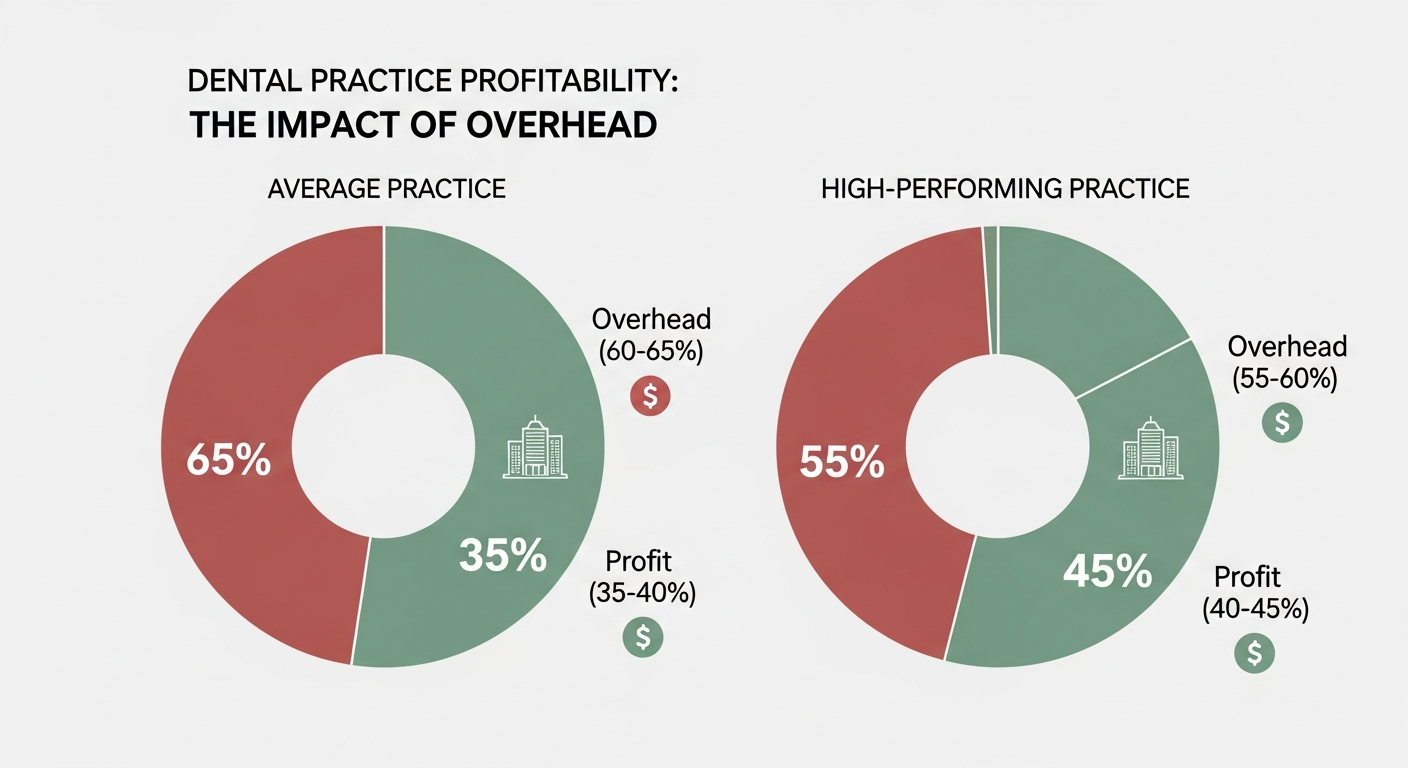 A visual comparison of overhead and profit margins in average versus high-performing dental practices. Even a 5-10% reduction in overhead can significantly boost a practice's take-home profit.
The financial well-being of a dental practice is a complex equation, with revenue on one side and expenses on the other. While increasing revenue is a constant focus, neglecting the expense side can quickly erode profits. The average practice expense per dentist in private practice surpassed $530,000 in 2023 [Becker's Dental Review, 2024]. This substantial figure underscores the critical need for meticulous oversight. Furthermore, the average dental practice overhead typically ranges from 60-65% of total collections, with high-performing practices maintaining overhead between 55-60% [Overjet, 2025]. Effective expense management isn't just about cutting costs; it's about strategic allocation of resources to maximize value, enhance patient care, and ensure long-term financial stability for the practice and its dentists.
Understanding Your Practice's Financial Pulse: The Foundation of Expense Reduction
Before implementing any cost-saving measures, a thorough understanding of your practice's financial health is paramount. This involves dissecting your financial statements, benchmarking your performance against industry standards, and categorizing your expenditures. This foundational knowledge empowers you to identify specific areas for improvement and track the impact of your strategies.
Deciphering Your Profit and Loss (P&L) Statement
The Profit and Loss (P&L) statement is your primary tool for understanding your practice's financial performance over a specific period. It details your revenue, lists all your expenses, and calculates your net profit or loss. To effectively manage expenses, you must regularly review your P&L to identify trends, pinpoint significant cost categories, and understand how each expense impacts your overall profitability. Breaking down P&L line items allows dentists to see precisely where their practice's funds are allocated, from dental supplies to salary expenses and lab fees.
Benchmarking Your Overhead: Where Do You Stand?
Benchmarking involves comparing your practice's financial performance, particularly its overhead costs, against industry averages or similar practices. This comparison helps identify if your expenses are disproportionately high in certain areas. Understanding where you stand relative to your peers can reveal opportunities for optimization that you might not have otherwise discovered. For instance, if your supply costs are significantly higher than the typical 5-10% of collections, it signals a need for closer examination of your procurement processes.
Distinguishing Between Fixed and Variable Costs
Understanding the nature of your costs is crucial for strategic reduction. Fixed costs, such as rent, insurance premiums, and equipment loan payments, remain relatively constant regardless of patient volume. Variable costs, on the other hand, fluctuate with practice activity; these include dental supplies, lab fees, and hourly wages for part-time staff. While fixed costs offer less flexibility in the short term, variable costs present more immediate opportunities for savings through efficient management and negotiation. Identifying and analyzing both types of costs allows for a more targeted and effective expense reduction plan.
Strategic Supply Chain Optimization: Maximizing Value, Minimizing Waste
Dental supplies represent a significant and often variable expense for any dental practice. Inefficient purchasing, excessive inventory, and poor management can lead to substantial financial losses. Optimizing your supply chain is key to reducing these costs without compromising the quality of patient care or the availability of essential materials.
Implementing Effective Inventory Management Systems
Effective inventory management is the cornerstone of controlling dental supply costs. Implementing systems like just-in-time ordering, establishing par levels for critical supplies, and conducting regular inventory audits can dramatically reduce waste. Utilizing inventory management software or even a well-organized spreadsheet can track usage, expiration dates, and reorder points, ensuring you have what you need when you need it, without overstocking.
Leveraging Group Purchasing Organizations (GPOs)
Group Purchasing Organizations (GPOs) aggregate the purchasing power of multiple dental practices, allowing them to negotiate better prices on dental supplies and equipment than they could individually. By joining a GPO, you can access significant discounts, favorable payment terms, and access to a wider range of vendors. This can lead to substantial savings on everything from basic consumables to specialized instruments, directly reducing your overhead costs.
Smart Sourcing: Balancing Quality and Cost in Dental Materials
When sourcing dental supplies and materials, striking a balance between quality and cost is essential. While it may be tempting to opt for the cheapest option, the long-term implications for patient care and potential remakes due to inferior materials can be costly. Researching reputable manufacturers, comparing prices from multiple trusted suppliers, and negotiating terms are critical. Consider the total cost of ownership, including durability, performance, and any associated risks. Nearly 90% of dentists reported an increase in the cost of supplies and materials since the start of 2025, with over 31% seeing increases of more than 10% [Becker's Dental Review, 2025], making smart sourcing more critical than ever.
Streamlining Ordering and Tracking Processes
Manual ordering and tracking of supplies can be time-consuming and prone to errors. Implementing digital ordering systems, establishing preferred supplier relationships, and utilizing practice management software features for supply management can streamline the entire process. Automated reordering based on par levels, digital invoice tracking, and centralized order management reduce administrative burden, minimize errors, and ensure consistent availability of dental supplies.
Mastering Dental Lab Costs: Quality, Efficiency, and Transparency
Dental lab fees represent another substantial expense for most practices. Unmanaged, these costs can significantly impact profitability. Gaining control over lab expenses requires understanding invoices, fostering strong relationships with reliable labs, and leveraging technology.
Deep Dive into Lab Fees: Understanding Your Invoices
Many practices pay lab invoices without fully scrutinizing them. Understanding the breakdown of charges—material costs, fabrication fees, shipping, and any surcharges—is crucial. Regularly reviewing these invoices helps identify discrepancies, opportunities for negotiation, and potential areas where costs are unnecessarily high. Ask your lab for detailed itemized statements to ensure transparency and to track the costs associated with different types of restorations or prosthetics.
Building Strategic Lab Partnerships
Developing strong, long-term partnerships with your dental labs can lead to better pricing, improved turnaround times, and higher quality work. Open communication about your practice's needs and expectations is vital. A collaborative relationship allows for discussions about material choices, cost-saving alternatives, and efficient workflow processes. Negotiating master service agreements can provide predictable pricing and discounts for consistent volume.
Leveraging Digital Technology for Lab Efficiencies
Digital dentistry, including CAD/CAM technology, 3D printing, and digital impressions, is revolutionizing lab work. Practices that adopt digital workflows can often reduce lab fees, improve accuracy, and shorten turnaround times. Digital impressions eliminate the need for impression materials and reduce shipping costs. Many labs offer discounted pricing for digitally submitted cases. The global digital dentistry market was valued at $5,331.59 million in 2023 and is projected to grow significantly, driven by increasing ROI from digital solutions [Precedence Research, 2024], highlighting its efficiency and cost-saving potential.
Preventing "Profit Leaks" from Untracked Lab Costs
Untracked lab costs can lead to significant "profit leaks." This includes fees for remakes due to poor fit or shade matching, unexpected rush charges, or insufficient tracking of material usage. Implementing a system to track remakes, identify common causes, and communicate feedback to your lab can reduce costly errors. Clearly defining quality standards and return policies with your lab helps prevent these financial drains.
Optimizing Staffing and Labor Expenses: Your Practice's Biggest Investment
Staff salary and benefits often constitute the largest single expense category for a dental practice. While essential for providing excellent patient care, optimizing staffing levels and productivity is key to controlling these costs without sacrificing quality or morale.
Analyzing Your Staffing Structure and Productivity
Regularly assess your team's roles, responsibilities, and overall productivity. Are you adequately staffed for your patient volume? Are there redundancies or inefficiencies in your workflow? Optimizing scheduling, cross-training staff to handle multiple roles, and implementing performance metrics can ensure your team is working at peak efficiency. The average compensation for dental front office staff increased by 16% according to the ADA's 2025 Economic Outlook Survey [Reach, 2025], making efficient staffing models even more critical. Many practices can lower staff costs through effective systems and training.
Strategic Staff Compensation and Benefits
While controlling salary expenses is important, competitive compensation and benefits are crucial for attracting and retaining skilled staff. Review your compensation structure regularly to ensure it aligns with industry standards and your practice's financial capacity. Consider offering performance-based bonuses or profit-sharing incentives tied to practice goals. Evaluating your benefits package for cost-effectiveness and value to employees can also help manage this significant expense.
Leveraging Technology and Outsourcing for Administrative Efficiency
Technology offers powerful tools to reduce administrative burdens and associated labor costs. Automating appointment scheduling, billing, insurance verification, and patient communication can free up staff time for more patient-facing tasks. Consider outsourcing certain functions, such as payroll, HR, or advanced IT support, if it proves more cost-effective than hiring dedicated in-house staff. This allows your team to focus on core clinical operations and patient care.
Streamlining Operational and Administrative Costs
Beyond supplies, labs, and staffing, numerous smaller operational and administrative expenses can accumulate. A systematic review of these areas can uncover significant opportunities for savings.
Reducing Facility and Utility Expenses
The costs associated with maintaining your practice facility—rent or mortgage, utilities, maintenance, and insurance—are substantial fixed expenses. Explore energy-efficient lighting, HVAC systems, and programmable thermostats to reduce utility bills. Regular maintenance can prevent costly emergency repairs. Review your lease agreements periodically to ensure you are getting competitive terms.
Controlling Software, Subscriptions, and Transaction Fees
Dental practices rely on a suite of software and subscription services, from practice management systems to imaging software. Audit all your software licenses, subscriptions, and recurring service contracts annually. Consolidate services where possible, negotiate better rates, or explore more cost-effective alternatives. Similarly, review your credit card and payment processing fees to ensure you are not overpaying.
Modernizing Insurance and Collections Processes
Inefficient insurance claim processing and collections are significant drains on practice revenue and introduce administrative overhead. At least 15% of received claims are denied by dental insurance companies, a rate significantly higher than in previous years [DentalInsurance.com, 2025]. Implementing robust insurance verification systems, utilizing electronic claims submission, and employing efficient denial management strategies can significantly reduce administrative time and revenue loss. Streamlining patient payment plans and clear communication about financial responsibilities at the outset can improve cash flow and reduce the burden of chasing overdue payments.
The Power of Digital: Reducing Paper and Storage Costs
The transition to digital records and workflows offers substantial savings. Reducing paper consumption means lower costs for paper, printing, ink, and physical storage. Digital patient records are easier to access, share, and manage, reducing administrative time and the risk of lost information. Implementing digital consent forms, online patient portals, and digital imaging archives contributes to a more streamlined and cost-effective practice.
Beyond Cost-Cutting: Proactive Strategies to Boost Profitability
While aggressively managing expenses is crucial, true profitability lies in a balanced approach that integrates cost control with revenue enhancement. By strategically reinvesting savings and optimizing revenue streams, practices can achieve sustainable financial growth.
Optimizing Your Fee Schedule and Insurance Participation
Regularly review and update your fee schedule to reflect current market rates and the value of the services you provide. Ensure your fee schedule is competitive yet profitable, accounting for your operational costs and desired profit margin. Carefully evaluate your participation with various dental insurance plans; while participation can drive patient volume, ensure that reimbursement rates adequately cover your costs and contribute to profitability.
Enhancing the Patient Experience for Increased Revenue
A positive patient experience is a powerful driver of revenue. Satisfied patients are more likely to return for regular care, accept recommended treatment plans, and refer new patients. Investing in patient comfort, efficient scheduling, clear communication, and empathetic staff interactions fosters loyalty and can lead to increased treatment acceptance rates and a stronger patient base. This translates directly into higher revenue for the practice.
Strategic Marketing and New Patient Flow
Effective marketing is essential for attracting new patients and ensuring a consistent flow of revenue. While marketing represents an expense, a well-executed strategy offers a strong return on investment. Targeted marketing campaigns, an optimized online presence, and patient referral programs can fill your schedule and increase overall revenue, providing a buffer against rising expenses. Studies consistently show a positive ROI from strategic marketing investments, helping to offset operational costs.
Conclusion
Effectively managing expenses is not merely a task for the accounting department; it is a strategic imperative for every dental practice owner and dentist aiming for sustained profitability. From meticulously controlling dental supply costs through smart inventory systems and GPOs to mastering lab fees with transparent partnerships and digital solutions, every dollar saved directly enhances your bottom line. Optimizing staffing, streamlining administrative processes, and modernizing insurance and collections further solidify your financial foundation.
By adopting a proactive approach that balances diligent cost management with strategic revenue enhancement—through optimized fee schedules, superior patient experiences, and targeted marketing—your practice can achieve not only significant cost reductions but also robust and sustainable growth. The intelligence brief highlights the opportunity to position this guide as a definitive resource, moving beyond simple cost-cutting to a holistic strategy for financial health. Implement these proven strategies, monitor your financial pulse, and transform your practice's expenses into investments that fuel greater profitability and ensure long-term success.