The landscape of modern dentistry is undergoing a profound transformation. In previous years, dental marketing was often measured by the sheer volume of new patient leads—a "more is better" approach that frequently prioritized quantity over the long-term sustainability of the practice. In 2026, the industry has shifted. Savvy practice owners are moving away from vanity metrics like click-through rates and social media likes, focusing instead on high-value case acceptance and measurable revenue. This guide provides a strategic roadmap for growing your dental practice by bridging the gap between digital marketing and clinical operations.
Shifting from Tactics to Revenue: The 2026 Marketing Mindset
Why Traditional Dental Marketing is Evolving
The era of broad-reach, non-targeted advertising is coming to an end. Historically, dental practices relied on basic SEO and generalized direct mail to fill hygiene chairs. While these methods can still provide some volume, they often struggle to attract the high-ticket patients required to scale a practice effectively. Today’s competitive environment demands a move toward hyper-targeted dental marketing that prioritizes patient intent over simple visibility. As search engines become more sophisticated, the focus has moved to "high-intent" queries, where patients are not just looking for a dentist, but for solutions to specific, often complex, oral health problems.
Moving Beyond Vanity Metrics: Focusing on ROI and Patient Lifetime Value
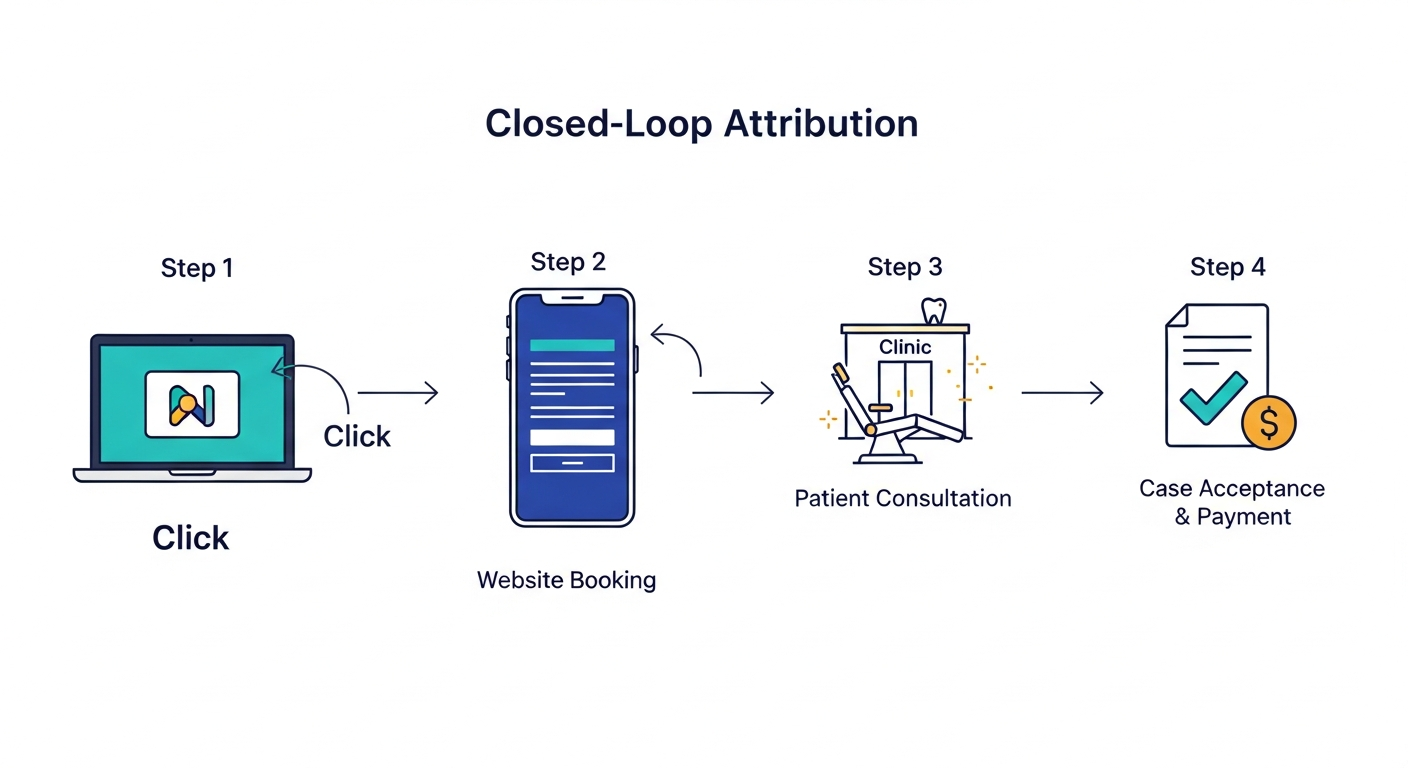 Closed-loop attribution connects your digital marketing efforts directly to clinical revenue, allowing you to track a patient's journey from their first click to case acceptance.
To thrive in 2026, you must treat marketing as a financial investment rather than a necessary business expense. Vanity metrics—clicks, impressions, and likes—are secondary to the metrics that actually drive practice growth: Cost Per Lead (CPL), Case Acceptance Rate, and Return on Investment (ROI). By connecting your marketing dashboard to your practice management software (PMS), you can track the lifecycle of a lead from the first click on a Google ad to the final payment for a full-arch implant case. This "closed-loop" attribution is the hallmark of a high-performing practice.
Building a High-Conversion Digital Foundation
Custom Dental Website Development: Speed, Mobile-First, and Conversion Rate Optimization
Your website is the digital storefront of your practice. In 2026, a website that is merely "aesthetic" is insufficient. It must be a high-conversion tool. Because the vast majority of patients research their dental needs on a mobile device, a "mobile-first" approach is non-negotiable. If your site does not load instantly, potential patients will abandon the session before they even see your homepage. Conversion Rate Optimization (CRO) involves strategic placement of clear calls-to-action (CTAs), simplified booking forms, and intuitive navigation that guides the user toward scheduling an appointment.
The Role of Branding and Graphic Design in Establishing Trust
Trust is the primary currency of dentistry. Your branding—from your logo to the imagery on your site—must project clinical excellence and comfort. Professional graphic design ensures that your digital presence mirrors the quality of care you provide in the operatory. By aligning your visual identity with the expectations of your target demographic, you build immediate authority that differentiates you from local competitors who utilize generic stock photography.
Google Page Speed Insights and User Experience (UX)
User experience is a critical ranking factor for search engines. Using tools like Google Page Speed Insights, you can identify the technical bottlenecks slowing down your site. A faster site not only improves your search engine rankings but also significantly increases the likelihood that a visitor will become a patient. Superior UX means that information—such as hours, insurance acceptance, and clinical bios—is immediately accessible, reducing the friction that often kills conversions.
Dominating Local Search: The Foundation of Patient Growth
Optimizing Your Google Business Profile for Top 3 Rankings
For local dental practices, the Google Business Profile (GBP) is the most powerful asset in your arsenal. The "Map Pack" (the top three local listings) captures the majority of local search traffic. Optimization requires consistent NAP (Name, Address, Phone) data, regular photo updates, and, crucially, a proactive strategy for soliciting and responding to reviews. Treating your GBP as a dynamic social channel rather than a static directory listing is essential for maintaining visibility in competitive markets.
Local SEO: Localized Keywords and Geographic Area Targeting
Dental SEO is no longer just about ranking for "dentist near me." It involves sophisticated localized keyword targeting that focuses on specific neighborhoods and high-value services. By creating location-specific landing pages and optimizing for long-tail, high-intent keywords like "Invisalign provider [City Name]" or "Dental implants specialist [Suburb Name]," you signal to search engines that you are the authority within your specific geographic area.
Dental Directories and the Online Marketplace
While your primary focus should be your own website, dental directories provide essential backlinks and visibility. Ensuring that your information is uniform across these platforms is vital. These directories serve as secondary touchpoints for potential patients, reinforcing your reputation and providing another avenue for SEO strength.
Driving Immediate Results with Dental PPC and Paid Advertising
Google Ads for Dental Practices: Capturing High-Intent Searchers
Google Ads remain the most effective way to generate immediate, high-intent traffic. Unlike passive awareness campaigns, Google Ads target users who are actively searching for dental solutions. By bidding on high-intent keywords—such as "emergency tooth pain" or "full arch restoration cost"—you reach patients at the exact moment they are ready to make a financial decision.
Facebook and Instagram Ads: Demographic Targeting for New Patient Leads
While Google captures high intent, social media platforms are excellent for building awareness and nurturing interest through visual storytelling. Use Instagram and Facebook ads to showcase cosmetic results or patient testimonials, targeting users based on demographics, interests, and life stages. This is particularly effective for procedures like Invisalign or teeth whitening where visual results drive demand.
Managing Ad Spend and Maximizing Return on Ad Spend (ROAS)
Effective ad management is about discipline. By constantly testing ad copy, images, and audience segments, you refine your campaigns to ensure your marketing budget is yielding a positive Return on Ad Spend (ROAS). If a campaign is not generating booked appointments, your ad spend should be reallocated to the platforms and keywords that demonstrate clear profitability.
High-Dollar Case Marketing: Implants and Cosmetic Dentistry
Attracting Full Arch and Dental Implant Cases
Marketing high-value dentistry requires a different narrative than general family dentistry. You are selling a life-changing procedure, not a standard check-up. Your marketing content should focus on the outcomes: restored function, confidence, and quality of life. High-dollar cases require a journey of education; ensure your website contains dedicated, deep-dive pages for complex services.
Tailoring Content for Cosmetic Dentistry and Second Opinions
Patients seeking cosmetic dentistry often want second opinions. They are comparing your authority and the results you have delivered to others. Content that explains the "why" and "how" of your procedure, backed by detailed case studies, helps establish you as the premier provider.
The Sale-Closing Process: Marketing to High-Value Patients
The transition from an online lead to a booked consultation for a $30,000 case is delicate. Use automation to nurture these prospects with case education, video content, and trust-building social proof before they even enter your office.
Closing the "Conversion Gap": From Inquiry to Appointment
The Role of the Front Desk: Sales Training and Call Handling
The "Conversion Gap" is the space between a lead arriving at your door and the patient actually booking the appointment. Often, marketing generates interest, but front-desk staff—who may lack sales training—fail to convert that interest into an appointment. Implementing rigorous call handling scripts and tracking systems is mandatory for any practice serious about growth.
Improving Your Closing Percentage through Strategic Treatment Planning
Strategic treatment planning isn't just clinical; it is communicative. By presenting multiple financial options and clearly outlining the benefits of treatment, you increase your closing percentage significantly. Marketing fails if the message in the office doesn't match the message on your website.
Empowering Treatment Coordinators to Increase Case Acceptance
For high-value procedures, a dedicated Treatment Coordinator is an essential business hire. Their role is to bridge the gap between clinical necessity and patient desire. They handle the financial and scheduling logistics, allowing the dentist to focus on providing high-quality care.
Leveraging Content and Video to Humanize Your Practice
Custom Built Video Content: Professional Video vs. Social Media Visuals
Video is the ultimate trust-builder. Professional, high-quality video walkthroughs of your office and interviews with the doctor provide a "human" element that builds immediate rapport. Conversely, informal, authentic social media clips can showcase the culture of your team, making the practice feel accessible.
Using Animated Videos to Explain Complex Dental Treatments
Patients often fear what they do not understand. Using high-quality 3D animations to explain procedures like bone grafting or implant placement removes the fear of the unknown. These visuals are highly effective on your website for improving patient education and reducing anxiety.
Blog Content that Addresses Patient Goals and Pain Points
Blogging in 2026 is not about "SEO filler." It is about answering the specific questions your patients are asking. Create content that addresses their fears, their financial concerns, and their desire for a better smile. This establishes your practice as a hub of valuable information, not just a place to get teeth cleaned.
Reputation Management: Building an Online Community
Automating the Patient Survey and 5-Star Review Process
Reputation is the backbone of local search. Use automated systems to initiate reviews immediately following a successful procedure. A high volume of 5-star reviews on Google is the single most important factor in new patient trust-building. Treat every review as a critical component of your ongoing marketing ecosystem.
Conclusion
Growing a dental practice in 2026 requires a transition from reactive marketing to a proactive, revenue-focused strategy. By integrating digital foundations like mobile-first websites and local SEO with sophisticated paid advertising and disciplined internal processes, you create a sustainable growth model. Remember, the true metric of success is not how many people saw your ad, but how many patients improved their lives through your care. Focus on closing the conversion gap, prioritize high-value case acceptance, and consistently measure your ROI. By aligning your digital presence with operational excellence, your practice will not only grow but thrive in the year ahead. Begin by auditing your current conversion processes—often, the most significant growth opportunities are hiding in your front desk’s call handling, not in your ad spend.