Introduction: Unlocking Seamless Fund Distribution with Stripe Split Payments
In today's dynamic digital economy, the ability to efficiently distribute funds is paramount for businesses operating on a platform model. Whether you're managing a bustling marketplace, a collaborative freelance network, or a crowdfunding initiative, the complexity of handling payments and ensuring timely payouts to various stakeholders can quickly become a significant operational hurdle. Manual processes are not only time-consuming but also prone to errors, leading to financial discrepancies and potential damage to relationships with your users and partners. This is where Stripe Split Payments, powered by the robust Stripe Connect platform, emerges as an indispensable solution. This comprehensive guide will demystify Stripe Split Payments, explore their strategic advantages, detail the underlying technology, and provide actionable insights for implementation, ensuring your business can scale seamlessly while managing its fund distribution with precision and ease.
What are Stripe Split Payments?
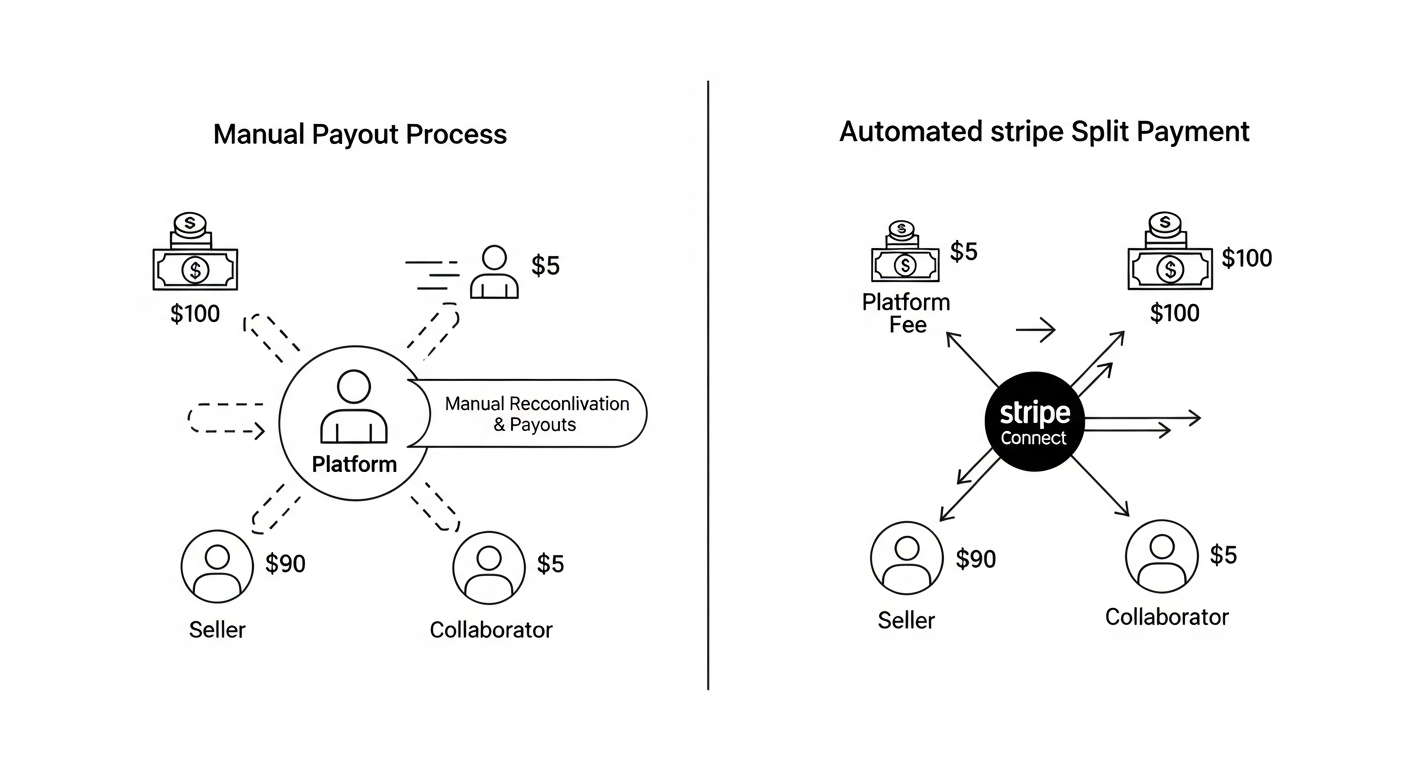 Stripe Split Payments automates the distribution of a single customer payment to multiple recipients, eliminating the need for manual reconciliation and payouts.
At its core, Stripe Split Payments refers to a capability that allows a platform to automatically divide a single customer payment into multiple predetermined portions, directing each portion to different recipients. Instead of the platform receiving the entire transaction amount and then manually disbursing funds to various parties, Stripe facilitates this distribution directly. This capability is crucial for businesses that act as intermediaries, connecting buyers with sellers, service providers with clients, or donors with causes. It streamlines the entire payment lifecycle, from the initial customer transaction to the final payout, creating a more efficient and transparent financial ecosystem for all involved. This automation reduces the burden on the platform, minimizes potential errors, and accelerates the flow of money, which is vital for maintaining healthy business relationships and fostering growth.
Why Your Business Needs Stripe Split Payments
The operational challenges of managing payments in a multi-party environment are substantial. Without a robust system for split payments, businesses often rely on cumbersome manual processes. These can include complex spreadsheets, batch transfers, and constant reconciliation efforts, which are not only inefficient but also introduce significant risks. A poor payments reconciliation process can cost the average business 120 wasted hours every month - or more. This inefficiency ties up valuable resources that could be directed towards core business growth.
Stripe Split Payments, powered by Stripe Connect, offer a strategic advantage by automating these complex payout flows. They enable businesses to scale their operations without a proportional increase in manual overhead. For platforms that process a high volume of transactions, this automation translates directly into significant cost savings and a reduction in operational errors. Furthermore, by ensuring timely and accurate payouts to vendors, service providers, or creators, platforms can significantly enhance user satisfaction and build stronger, more reliable partnerships. In an era where digital platforms are increasingly central to commerce, efficient fund distribution is not just a convenience but a necessity for maintaining a competitive edge. The global digital payment market size was estimated at USD 114.41 billion in 2024 and is projected to reach USD 361.30 billion by 2030, growing at a CAGR of 21.4% from 2025 to 2030, indicating the growing need for sophisticated payment processing capabilities.
Who This Guide Is For
This guide is designed for a wide range of professionals and business leaders who are involved in managing payments and operations for platform-based businesses. This includes:
- Platform Owners and Founders: Those looking to build or optimize their payment infrastructure for scalability and efficiency.
- Product Managers: Individuals responsible for enhancing platform features and user experience, particularly around payments and payouts.
- Engineering and Development Teams: Developers who will be integrating Stripe Connect and implementing split payment logic.
- Finance and Operations Managers: Professionals tasked with managing financial workflows, reconciliation, and ensuring compliance.
- Business Development Managers: Those evaluating partnerships and revenue-sharing models that require complex fund distribution.
Whether you are new to the concept of split payments or seeking to refine your existing Stripe implementation, this guide will provide the insights you need to leverage Stripe Split Payments effectively.
The Foundation: Understanding Stripe Connect for Split Payments
At the heart of Stripe's split payment capabilities lies Stripe Connect. This powerful platform is specifically engineered to enable businesses to facilitate payments between their platform and third-party accounts, such as those of sellers, service providers, or creators. It is the backbone that supports the complex orchestration of funds required for modern marketplaces and platforms.
Stripe Connect: The Engine Behind Modern Fund Splitting
Stripe Connect allows platforms to accept payments from their end customers and then automatically route funds to one or more "connected accounts." These connected accounts represent the individuals or businesses that are part of the platform's ecosystem and are entitled to a portion of the transaction revenue. Stripe Connect handles the intricacies of direct payouts, fee collection for the platform, and managing compliance requirements for these connected accounts. It transforms what would be a highly complex and labor-intensive manual process into a streamlined, automated, and scalable system, fundamentally changing how platforms manage their financial operations. As of 2024, the total market cap for the world's largest platform companies is now approaching $5 trillion, highlighting the immense scale and economic impact of this model, necessitating robust solutions like Stripe Connect.
Different Account Types for Diverse Business Needs
Stripe Connect offers three distinct account types, each designed to cater to different levels of complexity, control, and user experience requirements for your connected accounts:
- Standard Accounts: These are fully managed Stripe accounts that your connected accounts own and control. They go through Stripe's standard onboarding and verification processes, simplifying compliance for the platform. This is ideal when you want to offload the majority of compliance and onboarding burdens to Stripe.
- Express Accounts: These provide a balance between platform control and user experience. Express accounts are hosted by Stripe but allow for more customization in the onboarding flow and branding elements. Your platform can guide users through the onboarding process, collecting specific information while Stripe handles the underlying account management and compliance.
- Custom Accounts: These offer the highest degree of flexibility and control. Your platform fully manages the onboarding and user experience, building custom interfaces for users to connect their bank accounts and provide necessary information. This requires the most development effort but offers complete brand consistency and tailored user journeys.
Choosing the right account type is a critical decision that impacts your development effort, compliance responsibilities, and the overall user experience for your connected accounts.
How Payments Flow Through Stripe Connect
Understanding the payment flow is essential for grasping the power of split payments. When a customer makes a payment on your platform:
- Customer Payment: The customer initiates a transaction using their preferred payment method (e.g., credit card, digital wallet).
- Platform Receives Payment: Stripe processes this payment, and depending on your chosen split payment model, the funds can either be directed directly to a connected account or initially to your platform account.
- Fund Distribution: Stripe Connect then automatically distributes the appropriate portions of the transaction amount to the designated connected accounts based on predefined rules and logic. This might involve transferring funds directly to vendors, creators, or service providers.
- Platform Fees: If applicable, your platform's fees are deducted either during the initial charge or from the amounts being transferred to connected accounts.
This automated flow ensures that each participant in the transaction receives their rightful share promptly, minimizing manual intervention and potential errors. It’s a streamlined process that supports the complex financial needs of modern digital platforms.
Mastering Stripe's Split Payment Models: Destination Charges vs. Separate Charges and Transfers
Stripe offers two primary models for implementing split payments, each providing different levels of control and simplicity. Understanding these models is crucial for architecting a payment system that aligns with your business logic and operational needs.
Destination Charges: Simplicity for Direct Payouts
In the Destination Charges model, the customer's payment is charged directly to the connected account. This means that when a customer makes a purchase, the entire transaction amount is initially attributed to the connected account (e.g., a seller on a marketplace). Your platform then takes a fee by creating a separate transfer or debiting the connected account for your platform's share.
Benefits:
- Simplicity: This model is often easier to implement, especially for straightforward marketplace scenarios where the platform's primary role is to connect buyers and sellers and collect a commission.
- Direct Payout: Funds are conceptually directed towards the recipient from the outset, simplifying accounting for the connected account.
- Compliance: For platforms using Standard or Express accounts, Stripe handles much of the customer-facing compliance and dispute resolution.
Considerations:
- Less Control over Fee Application: While you can collect fees, the primary charge is tied to the connected account. This might have implications if you need to apply platform fees before funds reach the connected account in a complex way.
Separate Charges and Transfers: Granular Control for Complex Logic
The Separate Charges and Transfers model provides greater flexibility. Here, the platform initiates a charge to the customer, and the funds are initially held by your platform (or credited to your platform's Stripe balance). Subsequently, your platform initiates separate transfers to distribute funds to the connected accounts, keeping your platform's portion.
Benefits:
- Granular Control: This model offers maximum control over how funds are managed. You can apply various platform fees, handle complex revenue-sharing agreements, and manage the timing of payouts with precision.
- Platform-Centric Fee Collection: Your platform collects the full amount initially, allowing for more sophisticated fee structures and easier application of platform-specific charges.
- Adaptability: It’s well-suited for businesses with complex financial arrangements, such as those involving subscription revenue sharing, affiliate commissions, or intricate service agreements.
Considerations:
- Increased Complexity: This model requires more development effort to manage the separate charges and transfers, including handling potential discrepancies and ensuring accurate reconciliation.
- Platform Responsibility: The platform takes on more responsibility for managing the flow of funds and potential disputes related to the customer charge before distribution.
Choosing the Right Model: A Strategic Decision Framework
Selecting the appropriate split payment model is a strategic decision that hinges on your business needs, desired level of control, and development resources.
- For marketplaces and simple commission-based models: Destination Charges often provide a cleaner, more straightforward implementation. This is particularly true if your platform's primary goal is to facilitate transactions and take a percentage without complex intermediaries.
- For platforms with complex revenue-sharing, advanced fee structures, or a need for precise control over fund movement: Separate Charges and Transfers offer the necessary flexibility. This model is invaluable for businesses that require detailed oversight of every financial step.
Consider the onboarding experience for your connected accounts. Standard and Express accounts simplify compliance for your platform, while Custom accounts offer full branding control but demand more internal management. The chosen model should ultimately support your business objectives and provide a seamless experience for both your customers and your connected accounts.
Practical Applications: Who Benefits from Stripe Split Payments?
The versatility of Stripe Split Payments makes them an invaluable tool for a wide array of platform-based businesses. By automating fund distribution, these solutions enable businesses to scale efficiently and enhance the user experience for all parties involved.
Marketplaces and eCommerce Platforms
For online marketplaces connecting buyers with multiple sellers, or multi-vendor eCommerce platforms, split payments are essential. When a customer purchases an item, the payment can be split to automatically send the vendor's share directly to their connected account, while the platform retains its commission. This eliminates the need for manual invoicing and payouts, streamlining operations for platforms like Amazon Marketplace, Etsy, or Shopify's multi-vendor extensions. The growth of online retail, with 65% of retail transactions globally conducted through digital payment methods in 2024, underscores the importance of efficient payment processing.
Gig Economy and Freelance Platforms
Platforms like Upwork, Fiverr, or Toptal connect freelancers with clients. In these scenarios, Stripe Split Payments ensure that once a project is completed and paid for by the client, the freelancer receives their earnings promptly, minus any platform fees. This automated payout system is crucial for maintaining a positive experience for freelancers, encouraging continued use of the platform. This aligns with the trend that by 2025, 80% of all B2B sales interactions are expected to take place through digital platforms.
Crowdfunding and Donation Platforms
Platforms that facilitate crowdfunding campaigns or charitable donations can use split payments to manage contributions. Funds from donors can be automatically split, with a portion going to the campaign organizer or charity, and any platform fees being deducted. This ensures transparency and efficiency in fund allocation, building trust with both donors and recipients.
Event Ticketing and Management
For platforms selling tickets to events, split payments can be used to distribute revenue between the event organizer, venue, and ticketing platform. Upon ticket purchase, funds can be automatically allocated, simplifying complex financial arrangements and ensuring timely payments to all stakeholders involved in making the event happen.
Other Innovative Use Cases
The application of Stripe Split Payments extends beyond these common examples. Any business model that involves distributing revenue from a single transaction to multiple parties can benefit. This includes:
- Subscription services with revenue share: Distributing recurring subscription revenue to content creators or partners.
- SaaS platforms with partner programs: Paying out commissions to affiliates or partners based on customer subscriptions.
- Online course platforms: Splitting tuition fees between instructors and the platform.
- Real estate listing platforms: Distributing commissions to agents and brokers.
The core benefit remains the same: automating complex fund distribution to enable scalable, efficient, and transparent operations.
Beyond the Basics: Advanced Features and Considerations
Implementing Stripe Split Payments involves more than just setting up the basic charge and transfer logic. Several advanced features and considerations are critical for a robust and compliant system.
Handling Refunds and Disputes in a Split Payment Scenario
When a customer requests a refund, it's crucial that this is handled correctly across all parties involved. In a split payment scenario, Stripe typically handles refunds by reversing the original transaction. The platform needs to ensure that the refund logic correctly debits the funds from the relevant connected accounts and the platform's own balance to reflect the proportional reversal. Managing disputes also follows a similar pattern, with clear communication and process for how investigations and resolutions will impact each party.
Reconciliation and Accounting for Split Transactions
Accurate reconciliation is vital for financial health. With split payments, tracking individual transactions, their distributed portions, and platform fees can become complex. Platforms need robust accounting practices and potentially integration with accounting software to reconcile these transactions effectively. A poor payments reconciliation process can cost the average business 120 wasted hours every month - or more, highlighting the need for automated solutions or meticulous internal processes.
Navigating Cross-Border Split Payments
If your platform operates globally, handling split payments across different countries introduces complexities. This includes managing various currencies, differing regulatory requirements, and local payment methods. Stripe Connect supports a wide range of payment methods and currencies, but platforms must ensure their implementation accounts for currency conversion rates, potential cross-border fees, and any country-specific compliance mandates.
Platform Fees and Revenue Collection
A key function for platforms is collecting their own revenue from transactions. Stripe Split Payments make this process seamless. Whether using Destination Charges where you debit the connected account, or Separate Charges and Transfers where you retain your fee from the initial charge, Stripe provides the tools to define and collect your platform's commission or service fee efficiently and reliably. U.S. merchants paid a record $187.20 billion in processing fees in 2024, underscoring the significance of optimizing how platforms manage and collect their share.
Supporting Various Payment Methods
The ability to accept a wide array of payment methods—credit cards, debit cards, digital wallets, and local payment options—is essential for a good customer experience. Stripe Connect integrates with Stripe's extensive payment method support, ensuring that customers can pay using their preferred method, and that the split payment logic functions correctly regardless of the payment method used.
Security and Fraud Prevention in Split Payments
Security is paramount. Platforms must implement measures to protect both their users and their own funds from fraud. Stripe provides robust security features, but platforms also need to implement their own best practices, such as strong authentication, monitoring for suspicious activity, and careful management of connected account verification. Merchants globally are expected to lose a staggering $362 billion due to payment fraud between 2023 and 2028, making proactive security a business imperative.
Implementation and Best Practices for a Robust Split Payment System
Successfully implementing Stripe Split Payments requires careful planning, adherence to best practices, and a deep understanding of the Stripe Connect API.
Pre-Implementation Checklist
Before diving into development, conduct a thorough review:
- Define Your Business Logic: Clearly map out your fee structure, payout schedules, and how funds will be split among different parties.
- Choose Your Stripe Connect Account Type: Decide whether Standard, Express, or Custom accounts best suit your needs and the experience of your connected accounts.
- Understand Compliance Requirements: Research KYC (Know Your Customer), AML (Anti-Money Laundering), and any tax reporting obligations relevant to your business and the countries you operate in.
- Map Out User Journeys: Design the experience for both the customer making the payment and the connected account receiving payouts.
- Select Your Split Payment Model: Determine whether Destination Charges or Separate Charges and Transfers best fit your operational and financial strategy.
Leveraging the Stripe API for Customization and Control
The Stripe API is your primary tool for implementing custom split payment logic. You'll use it to:
- Create Charges: Initiate transactions with customers.
- Create Transfers: Manually or automatically move funds to connected accounts.
- Manage Connected Accounts: Create, update, and retrieve information about your connected accounts.
- Handle Webhooks: Set up real-time notifications for events like successful payments, refunds, and disputes to trigger subsequent actions within your platform.
By carefully crafting API calls and webhook handlers, you can build a sophisticated and automated split payment system tailored precisely to your platform's unique requirements.
Optimizing for Performance and Scalability
As your platform grows, your payment system must scale accordingly. Consider the following for optimal performance:
- Asynchronous Processing: Use background jobs and queues for creating transfers and handling webhook events to avoid blocking user interactions.
- Efficient API Usage: Minimize API calls and batch operations where possible.
- Robust Error Handling: Implement comprehensive error handling and retry mechanisms for API requests and webhook processing to prevent data inconsistencies.
- Monitoring and Alerting: Set up systems to monitor API performance, transaction success rates, and potential issues, with alerts for critical failures.
Conclusion
Stripe Split Payments, powered by the robust Stripe Connect platform, represent a fundamental shift in how businesses manage complex fund distribution. They move beyond basic payment processing to offer a sophisticated, automated solution that is critical for the growth and operational efficiency of any platform-based business. From marketplaces and gig economy platforms to crowdfunding initiatives, the ability to seamlessly divide customer payments and ensure timely, accurate payouts to stakeholders is no longer a luxury but a necessity.
By understanding the core concepts, choosing the right Stripe Connect account types, and mastering the distinct split payment models—Destination Charges and Separate Charges and Transfers—businesses can architect a financial system that scales effortlessly. The strategic advantages are clear: reduced manual effort, minimized errors, enhanced user satisfaction for both customers and connected accounts, and the ability to focus resources on core business development rather than intricate financial operations.
Moreover, this guide has illuminated the critical advanced considerations, from handling refunds and disputes to navigating cross-border transactions and ensuring robust security and compliance. The statistics cited underscore the immense growth of the platform economy and the increasing prevalence of digital payments, emphasizing the imperative for businesses to adopt solutions like Stripe Split Payments. A poor payments reconciliation process, for instance, can consume significant time, directly impacting profitability.
Implementing a successful split payment system requires meticulous planning, a clear understanding of your business logic, and strategic utilization of the Stripe API. By preparing with a pre-implementation checklist, designing seamless user journeys, and prioritizing performance and scalability, you can build a payment infrastructure that not only meets current demands but also future-proofs your business.
In essence, Stripe Split Payments are not merely a feature; they are a strategic enabler. They empower platforms to operate with unprecedented efficiency, transparency, and scalability, solidifying their position in the rapidly evolving digital economy. Embrace the power of Stripe Split Payments to unlock seamless fund distribution and drive sustainable growth for your platform.