In today's world, navigating the landscape of digital transactions can feel both ubiquitous and complex. From online shopping sprees to essential bill payments, the ability to move money swiftly and securely underpins our daily lives. While many transactions appear straightforward, a sophisticated infrastructure often operates behind the scenes, facilitating the smooth flow of funds. At the heart of this system lies the concept of third-party payments, a crucial mechanism that empowers individuals and businesses alike. Understanding how these payments function, who utilizes them, and the benefits they offer is key to fully grasping the modern financial ecosystem.
The Modern Payment Landscape: Why Understanding Third-Party Payments Matters
The digital revolution has fundamentally reshaped how we conduct financial transactions. With the explosion of e-commerce, the rise of the gig economy, and the increasing reliance on online services, the demand for efficient, secure, and versatile payment solutions has never been greater. Traditional direct payment methods, where one party pays another directly, are often insufficient for the complexities of modern commerce. This is where third-party payments emerge as an indispensable component. They bridge gaps, enhance security, and streamline processes that would otherwise be cumbersome or impossible. Understanding third-party payments is not just about grasping a financial concept; it's about understanding the engine that drives much of our digital economy, from daily purchases to complex business operations.
What to Expect in This Guide: Demystifying a Key Financial Concept
This guide aims to demystify the world of third-party payments. We will break down exactly what they are, how they operate step-by-step, and who the key players are within this intricate ecosystem. You'll discover the diverse range of individuals and organizations that rely on third-party payment services, from everyday consumers to large government agencies. We will explore the significant advantages these systems offer, such as enhanced convenience, expanded market reach, and improved operational efficiency. Furthermore, we will delve into the often-confusing realm of fees and costs associated with these services, emphasizing the importance of transparency. Finally, we will address the critical aspects of security and risk, providing actionable advice for navigating third-party payments safely. By the end of this guide, you will possess a comprehensive understanding of third-party payments, empowering you to engage with them more confidently and effectively.
Understanding the Basics: What Exactly Are Third-Party Payments?
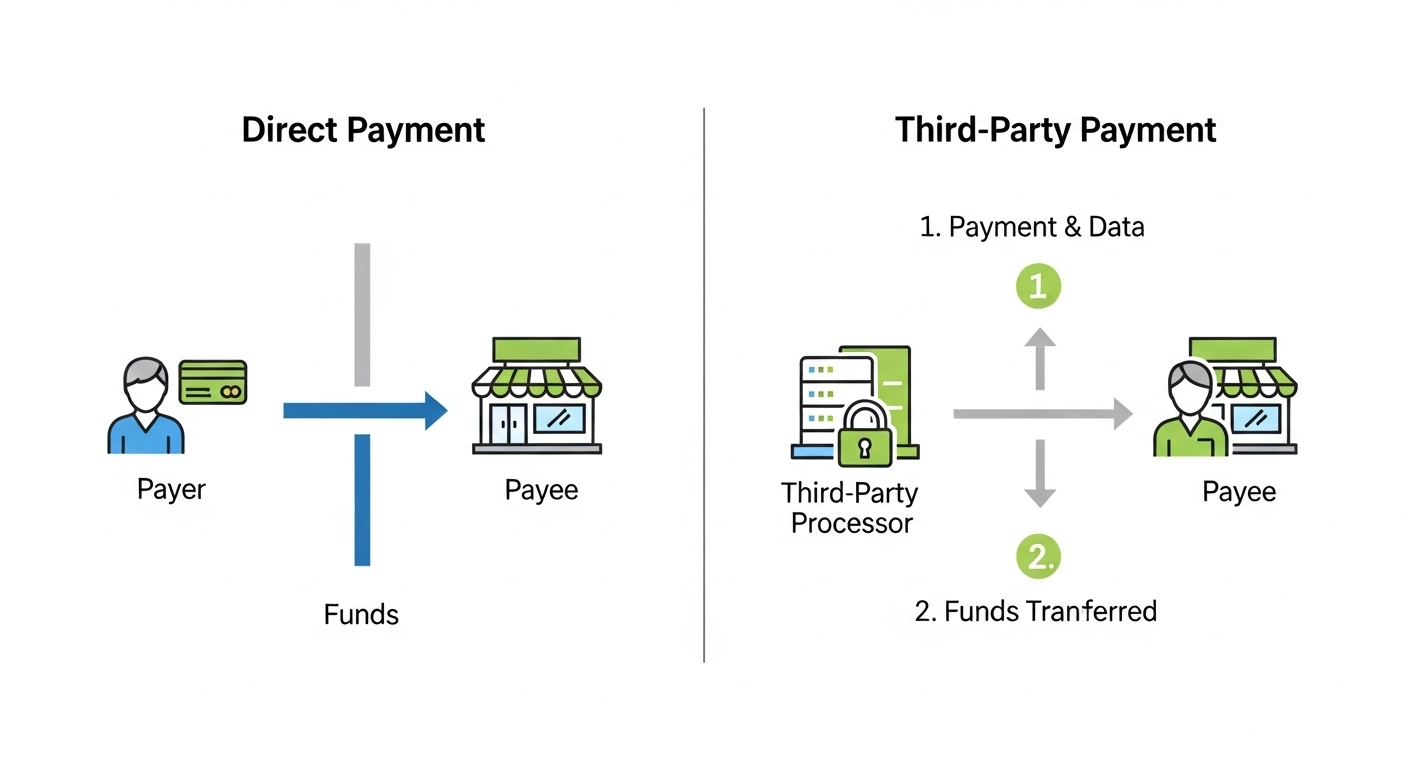 A third-party payment introduces an intermediary, unlike a direct payment where funds flow straight from payer to payee.
At its core, a third-party payment involves an intermediary that facilitates a financial transaction between two other parties. Instead of a direct exchange of funds, a neutral entity steps in to manage the payment process, ensuring security, compliance, and efficiency. This intermediary, or "third party," plays a vital role in enabling a vast array of digital transactions that we encounter daily.
Defining "Third-Party Payment": The Role of the Intermediary
A third-party payment, such as the service Flex Dental Solutions powered by Stripe provide, is a financial transaction where a provider, acting as a third party, handles the exchange of funds between a payer and a payee. This service is crucial because it allows the payer and payee to engage in a transaction without directly sharing sensitive financial information with each other. The third party acts as a trusted intermediary, managing the entire payment process from initiation to completion. For example, when you buy an item from an online website using a payment gateway, that gateway is the third party. It collects your payment information, processes it, and then transfers the funds to the merchant, ensuring a secure and seamless experience for both parties.
Third-Party vs. First-Party Payments: A Clear Distinction
The distinction between third-party and first-party payments lies in the presence of an intermediary. In a first-party payment scenario, the payer pays the payee directly. Think of handing cash to a vendor at a local market or directly transferring funds from your bank account to a friend's account via your banking app without any additional service. In contrast, third-party payments inherently involve an intermediary. This intermediary could be a payment processor, a digital wallet service, a marketplace platform, or even a specialized financial service provider. This involvement is what defines a third-party payment, offering benefits like enhanced security and streamlined processing that direct payments often lack.
Why the "Third Party" is Necessary: Solving Payment Challenges
The necessity of a third party in payment systems stems from the inherent challenges of direct transactions. For businesses, accepting payments directly from customers can be complex and risky. They would need to manage various payment methods, handle sensitive customer data securely, and bear the full brunt of fraud and chargebacks. For consumers, directly sharing bank account or credit card details with every vendor they interact with presents significant security risks. A third-party payment provider solves these problems by offering a standardized, secure, and efficient solution. They aggregate payment processing, handle compliance with financial regulations, and provide robust fraud detection mechanisms, making transactions safer and more accessible for everyone involved in the transaction.
How Third-Party Payments Work: Demystifying the Process
The operation of third-party payments, while complex under the hood, follows a logical and structured process. This involves several key stages and a network of participants, all working in concert to ensure funds move accurately from the payer to the payee.
The Standard Payment Flow: A Step-by-Step Breakdown
The payment process for third-party payments typically begins when a customer initiates a purchase. The customer provides their payment details (e.g., credit card number, digital wallet credentials) to the merchant's website or application. This information is then securely transmitted to a third-party payment processor, like Stripe. The processor routes the payment information through the relevant card networks or payment rails to the customer's bank for authorization. The customer's bank verifies funds and approves or declines the transaction. Once approved, the confirmation is sent back through the payment flows to the merchant. The funds are then held by the payment processor or bank until the settlement phase, where the actual transfer of money occurs, typically in batches, to the merchant's account. This entire process, from initiation to authorization, often happens in mere seconds.
Key Players in the Third-Party Payment Ecosystem
Several entities are vital to the functioning of third-party payments. At the forefront are Payment Processors, companies that specialize in handling payment transactions for merchants. They act as the conduit between merchants, banks, and card networks. The provider could also be a Payment Service Provider (PSP), which offers a broader range of services beyond just processing, such as fraud management and currency conversion. Banks are essential, acting as the issuing bank for the payer's account and the acquiring bank for the merchant's account, facilitating the movement of funds. Finally, the card networks (like Visa, Mastercard) and systems like the Automated Clearing House (ACH) provide the underlying infrastructure for transaction routing and settlement.
Common Types of Third-Party Payment Methods
Third-party payment services have proliferated, offering consumers and businesses a variety of convenient options. Digital wallets, such as Apple Pay, Google Pay, and PayPal, are immensely popular. They store payment information securely, allowing users to make quick online or in-person payments without re-entering details. The Automated Clearing House (ACH) network is another significant method, particularly for direct debits and direct deposits, commonly used for payroll, bill payments, and B2B transactions. Credit and debit card processing, facilitated by payment gateways and processors, remains a cornerstone of online and in-person transactions. Other methods include peer-to-peer payment apps and specialized online payment platforms catering to specific industries.
Who Uses Third-Party Payments and Why?
The utility of third-party payments extends across an incredibly broad spectrum of users, each leveraging these systems for distinct advantages. Their widespread adoption underscores their integral role in modern commerce and administration.
Individual Consumers: Enhancing Everyday Convenience
For individual consumers, third-party payments are synonymous with convenience and ease. Using digital wallets to pay online or in stores, making quick peer-to-peer transfers through apps, or subscribing to services online all rely on third-party facilitation. These services simplify the payment process, eliminating the need to repeatedly enter sensitive card details on various websites. They offer a secure way to manage multiple payment methods in one place and often provide purchase protection or buyer guarantees. This convenience is a primary driver for the global rise in digital wallet users, projected to grow from 4.3 billion in 2024 to 5.8 billion by 2029, a 35% increase. [Juniper Research, 2024]
Businesses (Merchants): Streamlining Operations and Expanding Reach
Businesses, from small startups to large enterprises, rely heavily on third-party payment solutions to manage sales and operations efficiently. Payment Processors and payment gateways enable merchants to accept payments from a wide range of customers and payment methods without needing to build their own complex payment infrastructure. This significantly streamlines the payment process, reduces operational overhead, and minimizes the risk of fraud and chargebacks. By integrating with third-party providers, businesses can expand their market reach, offering customers convenient payment options, which leads to improved customer satisfaction. According to Mastercard, 67% of small-sized companies upgraded their digital/e-pay solutions, and 81% of them reported improved customer satisfaction. Mastercard (cited in B2B Payments Market Report), 2026 The global B2B digital payment market, heavily reliant on these systems, was valued at USD 7.5 trillion in 2023. Grand View Research, 2024
Educational Institutions: Simplifying Student Billing and Sponsorships
Educational institutions utilize third-party payments to manage student finances efficiently. This includes processing tuition payments, housing fees, and other associated costs. Often, students have a Student Account that consolidates all their financial obligations, and third-party payment portals simplify the process of making payments towards this account. Furthermore, third-party payment systems are invaluable for managing sponsorships where a third party (like a government agency or private organization) directly pays for a student's education. This requires clear documentation and authorization, which third-party providers can manage, ensuring funds are correctly applied and accounted for.
Government Agencies: Efficient Collections and Disbursements
Government agencies leverage third-party payments for both collecting revenue and disbursing funds. Taxes, fines, permit fees, and other government levies can be collected through various third-party payment channels, making it easier for citizens to comply. On the disbursement side, agencies use these systems to distribute benefits, grants, and payments to vendors or individuals. Utilizing third-party treasuries or payment services can enhance efficiency, reduce administrative costs, and improve transparency in these financial flows, especially for large-scale operations.
Freelancers and Contractors: Facilitating Payouts
The rise of the gig economy has made third-party payments indispensable for freelancers and independent contractors. Platforms like Upwork, Fiverr, and various project management tools use third-party payment systems to manage client payments and then disburse earnings to the contractor. This simplifies the process of invoicing, receiving payments from multiple clients, and managing different currencies. These services ensure that contractors are paid reliably and efficiently for their work, often deducting platform fees as part of the process.
Non-Profit Organizations: Streamlining Donations and Membership Fees
Non-profit organizations depend on third-party payment solutions to facilitate donations and manage membership fees. Online donation platforms, often powered by third-party payment processors, make it easy for supporters to contribute securely from anywhere. Similarly, systems can be set up to handle recurring membership dues, ensuring a stable revenue stream for the organization. The ease of use and security offered by these platforms encourages greater participation and simplifies administrative tasks for the non-profit.
The Advantages of Third-Party Payments
The widespread adoption of third-party payments is a testament to the numerous benefits they offer to all parties involved. These advantages range from enhanced convenience and security for individuals to significant operational efficiencies and expanded reach for businesses and institutions.
For Consumers: Convenience, Accessibility, and Security
For consumers, the primary advantage of third-party payments is unparalleled convenience. Services like digital wallets and online payment gateways allow for quick, seamless transactions on websites and mobile apps. This accessibility means users can purchase goods and services from anywhere, at any time, often with just a few clicks. Crucially, these platforms enhance security by acting as a buffer. Instead of sharing sensitive credit card or bank account details directly with multiple merchants, users share their information once with a trusted third-party provider. This reduces the risk of data breaches and fraudulent use of personal financial information.
For Businesses: Expanded Market Reach, Operational Efficiency, and Fraud Reduction
Businesses benefit immensely from third-party payment solutions. By integrating with popular payment gateways and processors, merchants can accept a wide array of payment methods, including credit cards, debit cards, and digital wallets, thereby expanding their potential customer base. This integration leads to significant operational efficiency by automating the payment process, reducing manual entry, and streamlining reconciliation. Moreover, reputable third-party providers offer sophisticated fraud detection and prevention tools, including analyzing charge-back history, which helps mitigate losses from fraudulent transactions and reduces the likelihood of future charge backs. The global payment gateway market, a key component of this infrastructure, is projected to grow significantly, indicating its importance. The market was estimated at USD 26.7 billion in 2024 and is projected to reach USD 48.4 billion by 2029. MarketsandMarkets, 2024
For Institutions: Simplified Administration, Improved Cash Flow, and Compliance
Educational institutions, government agencies, and non-profits find third-party payments instrumental in simplifying complex financial administration. For universities, processing tuition payments and managing student accounts becomes far more efficient. For government entities, collecting revenue and disbursing funds is streamlined. Non-profits can more easily solicit and manage donations. A key benefit is improved cash flow, as payments are processed and settled more quickly. Furthermore, reputable third-party service providers ensure adherence to regulatory requirements and handle necessary documentation, reducing the compliance burden on the institution.
Understanding Fees and Costs Associated with Third-Party Payments
While third-party payment systems offer numerous advantages, it's essential to understand that their services come with associated fees. These costs are typically borne by the merchant or business, though in some cases, consumers might incur minor fees for specific services. Transparency regarding these fees is crucial for both providers and users.
How Payment Processors Charge: Common Fee Structures
Payment Processors and other third-party providers typically charge fees based on a combination of factors related to each transaction. Common structures include:
- Percentage-Based Fees: A percentage of the total payment amount is charged for each transaction. This is often tiered based on transaction volume.
- Per-Transaction Fees: A small fixed fee is charged for every transaction processed, regardless of the amount.
- Monthly Fees: Some providers charge a recurring monthly fee for access to their gateway services or for certain feature sets.
- Setup Fees: An initial one-time fee may be charged to set up the merchant account or payment gateway.
- Chargeback Fees: Merchants are often charged a fee if a customer disputes a transaction, resulting in a chargeback.
These various charges, including specific card processing fees, constitute the cost of using the service.
Who Bears the Cost?
Generally, the merchant clients are the primary payers of third-party payment fees. This is because the service enables them to accept payments, expand their business, and reduce their own risks. However, in some scenarios, the consumer might indirectly bear some cost, for instance, through slightly higher prices that account for the merchant's processing costs. For specific arrangements like educational sponsorships, a sponsoring agency might directly pay fees related to processing the educational payment. The goal for most businesses is to absorb these costs through sales volume and operational efficiencies rather than passing them directly to consumers.
The Importance of Fee Transparency
Fee transparency is paramount in the third-party payment industry. Unclear or hidden fees can lead to unexpected costs for businesses and erode trust. Reputable providers clearly outline their fee structures, detailing what each charge covers. Businesses should carefully review contract terms and understand the implications of different fee models on their overall profitability. For consumers, understanding how their payment method might incur fees, particularly for international transactions or specific digital wallets, is also important.
Risks and Security Considerations in Third-Party Payments
Despite the security measures embedded in most third-party payment systems, risks remain. Users, both individuals and businesses, must remain vigilant to protect their financial information and avoid fraudulent activities.
For Users: Data Security, Fraud, and Scam Awareness
A primary concern for users is data security. While third-party providers invest heavily in encryption and security protocols, data breaches can still occur. Users must be cautious about sharing their payment information, especially on unfamiliar websites. Fraudulent schemes are also prevalent. Scammers may impersonate legitimate businesses or services, attempting to trick individuals into making payments for goods or services that will never be delivered, or to obtain sensitive personal information. Recognizing suspicious activities is crucial. This includes unsolicited requests for payment, offers that seem too good to be true, or pressure to act immediately.
Best Practices for Safe Third-Party Payments
To ensure safe third-party payments, users should adopt several best practices:
- Use Reputable Providers: Stick to well-known and trusted third-party payment services and platforms.
- Secure Your Devices: Ensure your computer and mobile devices are protected with strong passwords, up-to-date antivirus software, and secure network connections.
- Enable Two-Factor Authentication (2FA): Whenever possible, enable 2FA for your payment accounts. This adds an extra layer of security beyond just a password.
- Monitor Your Accounts: Regularly review your bank and credit card statements for any unauthorized transactions. Report any discrepancies immediately.
- Be Wary of Phishing: Never click on suspicious links in emails or text messages that ask for your payment information. Always navigate directly to the official website of the service provider.
- Understand Transaction Details: Before confirming any payment, carefully review the amount, recipient, and any associated fees. Be alert for unusual patterns or suspicious activities.
- Review Privacy Policies: Understand how third-party providers collect, use, and protect your data.
Conclusion: Embracing the Future of Payments
Third-party payments have evolved from a niche solution to a cornerstone of modern commerce. They are the invisible threads connecting buyers and sellers, facilitating countless transactions every day with increasing speed, security, and convenience. From the individual consumer managing their daily expenses through digital wallets to large enterprises streamlining complex B2B payment flows, the reliance on these intermediary services is undeniable.
Understanding the mechanics of how these payments work, the roles of key players like Payment Processors, and the diverse range of user applications is no longer optional but essential for navigating our digital economy. While the associated fees and inherent security risks require careful consideration and proactive measures, the advantages in terms of efficiency, accessibility, and fraud mitigation are substantial.
As technology continues to advance, we can expect further innovations in the third-party payment space, including the integration of blockchain technologies, enhanced biometric authentication, and more sophisticated AI-driven fraud prevention. By staying informed and adopting best practices for secure transactions, individuals and businesses can confidently embrace the future of payments, leveraging the power of third-party solutions to their fullest potential.