The traditional phone call is increasingly becoming a friction point rather than a connection point. As patient expectations shift toward immediate, asynchronous communication, dental practices must pivot to meet them where they live: on their smartphones. Text messaging has moved beyond a simple appointment reminder tool; it is now the essential nervous system of a high-functioning dental practice, enabling seamless patient engagement, operational efficiency, and long-term practice growth.
Why Texting is the Modern Backbone of Dental Communication
Moving Beyond Phone Tag: Meeting Patients on Their Preferred Channel
The "phone tag" cycle is a silent profit killer. When a team spends hours chasing patients to confirm appointments or collect information, the administrative burden skyrockets, and patient satisfaction wanes. Patients today prioritize convenience, often avoiding unknown numbers or voicemail systems entirely. By shifting to text messaging, you respect the patient’s time and provide a communication channel that fits into their busy day, rather than demanding they stop what they are doing to answer a voice call.
The Shift from Functional Utility to Relationship Management
Moving from transactional reminders to a comprehensive messaging strategy allows a practice to build deeper rapport. When a dentist can safely communicate updates or answer quick clinical questions via secure text, they move from being a "service provider" to a "partner in health." This psychological shift is vital for building patient loyalty and long-term retention.
Key Benefits: Increased Efficiency, Reduced No-Shows, and Enhanced Patient Engagement
The data is clear: patients are significantly more likely to open a text than an email. By automating routine interactions, you drastically reduce no-shows, as text prompts provide a direct "yes/no" mechanism for schedule management. This allows your team to focus their energy on high-value interactions, such as treatment coordination and chairside patient experience, rather than administrative busywork.
Navigating the Legal Landscape: HIPAA Compliance and Security Protocols
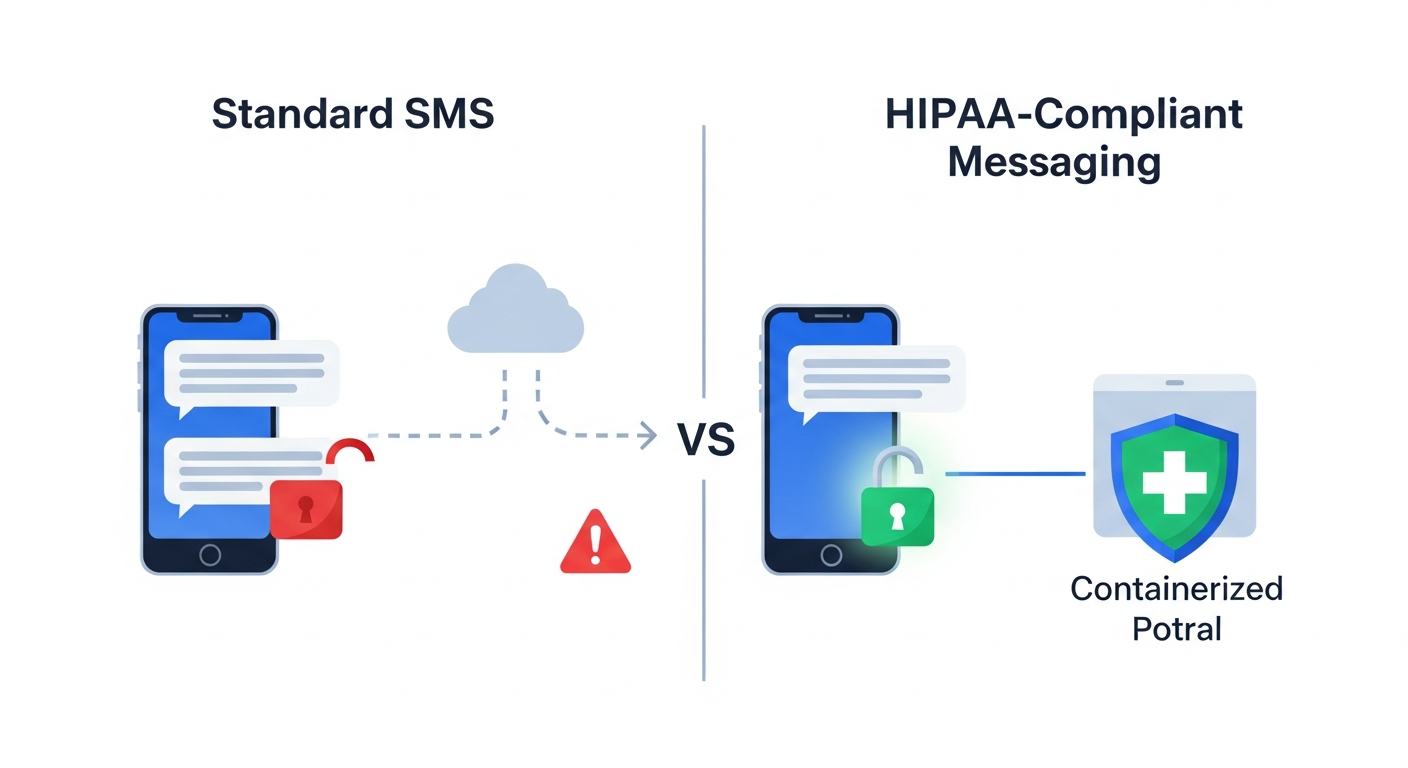 Standard SMS leaves patient data vulnerable to interception, whereas HIPAA-compliant platforms use end-to-end encryption to protect sensitive health information.
The Golden Rule: Understanding HIPAA-Compliant vs. Standard SMS
Many practices mistakenly assume that standard SMS is sufficient for patient communication. This is a dangerous misconception. Standard, unencrypted text messages are vulnerable to interception and do not meet the security requirements set forth by HIPAA for protecting Protected Health Information (PHI). A HIPAA-compliant platform uses end-to-end encryption and secure portals to ensure that patient data remains protected at every touchpoint.
The Difference Between End-to-End Encryption and Open Texting
Open texting transmits data in a format that could be exposed on servers, carrier networks, or even lock screens. In contrast, HIPAA-compliant platforms use a "containerized" approach. When a message contains sensitive info, the patient receives a notification to log into a secure, encrypted mobile interface. This distinction is the difference between a secure health conversation and a potential data breach that could lead to significant legal and financial consequences.
Managing Patient Consent: Opt-in Strategies and TCPA Regulations
Compliance isn’t just about the technology; it’s about the legal parameters of engagement. Under TCPA (Telephone Consumer Protection Act) regulations, you must obtain explicit, documented consent from a patient before sending automated marketing or appointment texts. Always ensure your intake forms include a specific, separate checkbox for SMS communication to protect your practice from regulatory complaints.
Operational Security: Handling Desktop Notifications and Device Privacy in the Office
The biggest risk to practice security is often the human element. If your team uses personal smartphones to text patients, you lose all oversight. Every practice must implement a centralized, web-based dashboard for all communication. Furthermore, ensure that front-desk computers are locked when unattended and that desktop notifications—which might display sensitive PHI on a screen visible to other patients—are disabled or appropriately managed.
The Compliance Audit: A Checklist for Evaluating Your Patient Engagement Platform
Before committing to any software, perform a thorough audit. Does the platform provide an audit trail of every sent and received message? Does it require multi-factor authentication (MFA) for your staff? Is there a Business Associate Agreement (BAA) in place? If the provider cannot answer "yes" to these questions, they are not suitable for a professional dental setting.
The Anatomy of an Effective Dental Text Message
The Psychology of a Response: Crafting Clear Calls to Action (CTAs)
A text message must be concise. Every message should have one, and only one, clear call to action. Whether it is "Reply C to confirm," "Click here to sign forms," or "Call us to reschedule," the patient should never have to guess what is expected of them. Ambiguity leads to silence; clarity leads to conversion.
Finding the Practice Voice: Balancing Professionalism with Personal Warmth
Texting is informal by nature, but your practice must maintain a professional tone. Avoid excessive abbreviations or overly casual slang. Instead, focus on a voice that is empathetic, welcoming, and reassuring. Use the patient’s first name to humanize the interaction, but keep the core information focused and direct.
Strategic Timing: When to Automate and When to Send Real-Time Messages
Automation is a tool, not a replacement for human connection. Automate routine appointment reminders and intake requests, but use real-time, manual texting for urgent patient concerns or follow-ups after complex procedures. The "human touch" is essential when a patient expresses pain or anxiety; an automated bot response in these moments can feel dismissive and impersonal.
Optimizing the Pre-Visit Experience: Efficiency Before the Chair
Automated Appointment Reminders and Multi-Touch Confirmation Sequences
An effective reminder strategy uses a sequence: one message sent a week out, another two days before, and a final "day-of" text. This multi-touch approach ensures that the appointment remains top-of-mind for the patient, significantly reducing the likelihood of last-minute cancellations.
Seamless Intake: Using Online Forms and Insurance Verification via SMS
The waiting room should be for waiting, not filling out paperwork. Utilizing a patient engagement software, such as Flex Dental Solutions, you can easily simplify this process. By texting patients a link to their digital intake forms, you allow them to complete the process from the comfort of their home. This reduces the administrative backlog at the front desk and provides your team with necessary insurance information well before the patient steps into the office.
Filling the Schedule: Managing Waitlists and Broadcast Messages for Last-Minute Openings
When a patient cancels on short notice, the goal is to fill that chair immediately. A broadcast message sent to your automated waitlist is the fastest way to turn a potential loss into a revenue opportunity. A simple text, "We have an opening today at 2 PM, reply YES if you’d like it," often results in a filled slot within minutes.
Handling Scheduling Conflicts and Rescheduling Requests via Two-Way Texting
Two-way texting transforms a "no" into a "later." When a patient needs to reschedule, a quick, polite text conversation is far more efficient than a prolonged phone call. This capability allows your scheduling team to offer alternative times immediately, keeping the patient in the system rather than losing them to the abyss of a postponed follow-up.
Streamlining In-Office Workflows with Real-Time Communication
The Contactless Check-In: Using Text Alerts for Arrival and Patient Kiosk Integration
Allowing patients to text "I am here" from their car allows your team to manage the flow of the waiting room effectively. This reduces congestion and creates a seamless, modern arrival experience that patients increasingly demand.
Internal Team Coordination: Using a Centralized Dashboard to Reduce Office Chaos
Your team should never be shouting across the office to coordinate patient movement. A centralized, browser-based messaging dashboard allows the hygienist to text the front desk that they are ready for the next patient, or the assistant to update the clinical team on procedural delays. This quiet, digital internal communication keeps the office environment calm and professional.
Communication During the Procedure: Updates for Family Members and Guardians
For pediatric or high-anxiety patients, the ability to send a quick, reassuring update to a parent in the lobby is a massive value-add. A simple "Everything is going great, we are almost done!" goes a long way toward building trust and reducing stress for the family, demonstrating a commitment to the patient experience that goes beyond clinical skill.
Driving Post-Visit Growth: Revenue, Reviews, and Retention
Accelerating Cash Flow: Implementing Text-to-Pay and Online Payments
Collecting patient balances is often the most uncomfortable part of the dental business. Text-to-pay links simplify this process, allowing patients to settle their accounts instantly on their phones. This removes the friction of manual billing and significantly accelerates your practice's accounts receivable cycle.
Reputation Management: Automating Review Requests to Build Social Proof
Social proof is the lifeblood of dental marketing. Use an automated trigger to send a text request for a review immediately after a patient has a positive, pain-free visit. Because you are catching them when their satisfaction is highest, the likelihood of receiving a positive testimonial is significantly higher.
The Recall System: Using Recurring Texts to Fill the Hygiene Schedule
Your hygiene department depends on consistent, recurring visits. Use text sequences to remind patients that they are due for a cleaning. If they don't book, follow up with a nudge two weeks later. This consistent communication ensures that your hygiene schedule stays full, which is the foundational element of a sustainable, long-term practice.
Targeted Marketing: Promoting Invisalign, Whitening, and Cosmetic Dentistry via SMS
Text messaging is a powerful, underutilized marketing channel. Use it to share information about elective services with patients who have already expressed interest. For example, a text about whitening specials during the holiday season or Invisalign consultations for existing patients can drive significant incremental revenue with minimal effort.
Clinical Applications: Education and Post-Operative Care
Texting is an ideal tool for reinforcing clinical advice. After a procedure, send a follow-up text with post-operative care instructions, effectively acting as a digital safety net. You can also send brief, educational "nudges"—reminding a patient to floss or scheduling their next maintenance. By focusing on preventative education through these channels, you position your practice as a true partner in the patient’s long-term health, not just a place they visit when something goes wrong.
Conclusion
The transition to a text-centric communication model is no longer optional; it is a fundamental requirement for any dental practice aiming to thrive in the modern era. By prioritizing HIPAA-compliant, secure platforms, your team can eliminate the inefficiencies of phone-based communication and replace them with a seamless, patient-focused workflow that boosts both production and satisfaction.
The key to success lies in the balance between automation and the human touch. While automated appointment reminders and billing links drive the operational engine, it is your team’s ability to use two-way messaging for genuine engagement that builds lasting patient relationships. To begin your transition, perform an immediate audit of your current messaging compliance, train your staff on centralized dashboard usage, and start leveraging SMS for the high-impact areas like post-operative care and recall management. When you treat the digital channel with the same level of care and professionalism as you do your clinical procedures, you will find that your practice becomes more efficient, more profitable, and significantly more connected to the patients you serve.