The landscape of modern dentistry is rapidly evolving. Beyond the traditional art of healing and patient care, dental practices are increasingly operating as complex businesses. In this dynamic environment, relying solely on intuition or historical operational habits is no longer sufficient to achieve sustained growth and optimal performance. The integration of technology, like Flex Dental Solutions, has revolutionized how practices function, from digital imaging to advanced treatment modalities. Yet, a significant opportunity lies untapped for many dental practices: the strategic utilization of their own data. This article explores how embracing data-driven analytics can transform a dental practice, unlocking its full potential by providing actionable insights that enhance revenue, patient engagement, operational efficiency, and clinical excellence.
The Evolution of Dentistry: Beyond Traditional Practice Management
For decades, dental practice management relied on established, often manual, systems and paper-based reporting. The advent of Practice Management System (PMS) software, like Open Dental, marked a significant leap forward, automating scheduling, billing, and patient records. These systems provided a foundational layer for practice management, offering basic reports that could offer a glimpse into production, collections, and patient demographics. However, this era of rudimentary reporting and fragmented data collection offered a limited view. As Dental Practices grew in complexity and faced increasing market pressures, the limitations of these traditional approaches became more apparent. The sheer volume of patients, intricate treatment plans, and evolving technology demanded a more sophisticated approach to understanding the heartbeat of the practice.
The Promise of Data: Transforming Raw Patient Data into Actionable Insights
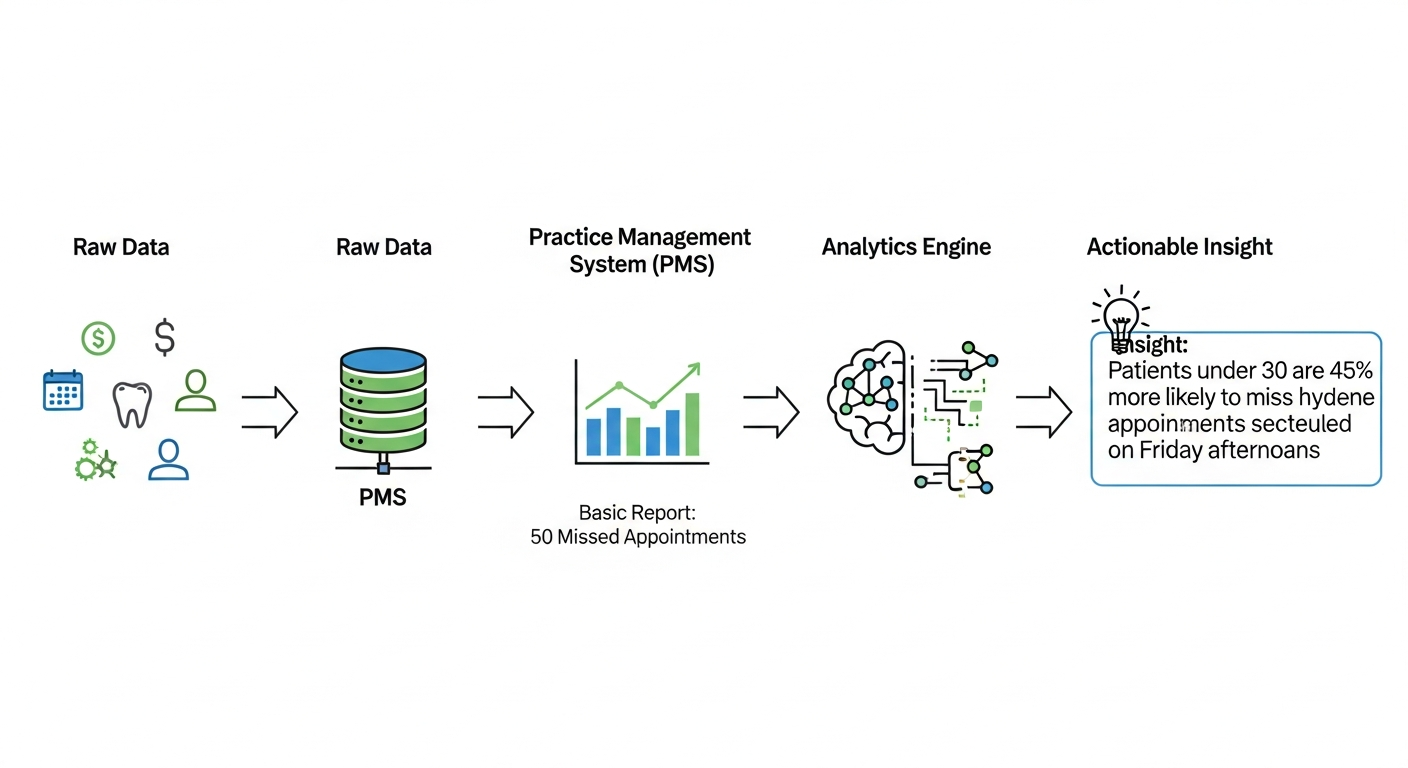 The journey from raw data to actionable insight. Analytics transforms basic reports (the 'what') into deep insights (the 'why') that can guide practice strategy.
At its core, a dental practice generates vast amounts of data daily. This includes everything from patient demographics, appointment histories, treatment plans, insurance information, and financial transactions. Traditionally, this data was confined within the Practice Management System, such as Open Dental, accessible primarily through static reports. The true power of data-driven analytics lies in its ability to transform this raw information into insights. These are not just numbers on a page; they are meaningful, contextually relevant pieces of information that reveal trends, patterns, and potential opportunities or challenges. For instance, a basic report might show the number of missed appointments, but analytics can delve deeper to identify why these appointments are missed – perhaps specific days, times, types of procedures, or even patient segments are more prone to no-shows. This transformation from raw data to actionable insights is fundamental to making informed decisions for any dental practice.
Why Data-Driven Analytics is Now Essential for Dental Practices
The contemporary dental market is characterized by increasing competition and evolving patient expectations. While the overall dental industry market size was valued at USD 41.03 billion in 2025 and is projected to grow significantly, this growth is not automatic for every dental practice [Fortune Business Insights, 2025]. Economic uncertainties can impact patient spending and insurance reimbursements, yet remarkably, 60% of practices reported year-over-year same-store production growth in 2024, defying these challenges [Business Wire, 2025]. This resilience is often fueled by smarter operational strategies. Furthermore, nearly 40% of patients now use social media to guide their dental and medical decisions [Forbes, 2024], underscoring the need for practices to understand and engage with their patient base on multiple levels. Data-driven analytics has moved from a competitive advantage to a necessity, providing the clarity needed to navigate these complexities, optimize performance, and ensure sustained profitability and growth in a rapidly changing landscape. It empowers businesses to move beyond guesswork and make strategic choices backed by empirical evidence.
The Data Dilemma: Why Traditional Reporting Falls Short
The limitations of traditional reporting mechanisms within many dental practices create a significant "data dilemma." This gap arises from the inherent nature of standard reports and the way data is often siloed, making it difficult to gain a comprehensive understanding of practice performance.
The Limitations of Basic Practice Management Software Reports
Most Practice Management Systems offer a suite of standard Reports. While these are valuable for basic record-keeping and regulatory compliance, they often fall short for strategic decision-making. These Reports are typically reactive, presenting historical data without much context or predictive power. For example, a production report might show total revenue generated, but it rarely explains how that revenue was achieved – which procedures were most profitable, which providers contributed most, or what factors influenced patient acceptance of treatment plans. Similarly, collection reports might detail outstanding balances but offer little insight into the reasons for delayed payments or the effectiveness of collection workflows. The systems are designed for operational tracking, not deep strategic analytics. This lack of depth means practice owners are often looking at symptoms rather than root causes.
Missing the Bigger Picture: Beyond Just the Numbers
The fundamental issue with traditional reporting is that it often presents isolated numbers without weaving them into a cohesive narrative. This means practices can miss critical insights that lie at the intersection of different data sets. A high appointment volume might look good on paper, but if those appointments are not translating into accepted treatment plans or returning patients, the performance metric is misleading. The real value of data-driven analytics is its ability to connect these disparate pieces of information, providing a holistic view of the dental practice. It's about understanding the intricate relationships between patient acquisition, treatment acceptance, recall workflows, and financial performance. Without this broader perspective, decisions can be suboptimal, leading to missed opportunities for growth and efficiency. This "bigger picture" is precisely what sophisticated analytics aims to reveal, moving beyond a simple rearview mirror view to a dynamic, forward-looking understanding.
The Power of Practice Analytics: Transforming Data into Strategic Growth
Practice analytics represent a paradigm shift from basic reporting to a dynamic, insightful approach to understanding and managing a dental practice. It’s about leveraging technology to glean meaningful insights from data, driving strategic growth and improving overall performance.
Defining Data-Driven Analytics for Dental Practices
Data-driven analytics for a dental practice refers to the systematic process of collecting, integrating, analyzing, and interpreting diverse data sources—including clinical, financial, operational, and demographic information—to uncover patterns, identify trends, and generate actionable insights. Unlike simple reporting, which presents static numbers, analytics actively seeks to explain why things are happening and predict what might happen next. This involves using advanced tools and technology to process data from various systems, such as the Practice Management System, patient engagement platforms, and financial software. The goal is to move from simply observing performance metrics to actively understanding the underlying drivers of that performance, enabling informed decision-making that can lead to significant improvements in profitability, patient satisfaction, and operational efficiency.
The Strategic Advantage: Making Informed Decisions for Practice Owners
The most profound benefit of data-driven analytics for Dental Practices is the strategic advantage it confers upon practice owners and managers. Instead of relying on intuition or anecdotal evidence, decisions are grounded in quantifiable facts and trends. This leads to a more confident and effective approach to running the business. For example, an owner can use analytics to understand the true lifetime value of different patient segments, guiding marketing efforts and service development. They can identify which staff members are most effective at patient scheduling or treatment plan presentation, allowing for targeted training and recognition. The ability to forecast revenue based on historical appointment trends and treatment acceptance rates provides a more stable financial outlook. Ultimately, analytics transforms practice management from a reactive, day-to-day operational challenge into a proactive, strategic endeavor focused on sustainable growth and enhanced performance. This empowered approach allows businesses to adapt and thrive in an increasingly competitive marketplace.
Key Pillars of Practice Potential Unlocked by Analytics
Data-driven analytics offers a comprehensive toolkit for unlocking potential across all facets of a dental practice. By providing deep insights into key areas, it empowers practices to optimize their performance, enhance patient relationships, streamline workflows, and elevate clinical outcomes.
Revenue Optimization: Maximizing Your Practice's Financial Health
For any dental practice to thrive, strong financial performance is paramount. Analytics provides the granular reporting and insights necessary to maximize revenue and profitability. By analyzing production reports in conjunction with treatment acceptance rates, practices can identify high-value procedures and understand patient preferences. They can pinpoint bottlenecks in their collection workflows, analyzing accounts receivable aging and insurance claim statuses to accelerate payments and reduce outstanding balances. For instance, understanding which insurance companies have the slowest reimbursement rates allows for proactive management of claims and patient expectations. Furthermore, analytics can help forecast future revenue by examining historical appointment data, recall compliance, and projected treatment acceptance. This financial clarity is crucial, especially as the average net income for general practice dentists in 2024 saw a decrease of more than $17,000 from 2023 according to the American Dental Association [Becker's Dental Review, 2025], highlighting the need for every practice to meticulously manage its financial performance. Key KPIs such as Production per Visit, Collection Rate, and Accounts Receivable Aging become not just metrics, but actionable levers for financial improvement.
Patient Engagement & Retention: Building Lasting Relationships
In today's competitive market, acquiring new patients is only part of the equation; retaining existing ones and fostering their loyalty is equally critical for sustained growth. Data-driven analytics offers powerful tools to understand patient behavior and preferences, enabling practices to build stronger, longer-lasting relationships. By analyzing patient demographics and treatment histories, practices can segment their patient base for targeted marketing campaigns and personalized communication. Tracking recall compliance is essential; analytics can reveal patterns in missed appointments or overdue recalls, allowing practices to implement proactive outreach strategies. Furthermore, analyzing feedback from patient surveys and online reviews can highlight areas of strength and opportunities for improvement in the patient experience. A more engaged patient base not only leads to higher revenue through consistent care but also generates valuable word-of-mouth referrals. Understanding the patient journey from initial contact through ongoing care allows practices to optimize every touchpoint, ensuring patients feel valued and understood. The importance of this engagement is underscored by the fact that nearly 40% of patients use social media to guide their dental and medical decisions [Forbes, 2024], demonstrating the interconnectedness of patient experience and practice performance.
Operational Efficiency: Streamlining Your Practice Workflows
The smooth functioning of a dental practice relies heavily on efficient workflows and optimized resource allocation. Analytics provides the insights needed to identify inefficiencies and streamline operations across the board. By analyzing appointment scheduling data, practices can identify peak times, minimize patient wait times, and reduce gaps in the schedule, maximizing chair utilization. Staff productivity can be assessed by examining metrics related to appointment booking, treatment plan presentation, and administrative tasks, enabling targeted training and support. Front-office workflows, from check-in to check-out, can be scrutinized to reduce administrative overhead and improve the patient experience. Understanding the flow of patients and resources helps eliminate waste, reduce costs, and improve the overall operational performance of the practice. For instance, analyzing the time it takes to complete certain procedures or administrative tasks can inform scheduling adjustments and resource allocation. This focus on efficiency is critical, especially as the dental services organization market is predicted to see substantial growth, indicating a trend towards more streamlined and optimized dental businesses [Precedence Research, 2026].
Clinical Excellence: Elevating Patient Care and Outcomes
Beyond the financial and operational aspects, data-driven analytics plays a crucial role in enhancing clinical excellence and improving patient care. By tracking treatment acceptance rates, practices can gain insights into why certain patients might hesitate to proceed with recommended treatments, allowing for more effective communication and patient education. Analyzing clinical outcomes for specific procedures can help identify best practices and areas for further training among the clinical staff. Furthermore, analytics can highlight opportunities to focus on preventative care initiatives, which not only benefit patients' long-term oral health but can also reduce the need for more complex and costly treatments down the line. Understanding which preventative workflows are most effective and which patient segments benefit most allows for a more targeted and impactful approach to oral health. This focus on clinical data ensures that the practice is not only financially sound and operationally efficient but also delivering the highest quality of care to its patients, ultimately contributing to better health outcomes and increased patient trust.
Implementing Data-Driven Analytics: Tools and Culture
Successfully integrating data-driven analytics into a dental practice involves more than just acquiring software; it requires a strategic approach to selecting the right tools and fostering a culture that values data in decision-making.
Choosing the Right Analytics Platform: What to Look For
Selecting an appropriate analytics platform is a critical first step. The ideal platform should seamlessly integrate with your existing Practice Management System and other relevant technology systems. Key features to prioritize include user-friendliness, intuitive dashboards, and customizable reporting capabilities. Real-time data access is essential for making timely decisions, allowing practice owners to monitor performance as it happens, rather than waiting for end-of-day or end-of-month reports. The platform should also be scalable, capable of growing with your practice and accommodating increasing volumes of data and more sophisticated analytics. Look for solutions that offer robust KPI tracking and visualization tools that make complex information easy to understand at a glance. The global dental practice management software market, estimated at USD 2.4 billion in 2024, demonstrates the significant investment in technology aimed at improving practice operations, highlighting the availability of tools designed for this purpose.
The Role of Intelligent AI and Machine Learning: Demystifying Advanced Analytics
The integration of Artificial Intelligence (AI) and Machine Learning (ML) is elevating dental analytics to new heights. These advanced technologies can automate complex data analysis, identify subtle patterns that human analysts might miss, and provide predictive insights. For example, AI can forecast appointment no-show rates with greater accuracy, allowing the practice to proactively overbook or implement targeted reminder workflows. ML algorithms can identify high-value patient segments based on a multitude of factors, informing personalized marketing strategies and treatment recommendations. AI can also streamline administrative tasks, such as claim processing or document verification, freeing up staff time. While the terms AI and ML might sound intimidating, their practical application in dental analytics is about making data more accessible, analysis faster, and insights more profound, ultimately leading to more informed and effective business decisions.
Building a Data-Driven Culture: Empowering Your Team
Technology alone is insufficient; a cultural shift is necessary to truly leverage data-driven analytics. This begins with leadership buy-in, where practice owners champion the importance of data in all decision-making processes. Training the staff on how to interpret reports and understand key KPIs is crucial. When staff can see how data impacts their daily roles—whether it's front-desk staff understanding the impact of scheduling workflows on patient satisfaction or clinical staff seeing how treatment acceptance rates influence practice revenue—they become more invested in its accuracy and utility. Encouraging staff to use data to identify areas for improvement and propose solutions fosters a collaborative environment. Making data accessible and relevant to everyone on the team empowers them to contribute to the practice's overall performance and success, transforming the practice into a truly data-informed business.
Measuring Success: Beyond Basic Metrics to True Practice Potential
Transitioning to a data-driven approach requires a clear understanding of how to measure success. This involves moving beyond superficial metrics to establish a comprehensive view of practice performance and quantifying the tangible return on investment (ROI) of analytics initiatives.
Establishing a Holistic Dental Dashboard for Comprehensive Performance
A cornerstone of measuring success in data-driven analytics is the establishment of a holistic dental dashboard. This dashboard should consolidate key performance indicators (KPIs) from across all pillars of the practice—revenue, patient engagement, operational efficiency, and clinical outcomes. Instead of looking at isolated Reports, a comprehensive dashboard provides a unified, real-time view of the practice's health. For example, it might display revenue per visit alongside patient recall compliance and chair utilization rates, illustrating how these factors are interconnected. This visual representation allows for quick identification of trends, potential issues, and areas of success. The goal is to provide a single source of truth that informs strategic decisions and tracks progress towards overarching practice goals. Such a dashboard moves beyond basic reporting to offer actionable intelligence, enabling practice owners to maintain a pulse on their entire business.
Quantifying ROI: Demonstrating the Tangible Value of Analytics
Implementing data-driven analytics represents an investment, and it's essential to quantify the return on that investment (ROI). This goes beyond simply observing increases in revenue. The ROI can be demonstrated through various tangible benefits. For instance, analyzing appointment scheduling workflows might reveal ways to reduce no-show rates by 10%, directly saving the practice thousands of dollars annually in lost revenue and wasted staff time. Similarly, improved patient retention workflows can lead to a measurable increase in patient lifetime value. Streamlining administrative processes can reduce overhead costs and free up staff to focus on higher-value tasks, contributing to improved profitability. By tracking specific KPIs before and after implementing analytics initiatives, practices can demonstrate concrete improvements in performance and justify the ongoing investment in technology and data analysis. This quantitative proof solidifies the value of analytics as a strategic tool for practice growth and sustainability.
Conclusion: Embrace the Future of Dentistry with Data-Driven Growth
Recap the Journey: From Data Dilemmas to Unlocking Full Practice Potential
We’ve journeyed from understanding the limitations of traditional dental practice management and basic reporting to recognizing the profound impact of data-driven analytics. The "data dilemma" faced by many practices—the challenge of turning raw patient data into actionable insights—is now a solvable problem. By embracing advanced analytics, Dental Practices can move beyond reactive operations to a proactive, strategic approach that fuels growth and enhances performance. We’ve explored how this transformation impacts revenue optimization, patient engagement, operational workflows, and clinical excellence, demonstrating that data is not just about numbers, but about unlocking the full potential of your business.
The Transformative Power of Data-Driven Analytics for Every Dental Practice
The adoption of data-driven analytics is no longer a luxury but a fundamental requirement for success in modern dentistry. As technology continues to advance, the ability to interpret and act upon data will increasingly define leading Dental Practices. The dental services organization market’s projected growth highlights a trend towards more efficient and data-informed businesses [Precedence Research, 2026]. By leveraging analytics, practices can achieve greater profitability, build stronger patient relationships, streamline workflows, and elevate the quality of care. The insights gleaned from data empower staff, inform strategic decisions, and ultimately lead to a more resilient, adaptable, and thriving practice.
Call to Action: Embrace Digital Transformation for a More Successful and Efficient Practice
The future of dentistry is data-driven. We encourage you to embrace this digital transformation. Begin by assessing your current reporting capabilities and identifying areas where data-driven analytics can make the most significant impact. Explore analytics platforms that integrate with your existing systems and empower your staff with the insights they need. By investing in data-driven analytics, you are not just investing in technology; you are investing in the long-term success, efficiency, and ultimate potential of your dental practice. Take the step today to unlock a more informed, profitable, and patient-centric future.