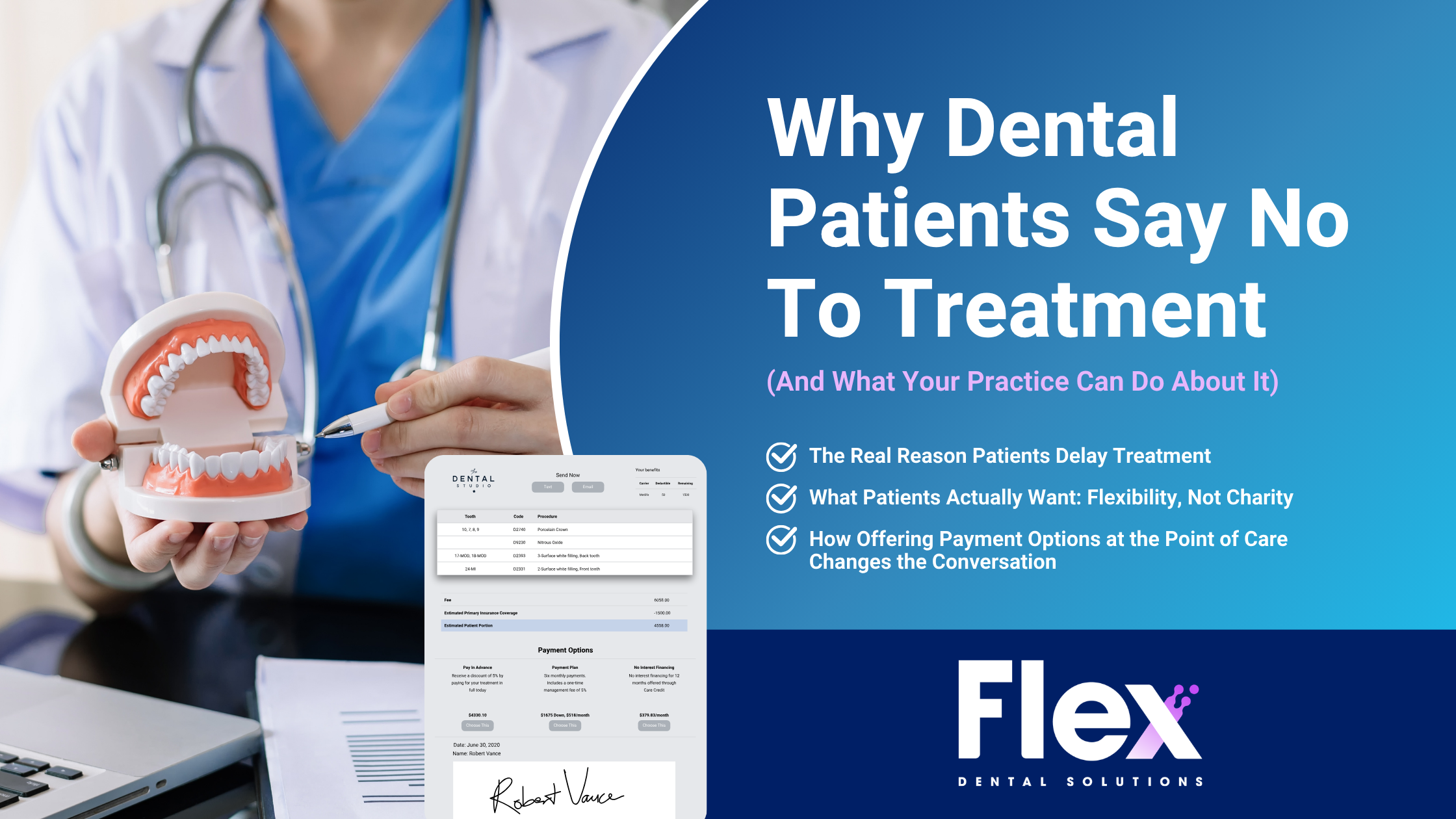
Why Dental Patients Say No to Treatment (And What Your Practice Can Do About It)
The patient nodded through the whole appointment. Understood the diagnosis. Agreed the treatment made sense. And then, at the front desk, said the six words that follow dental teams home at night:
“I’ll have to think about it.”
It's not a no. But it rarely becomes a yes either. And somewhere between the treatment room and the parking lot, a real clinical need — and real practice revenue — quietly disappears.
This happens hundreds of times a day in dental offices across the country. And while it can feel like a communication problem, a trust problem, or even a scheduling problem, the data points to something more specific: it's usually a cost problem.
The Real Reason Patients Delay Treatment
Multiple studies on patient behavior in dental settings point to the same conclusion — out-of-pocket cost is the single most common barrier to treatment acceptance. Not anxiety. Not time. Not skepticism about whether the treatment is necessary.
Cost.
And the math isn't hard to understand. A patient looking at a $2,400 crown, a $4,500 implant, or a $5,000 Invisalign case isn't necessarily unwilling to invest in their oral health. They're looking at a number that doesn't fit neatly into this month's budget, and they don't see a path forward.
So they leave to think about it — and most of the time, they don't come back.
The challenge for practices isn't convincing patients that treatment matters. Most already know. The challenge is giving them a realistic way to say yes.
What Patients Actually Want: Flexibility, Not Charity
Here's something worth sitting with: patients who delay treatment because of cost are not asking for a discount. They're not asking for a payment arrangement scribbled on a sticky note. They're not looking for sympathy.
They want what they get everywhere else in their financial life — a clear, manageable, modern way to pay for something that matters to them over time.
Think about how patients finance cars, appliances, home repairs, and travel. The infrastructure for consumer financing is everywhere. Monthly payment options are built into almost every significant purchasing decision in a patient's life outside of dentistry.
And yet, in many dental practices, the payment conversation still ends at: "We accept Visa, Mastercard, and CareCredit." That gap — between how patients want to pay and what practices offer — is where treatment cases go to disappear.
How Offering Payment Options at the Point of Care Changes the Conversation
The moment a patient sees a flexible payment option available — right there, at checkout, alongside their treatment plan — the math changes. Instead of "I need to come up with $3,800," they're looking at something much closer to "that's about $120 a month."
Same treatment. Same cost. Completely different decision.
Research consistently shows that presenting financing options at the point of care — before a patient has time to leave and second-guess — dramatically increases the likelihood that treatment gets scheduled. Practices offering modern flexible payment options at checkout see case acceptance lift by as much as 15%.
|
Up to 15% case acceptance increase |
40% of patients cite cost as reason for delaying treatment |
$10K+ average monthly production recovered |
That's not a marketing number. That's what happens when the financial barrier goes down and the path to yes gets clearer.
Introducing Buy Now, Pay Later Through FlexPayments — Powered by Affirm and Klarna
Flex Dental Solutions has added Buy Now, Pay Later to FlexPayments — giving Open Dental practices the ability to offer Affirm and Klarna financing options directly at the point of care.
Patients can choose a payment plan that works for their budget. The practice collects upfront. And the entire process happens inside the existing FlexPayments checkout flow — no separate portal, no paper applications, no new system for the team to manage.
For practices already using FlexPayments, this is the missing piece in the patient payment experience. For practices considering Flex, it's one more reason the platform is built to close the revenue loop from treatment presented to payment collected.
What This Looks Like in a Real Open Dental Practice
A patient comes in for a hygiene visit. The hygienist notes early-stage bone loss and recommends a full periodontal workup. The treatment coordinator walks through the plan — $2,100 after insurance.
Under the old model: the patient says they'll think about it. Maybe they call back. Probably they don't.
Under the Flex model: the treatment coordinator mentions that flexible payment options are available through Affirm and Klarna. The patient pulls up the checkout screen on their phone, sees that the treatment breaks down to roughly $70 a month over 30 months, and books the appointment before they leave.
Same patient. Same treatment. Different outcome — because the practice had the right tool in the right moment.
|
Ready to see how FlexPayments with BNPL works? We'll show you how it fits into your Open Dental workflow in 20 minutes. Book a demo → Meet with a Flexpert! |
-1.png)