Introduction: Beyond the Bottom Line – Why Strategic Investment Matters
Simply offering excellent clinical care is no longer enough to guarantee sustained success. Dental practice owners and managers are increasingly recognizing the imperative to operate with a keen financial eye, understanding that strategic investment is the cornerstone of not just survival, but thriving growth. Beyond the immediate metrics of patient numbers and daily revenue, a deeper understanding of Return on Investment (ROI) can transform how decisions are made, ensuring that every dollar, hour, and resource is optimally deployed. This article delves into the multifaceted world of dental practice ROI, providing a comprehensive framework for identifying, implementing, and measuring strategic investments that unlock lasting profitability.
Demystifying ROI for Dental Practices
Understanding the concept of Return on Investment is fundamental for any business owner seeking to optimize financial performance. For dental practices, it offers a crucial lens through which to evaluate the effectiveness and profitability of various initiatives, from adopting new technology to refining marketing campaigns.
What is Return on Investment (ROI)?
At its core, Return on Investment (ROI) is a performance measure used to evaluate the efficiency of an investment or compare the efficiency of a number of different investments. It represents the profitability of an investment relative to its cost. The basic formula for calculating ROI is:
ROI = (Net Profit from Investment / Cost of Investment) x 100%
In the context of a dental practice, "Net Profit" refers to the profit generated directly attributable to a specific investment after accounting for all associated costs. The "Cost of Investment" includes not only the upfront purchase price but also any ongoing expenses, training, or maintenance associated with that investment. A positive ROI indicates that the investment generated more revenue than it cost, while a negative ROI suggests a loss.
Key Metrics for Measuring Dental ROI Accurately
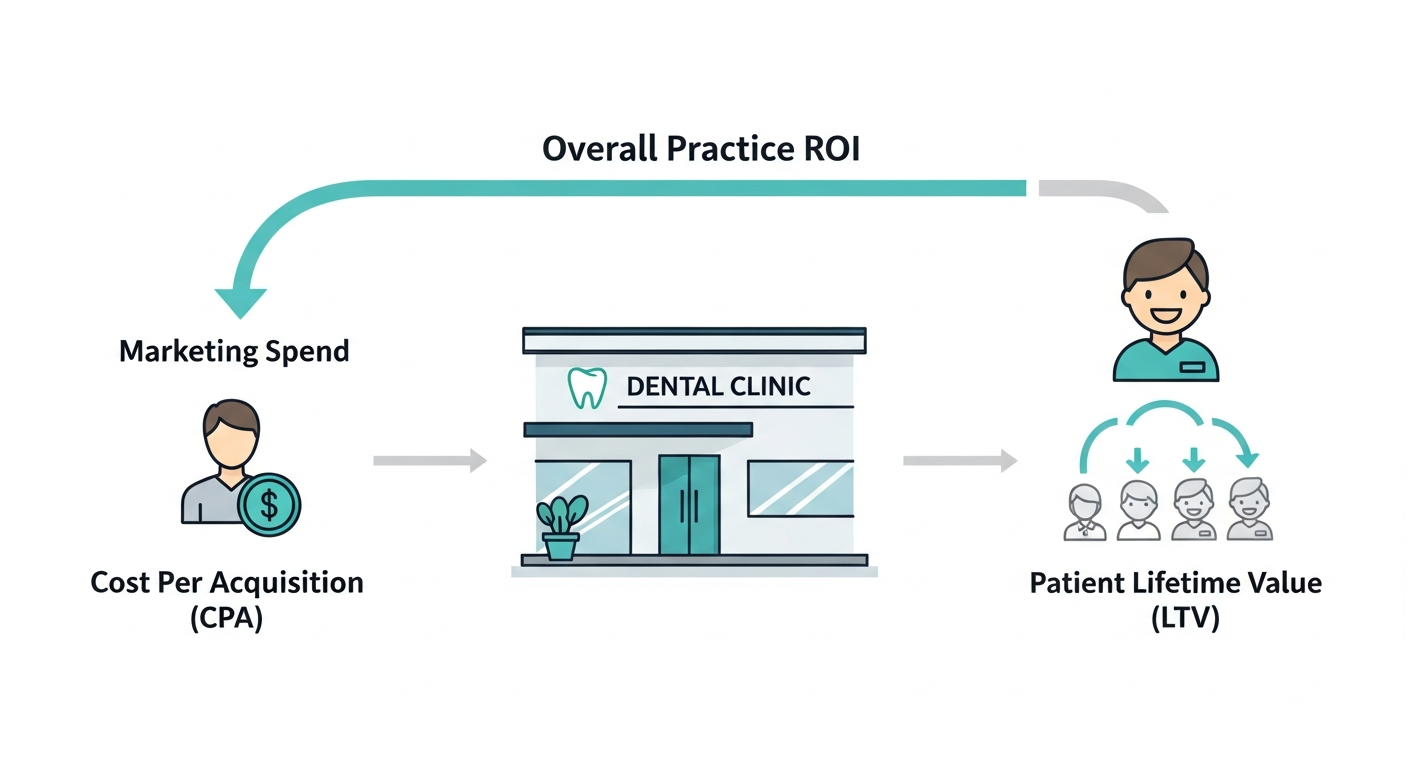 A holistic view of dental ROI connects the cost of acquiring a new patient (CPA) with the long-term revenue that patient generates (LTV).
While the basic ROI formula provides a valuable starting point, dental practices benefit from a broader suite of metrics to accurately assess the financial impact of their investments. Focusing solely on immediate profit can overlook crucial long-term value drivers. Key metrics include:
- Patient Lifetime Value (LTV): This metric estimates the total revenue a practice can expect from a single patient over the entire duration of their relationship. Investments that increase patient retention and satisfaction directly boost LTV, a critical component of long-term ROI.
- Cost Per Acquisition (CPA): Crucial for marketing efforts, CPA measures how much it costs to acquire a new patient. Lowering CPA while maintaining or increasing patient quality indicates a more efficient marketing investment.
- Conversion Rates: This tracks the percentage of potential patients who take a desired action, such as filling out an online form, making a phone call to schedule an appointment, or becoming a booked patient after an initial inquiry. Optimizing website design and patient communication processes directly impacts conversion rates.
- Patient Retention Rate: A measure of how many patients continue to seek care at the practice over a given period. High retention rates are far more cost-effective than acquiring new patients and are a strong indicator of patient satisfaction.
- Operational Cost Per Patient: Tracking expenses such as supplies, labor, and overhead relative to the number of patients seen provides insight into the efficiency of practice operations.
- Staff Productivity: Measuring output and efficiency per staff member can highlight the ROI of training, improved workflows, and effective management.
By integrating these metrics with the standard ROI calculation, a dental practice owner gains a comprehensive understanding of how investments contribute to both immediate profitability and sustainable success.
Pillar 1: Strategic Investment in Your People (Staff & Dentist)
Often overlooked in favor of tangible assets, the investment in human capital—your staff and the dentist—is perhaps the most critical driver of a dental practice's overall ROI and long-term success.
Maximizing Staff Efficiency, Engagement, and Retention
A highly trained, motivated, and engaged staff directly impacts patient experience, operational efficiency, and ultimately, revenue. Investing in your team through continuous training, professional development, and fostering a positive work environment yields significant returns.
- Training ROI: Investing in clinical, administrative, and customer service training equips staff with advanced skills, improves patient care delivery, and boosts efficiency. This reduces errors, minimizes the need for rework, and enhances the patient journey.
- Engagement and Retention: High staff turnover is a substantial cost for any practice, encompassing recruitment, onboarding, and lost productivity. Investing in a positive workplace culture, offering competitive compensation, and providing opportunities for growth fosters loyalty, reduces turnover, and ensures a stable, experienced team. Engaged staff are more productive and provide better client service, leading to higher patient satisfaction and increased lifetime value.
The Dentist as a Strategic Investment
The dentist is the central figure in any dental practice, and their continuous development and well-being are paramount to the practice's growth and profitability.
- Continuing Education (CE): Investing in advanced clinical training, new techniques, and emerging technologies allows the dentist to offer a wider range of services, attract more specialized cases, and stay competitive. This directly translates to increased revenue potential.
- Leadership and Management Skills: Enhancing leadership capabilities can improve practice management, staff motivation, and strategic decision-making, all contributing to better operational ROI.
- Well-being: Burnout is a real threat. Investing in the dentist's well-being—through manageable workloads, support systems, or even professional coaching—is crucial for sustained high performance and preventing costly disruptions. The dentist's expertise and leadership are invaluable assets, and investing in their ongoing development and health is a direct investment in the practice's future success.
Pillar 2: Strategic Investment in Technology & Equipment
Strategic adoption of technology and modern equipment can profoundly impact a dental practice's efficiency, patient experience, and overall profitability.
Enhancing Operational Efficiency and Patient Experience Through Technology
Modern technology, such as Flex Dental Solutions, offers numerous avenues to streamline operations, improve diagnostic capabilities, and elevate the patient experience. This includes digital imaging systems, advanced practice management software, like Open Dental, patient communication platforms, and diagnostic tools like intraoral scanners.
- Efficiency Gains: Digital systems reduce administrative burdens, automate repetitive tasks (like appointment reminders), and improve record-keeping, freeing up staff time for direct patient care. This increased efficiency can lead to seeing more patients, thus boosting revenue.
- Improved Patient Experience: Technologies like digital check-in forms, clear visual aids for treatment explanations, and comfortable, state-of-the-art equipment enhance patient comfort and trust. A positive client experience is directly linked to higher patient satisfaction and retention, contributing to lifetime value.
- Diagnostic Accuracy: Advanced diagnostic technology allows for earlier detection of issues and more precise treatment planning, leading to better patient outcomes and reducing the likelihood of complications or rework.
Understanding Capital Expenditures and Tax Deductions
Investing in new technology and equipment often involves significant capital expenditures. Understanding the financial implications, including tax benefits, is crucial for maximizing the return on investment.
- Depreciation: Capital assets depreciate over time, offering a tax deduction that reduces the practice's taxable income.
- Section 179 Deduction: This allows businesses to deduct the full purchase price of qualifying equipment and technology up to certain limits in the year it is placed in service, providing a significant upfront tax advantage.
- Consultation: It is always advisable to consult with a qualified accountant or financial advisor to fully understand the tax implications and optimize the financial benefits of capital investments in your dental practice.
Pillar 3: Strategic Investment in Patient Acquisition & Retention (Marketing)
Attracting new patients and retaining existing ones are fundamental pillars of profitability for any dental practice. Strategic marketing investments are essential for achieving these goals.
Crafting an Effective Dental Marketing Strategy for New Patient Growth
A robust marketing strategy focuses on reaching the right audience and converting them into loyal patients. This involves a multi-channel approach leveraging digital platforms and clear calls to action.
- Website Optimization: Your website is your digital storefront. Investing in a professional, user-friendly website optimized for search engines (SEO) and clear conversions—such as prominent phone call buttons and easily accessible online form submission—is crucial for attracting new patients.
- Digital Advertising (Google Ads): Targeted Google Ads campaigns can drive highly qualified traffic to your website, increasing the likelihood of conversions. Measuring the ROI of these campaigns by tracking leads generated and appointments booked from specific ad groups is vital.
- Lead Generation: Optimizing how phone calls and online forms are managed ensures that inquiries from potential patients are handled efficiently and professionally, converting interest into booked appointments.
Measuring the ROI of Your Marketing Spend
The true measure of marketing investment success lies in its quantifiable impact on practice revenue and patient acquisition.
- Tracking Sources: Implement systems to track where new patients are coming from (e.g., Google Ads, social media, referrals). This allows for accurate ROI calculation per channel.
- CPA and LTV Alignment: Compare the Cost Per Acquisition of new patients against their projected lifetime value. A healthy ratio indicates that marketing efforts are bringing in profitable clients. For instance, if your average marketing CPA is $150 but the lifetime value of a patient is $1000, the investment is clearly justified.
- Conversion Tracking: Monitor the conversion rates of phone calls and website forms to understand the effectiveness of your lead generation and initial communication strategies. For example, tracking how many phone calls result in scheduled appointments.
Pillar 4: Strategic Investment in Operational Efficiency & Patient Experience
Beyond marketing and clinical technology, investing in the core operational management of your dental practice is a powerful way to enhance profitability and improve the overall patient journey.
Streamlining Practice Management for Enhanced Profitability
Efficient management reduces waste, minimizes downtime, and improves the flow of both staff and patients, directly contributing to increased revenue and a better client experience.
- Optimized Scheduling: Implementing advanced scheduling technology can reduce appointment gaps, minimize no-shows through automated reminders, and ensure efficient use of chair time, thereby maximizing the practice's earning potential.
- Streamlined Intake Processes: Digital check-in forms, online patient registration, and integrated communication systems simplify the onboarding process for new patients. This not only saves time and reduces administrative overhead but also provides a smoother, more modern experience for the patient, increasing satisfaction and retention.
- Workflow Automation: Automating tasks like insurance verification, billing follow-ups, and recall notifications frees up staff to focus on higher-value activities, improving overall practice productivity and reducing operational costs. The synergy between efficient processes and the right technology is a key driver of success.
Pillar 5: Strategic Investment in Your Practice's Future & Value
Long-term success for a dental practice extends beyond immediate revenue generation to building enduring value and ensuring a viable future, whether through expansion or eventual succession.
Building a Foundation for Long-Term Practice Growth and Succession
Strategic investment today lays the groundwork for the practice's future worth and marketability. This involves creating systems, a strong brand, and a reputation that transcend individual practitioners.
- Systematization: Investing in robust practice management systems, documented procedures, and efficient workflows creates a more predictable and scalable business. This makes the practice more attractive to potential buyers or successors, as it can operate effectively even with a change in leadership.
- Brand Equity: Building a strong brand reputation through consistent patient experience, ethical practices, and community engagement adds significant intangible value to the practice. This reputation can attract new patients and foster loyalty, directly impacting long-term revenue streams.
- Valuation Enhancement: Every strategic investment—whether in technology, staff, or marketing—contributes to the overall value of the dental practice. A well-managed, profitable, and efficient practice commands a higher valuation, providing a greater return for the owner upon sale or transition.
Developing and Executing Your Strategic Investment Plan
Transforming the concept of strategic investment into tangible success requires a structured approach. A well-defined plan ensures that resources are allocated effectively and ROI is consistently monitored.
A Step-by-Step Framework for Practice Owners
- Assess Current Performance: Conduct a thorough review of your practice's financial health, operational efficiency, and patient satisfaction metrics. Identify key areas of strength and weakness.
- Define Clear Goals: Set specific, measurable, achievable, relevant, and time-bound (SMART) goals for each area of potential investment. For example, "Increase new patient acquisition by 15% in the next 12 months through enhanced online marketing."
- Prioritize Investments: Evaluate potential investments based on their projected ROI, alignment with practice goals, and available resources. Consider the interconnectedness of different investments; for example, investing in technology for patient intake might complement marketing efforts aimed at attracting new patients.
- Develop a Budget and Timeline: Allocate a realistic budget for each prioritized investment and establish a clear implementation timeline. Factor in all associated costs, including training and ongoing maintenance.
- Implement and Track: Execute the investment strategy. Crucially, establish robust tracking mechanisms from the outset to measure key metrics and assess performance against your defined goals. This is where tracking phone calls, website form conversions, and patient acquisition costs becomes essential.
- Monitor, Analyze, and Adjust: Regularly review performance data. Analyze the ROI of your investments, identify what's working and what's not, and be prepared to make necessary adjustments to your strategy. Continuous evaluation is key to sustained profitability.
Common Pitfalls to Avoid in Dental Practice Investment
While the pursuit of ROI is essential, several common pitfalls can undermine the effectiveness of even the best-intentioned investments. Recognizing and avoiding these traps is as crucial as identifying profitable opportunities.
The "Shiny Object" Syndrome: Investing in trends without clear goals or a solid plan for measuring ROI.
The allure of the latest technology or marketing fad can lead to impulsive purchases. Without clearly defined objectives and a method to measure the return, these investments often become costly distractions rather than profit drivers for the dental practice.
Neglecting Staff Buy-in and Training: New technology or processes will fail without proper team adoption and comprehensive staff training.
Even the most advanced technology or innovative strategy will falter if the staff are not adequately trained, understand its purpose, or buy into its implementation. Their engagement is critical for successful adoption and realizing the intended ROI.
Underestimating Long-Term Costs: Overlooking maintenance, upgrades, subscriptions, and ongoing training for new investments.
The initial purchase price is often only a fraction of an investment's total cost. Failing to account for ongoing expenses, such as software subscription fees, technology maintenance, or recurring training, can significantly diminish the actual ROI and impact practice revenue negatively.
Conclusion: Your Roadmap to Unlocking Sustainable Profitability
Strategic investment is not merely about spending money; it's about making calculated decisions that drive tangible improvements across every facet of your dental practice. By embracing a holistic approach that considers your staff, dentist, technology, marketing efforts, and operational efficiency, you can build a roadmap to sustained profitability and long-term success. Demystifying ROI and actively measuring its impact across these pillars—from acquiring new patients and optimizing website conversions to enhancing patient lifetime value and streamlining management—empowers you to make informed choices. Avoid the common pitfalls, and focus on creating a practice ecosystem where every investment contributes to a stronger, more resilient, and more profitable future. Your strategic investment plan is your guide; consistent execution and evaluation are your keys to unlocking enduring success for your dental practice.