In today's competitive healthcare landscape, dental practices face constant pressure to balance exceptional patient care with financial sustainability. While clinical excellence remains paramount, the often-overlooked administrative overhead can significantly impact profitability and operational efficiency. Many dentists find themselves bogged down by non-clinical tasks, diverting valuable time and resources away from revenue-generating activities and patient engagement. This article provides a comprehensive, actionable playbook for dental practices aiming to slash administrative costs, streamline operations, and ultimately enhance their financial health and patient experience. By understanding where your overhead lies, leveraging technology effectively, optimizing financial processes, refining staffing, and adopting smart purchasing strategies, you can transform your administrative functions from a cost center into a strategic advantage.
Understanding Your Administrative Overhead: The Foundation of Cost Savings
Before any effective cost-saving measures can be implemented, a deep understanding of your current administrative overhead is essential. This involves dissecting what constitutes these costs, benchmarking your practice's efficiency against industry standards, and conducting a thorough audit to pinpoint specific areas for improvement.
What Exactly Constitutes Administrative Overhead?
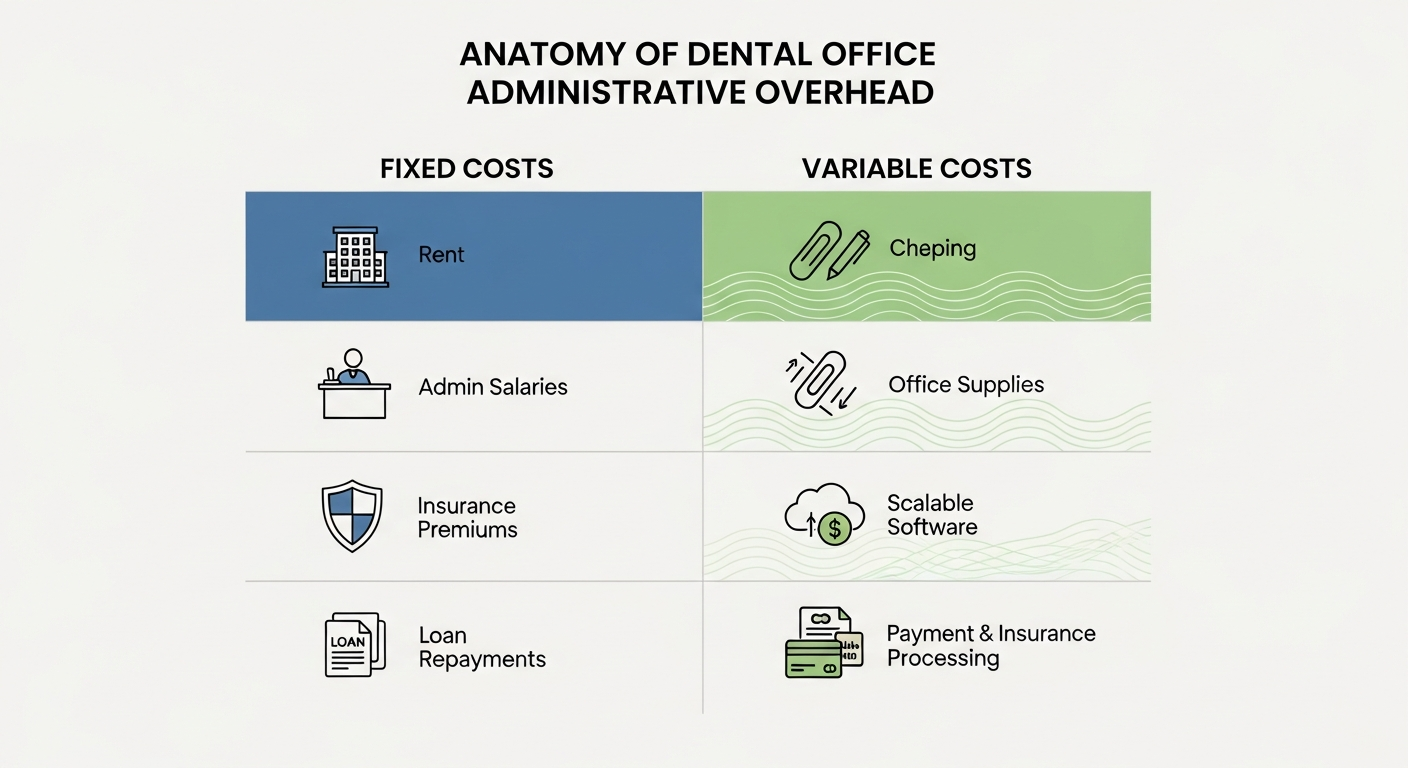 Administrative overhead is composed of both fixed costs, which remain constant, and variable costs, which fluctuate with practice activity.
Administrative overhead encompasses all the costs associated with running the business side of a dental practice that are not directly related to providing clinical dental care. These costs can be broadly categorized into fixed and variable expenses. Fixed costs are those that remain relatively constant regardless of patient volume, such as rent, salaries for administrative staff, insurance premiums, and loan repayments. Variable costs, on the other hand, fluctuate with the level of activity. In an administrative context, these might include office supplies, software subscriptions that scale with usage, or costs associated with processing payments and insurance claims. Understanding these distinctions is crucial for targeted cost reduction strategies. For instance, while rent is a significant fixed cost, inefficiencies in billing processes contribute to variable costs that can be more readily controlled.
Benchmarking Your Practice's Administrative Efficiency
To gauge how your dental practice performs, benchmarking against industry averages is vital. Overhead in dental practices can average between 60% to 65% of collections, with administrative costs forming a substantial part of this. High administrative overhead can signal inefficiencies that detract from potential revenue and hinder growth. Regularly comparing your practice's overhead percentages to national or regional benchmarks, often provided by dental associations or financial consultants, offers critical insights. This comparison helps identify if your administrative spending is disproportionately high, prompting a closer look at specific cost drivers.
Conducting a Comprehensive Administrative Cost Audit
A thorough administrative cost audit is the cornerstone of any successful cost-reduction initiative. This process involves a detailed review of all expenses related to non-clinical operations. Start by categorizing all administrative costs, from staffing and office supplies to technology subscriptions and lab fees. Analyze each expenditure line item: Is it necessary? Is there a more cost-effective alternative? Can its consumption be reduced? For example, a deep dive into office supply costs might reveal overstocking or inefficient ordering practices. Similarly, reviewing software subscriptions could uncover underutilized features or redundant services. This audit should also assess the time spent by staff on various administrative tasks, as excessive time allocation often translates directly into higher labor costs.
Leveraging Technology for Administrative Automation and Efficiency
Technology offers powerful solutions to automate repetitive tasks, streamline workflows, and enhance overall administrative efficiency, ultimately reducing costs and improving the patient experience.
Maximizing Your Practice Management System (PMS) Capabilities
A robust Practice Management System (PMS), such as Open Dental, is more than just a scheduling tool; it’s a central hub for practice operations. To cut administrative costs, ensure you are fully utilizing your PMS. Explore its features for patient registration, insurance eligibility verification, appointment reminders, billing, and reporting. Automating these functions reduces manual effort, minimizes errors, and frees up staff time. For instance, automated appointment reminders can decrease no-shows, directly impacting revenue and staff efficiency. Many PMS systems also offer integrated patient communication tools, like Flex Dental Solutions, an authorized vendor with Open Dental, further streamlining interactions.
Streamlining Communication and Enhancing Patient Experience
Efficient communication is key to both administrative cost reduction and an improved patient experience. Over 60% of dental practices in the U.S. are projected to adopt AI-driven billing solutions by 2025, which can significantly reduce claim denials and expedite reimbursements [Qodoro]. Implementing automated patient communication, such as appointment confirmations, pre-visit instructions, and post-appointment follow-ups via text or email, not only saves staff time but also enhances patient satisfaction and reduces no-shows. Integrating patient portals where patients can fill out forms, view statements, and make payments online further streamlines administrative processes and empowers patients, contributing to a smoother overall patient journey.
Embracing a Paperless Administrative Office
The transition to a paperless administrative office offers significant cost savings and efficiency gains. Reducing reliance on paper, printing, and physical storage lowers expenses related to supplies, postage, and record-keeping. Digital records are easier to access, share, and back up, improving workflow and data security. Implementing electronic health records (EHRs) and digital document management systems can transform administrative processes. Patient forms can be completed online or on tablets, and digital archiving of financial records, insurance documents, and correspondence streamlines operations, reduces the physical footprint required for storage, and minimizes the risk of lost paperwork.
The Role of AI in Revolutionizing Administrative Tasks
Artificial Intelligence (AI) is rapidly transforming administrative functions in dental practices. Over 60% of dental practices in the U.S. are projected to adopt AI-driven billing solutions by 2025, which can significantly reduce claim denials and expedite reimbursements [Qodoro]. AI can automate tasks like insurance verification, claim submission, payment posting, and even patient scheduling by analyzing patterns and predicting needs. Early adopters of AI-enhanced Revenue Cycle Management (RCM) report 25-40% reductions in days sales outstanding (DSO) and 15% improvements in collection rates [Intel Market]. These technologies not only cut labor costs associated with these tasks but also improve accuracy and speed, leading to faster revenue cycles and better financial performance.
Optimizing Financial and Insurance Administration
Effective management of financial and insurance-related tasks is critical for maintaining healthy cash flow and maximizing revenue, directly impacting a dental practice's bottom line.
Mastering Insurance Claims Processing for Faster Reimbursement
Insurance claims processing is a significant administrative burden and a common source of revenue leakage. Inaccurate billing and administrative errors can drain 5-10% of a dental practice's annual revenue [Dentistry Support]. Streamlining this process involves diligent verification of patient insurance details before treatment, accurate coding, and timely submission of claims. Utilizing practice management software with integrated claims processing features can automate much of this workflow, reducing manual entry and the potential for errors. Regular follow-up on pending claims and efficient appeals for denied claims are also crucial for ensuring timely reimbursement.
Efficient Payment Processing and Collections
Prompt payment collection is vital for practice solvency. Implementing efficient payment processing systems can reduce administrative burden and accelerate cash flow. Offer patients multiple payment options, including online payments, payment plans, and automatic recurring payments. Automating payment reminders and utilizing clear, concise billing statements reduce the need for manual collection efforts. For outstanding balances, establish a consistent and professional collection process, potentially leveraging third-party services for aged accounts if internal efforts are proving too time-consuming or ineffective. Reducing the days sales outstanding (DSO) directly improves working capital and reduces the cost of carrying receivables.
Improving Accounting Practices for Better Financial Visibility
Accurate and insightful accounting practices are fundamental to understanding and controlling administrative costs. Utilize accounting software that integrates with your PMS to provide a real-time view of your financial health. This includes tracking revenue, expenses, accounts receivable, and overhead percentages. Regularly review financial reports with your accountant or financial advisor to identify trends, budget variances, and opportunities for cost savings. Proper accounting ensures that you have clear visibility into where your money is going, enabling informed decisions about where to focus cost-reduction efforts and how to optimize resource allocation for greater profitability.
Optimizing Staffing and Workflow for Administrative Roles
The efficiency of your administrative team and the workflows they follow directly impact overhead. Optimizing these elements can lead to significant cost savings and improved practice operations.
Maximizing Front Office Staff Productivity
Front office staff are often the first point of contact for patients and play a critical role in practice administration. To maximize their productivity, clearly define roles and responsibilities, provide adequate training on software and procedures, and empower them with the tools and autonomy to manage their tasks effectively. Cross-training staff can also ensure continuity and flexibility. Regularly assessing workloads and identifying bottlenecks in their daily routines can lead to process improvements that save time and reduce stress.
Implementing Lean Management Principles in Administrative Workflows
Lean management principles, originating from manufacturing, can be effectively applied to dental office administrative workflows to eliminate waste and increase efficiency. This involves mapping out current processes, identifying steps that do not add value, and redesigning workflows for optimal flow. For instance, a lean approach to patient check-in might involve pre-registration online, digital form completion, and streamlined payment processing. By focusing on continuous improvement and empowering staff to identify and suggest solutions, you can systematically reduce wasted time, resources, and effort, thereby lowering administrative costs.
Strategic Staff Compensation and Benefits Review
Staff compensation and benefits represent a significant portion of administrative overhead. While reducing staff costs is not the primary goal, a strategic review can optimize this expenditure. Ensure your compensation packages are competitive enough to attract and retain skilled administrative staff, reducing turnover costs associated with hiring and training. Evaluating benefits packages for cost-effectiveness and employee satisfaction is also important. Focus on creating a positive work environment that fosters loyalty and productivity, as highly engaged staff are often more efficient and contribute to lower overall operational costs through better performance and reduced errors.
Smart Purchasing and Inventory Management (Administrative Focus)
While often associated with clinical supplies, smart purchasing and inventory management also apply to administrative office supplies and services, offering further opportunities for cost reduction.
Strategic Vendor Negotiation and Supply Management
Review your contracts with vendors for office supplies, software, and services. Negotiate terms and pricing regularly to ensure you are receiving the best value. Consolidating purchases with fewer suppliers can sometimes lead to volume discounts and simplified management. For essential office supplies, implement a system for tracking usage and forecasting needs to avoid over-ordering or stockouts, both of which can be costly. Consider alternative suppliers or purchasing groups that may offer better pricing for administrative essentials.
Implementing an Efficient Inventory Management System
An efficient inventory management system for administrative supplies prevents unnecessary expenditure. Overstocking ties up capital and risks supplies becoming obsolete or expiring. Conversely, frequent last-minute orders can incur higher shipping costs and rush fees. Implement a system for regular inventory counts, set reorder points, and maintain a list of preferred suppliers. Utilize your PMS or dedicated inventory software to track stock levels and consumption patterns, allowing for more accurate purchasing decisions and reduced waste.
Streamlining Lab Communications and Cost Control
While dental lab fees are typically a variable cost tied to clinical services, efficient administrative communication with laboratories can significantly impact overall practice costs. Streamlined communication channels, clear order specifications, and timely processing of invoices can prevent errors and disputes, which consume administrative time and resources. Negotiate favorable terms with your preferred labs, and ensure that billing for lab work is accurately reflected in your patient statements. Tracking lab costs per procedure can also reveal opportunities for negotiation or alternative service providers.
Proactive Cost Monitoring and Continuous Improvement
Reducing administrative costs is not a one-time project but an ongoing commitment to efficiency and financial stewardship. Proactive monitoring and a culture of continuous improvement are essential for sustained savings and enhanced practice profitability.
Regular Review of Overhead Benchmarks and Financial Reports
Continuously monitor your practice's financial performance and administrative overhead percentages. Schedule regular reviews of financial reports, comparing actual expenses against budgets and industry benchmarks. Use your PMS, such as Open Dental, and accounting software to track key performance indicators (KPIs) related to administrative efficiency, such as DSO, claim denial rates, and administrative labor costs per patient. This regular oversight allows for early detection of cost creep and facilitates timely adjustments to your strategies.
Calculating Return on Investment (ROI) for Administrative Initiatives
When considering new technologies or process changes, it is crucial to calculate the potential Return on Investment (ROI). For example, early adopters of AI-enhanced Revenue Cycle Management (RCM) report 25-40% reductions in days sales outstanding (DSO) and 15% improvements in collection rates [Intel Market]. Quantify the expected savings in time, labor, and reduced errors against the cost of implementation. This data-driven approach ensures that investments are strategic and deliver tangible financial benefits, helping to slash overhead effectively.
Fostering a Culture of Cost-Consciousness and Efficiency
Ultimately, sustained administrative cost reduction relies on fostering a culture of cost-consciousness and efficiency throughout the dental practice. Encourage all team members, from the front desk to the back office, to identify opportunities for savings and process improvements. Implement an open-door policy for suggestions and reward innovative ideas that lead to tangible benefits. When every team member understands the importance of efficient operations and cost control, the entire practice becomes more productive and profitable, creating a positive feedback loop that drives continuous improvement.
Conclusion: Your Playbook for Leaner Dental Administration
Effectively managing administrative overhead is not merely about cutting expenses; it’s about optimizing resources, enhancing operational efficiency, and ultimately strengthening the financial foundation of your dental practice. By embracing the strategies outlined, from understanding your current cost structure to leveraging technology and fostering a culture of continuous improvement, you can significantly reduce administrative costs while simultaneously improving patient care and staff satisfaction.
Recapping Key Strategies for Sustained Savings and Enhanced Profitability
We’ve explored critical areas for slashing dental office admin costs: conducting a comprehensive overhead audit to understand where your money is spent, leveraging technology like practice management software and AI to automate tasks and streamline communication, optimizing insurance claims processing and payment collection for better cash flow, enhancing front office staff productivity through lean workflows, and implementing smart purchasing practices for administrative supplies. Regularly reviewing financial reports, benchmarking against industry standards, and calculating the ROI of new initiatives are vital for sustained savings. Remember that administrative efficiency directly impacts your practice’s profitability and the quality of the patient experience.
The Future of Efficient Dental Practice Management: A Call to Action
The dental landscape is evolving, and embracing efficiency in administrative operations is no longer optional—it’s a necessity for long-term success. The insights and actionable steps provided in this playbook equip dentists and practice managers with the tools to transform their administrative functions. Start by implementing one or two key strategies this week. Perhaps it’s a deeper dive into your PMS capabilities, a review of your insurance claims process, or a conversation with your team about workflow improvements. Proactive cost management and a commitment to efficiency will not only slash administrative overhead but will also free up valuable time and resources, allowing dentists to focus on what they do best: providing exceptional patient care and building a thriving dental practice.