What Is Text-to-Pay? How Dental Patients Pay Their Balance by Text
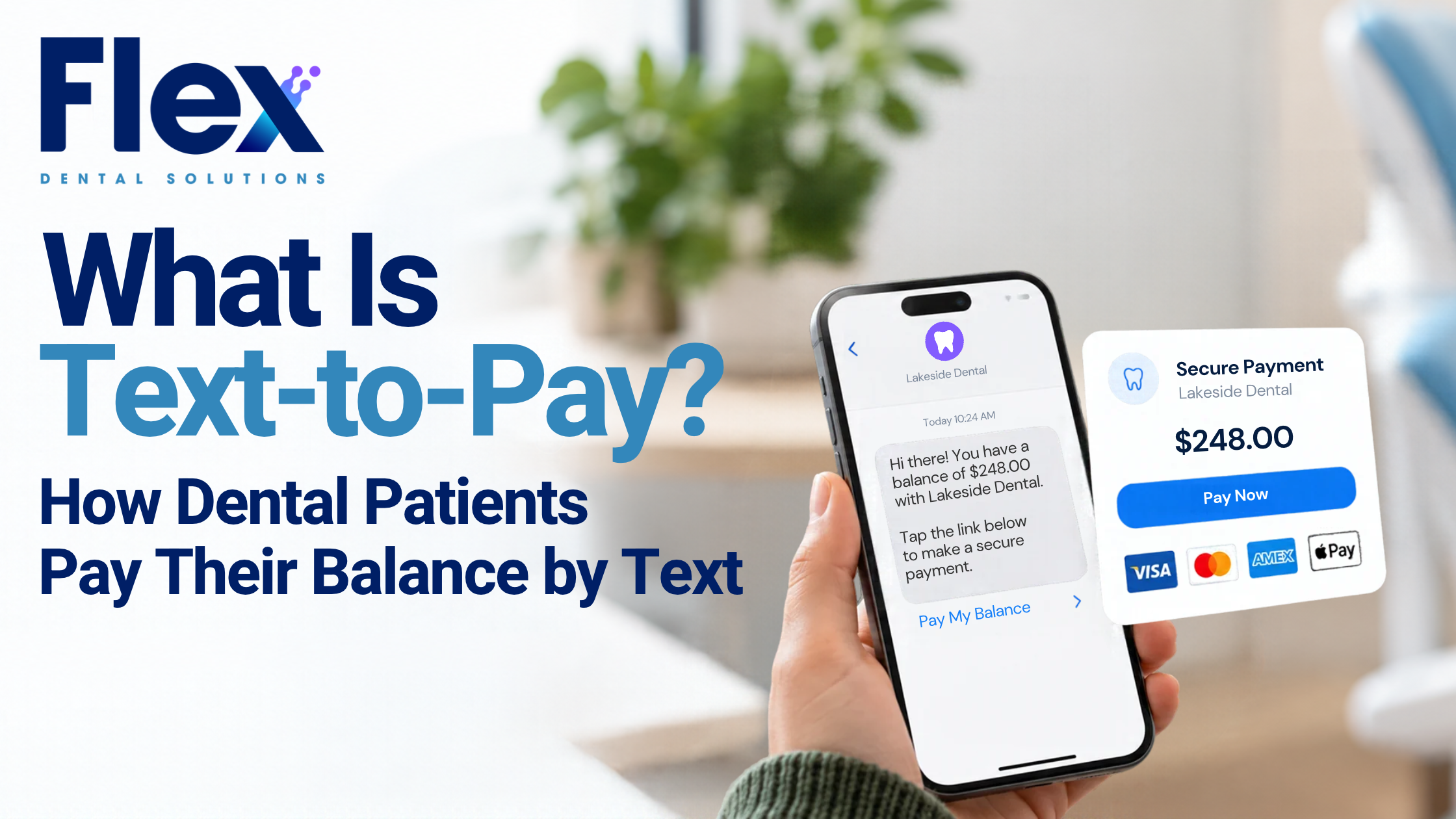
Text-to-pay for dental offices is a payment method that lets patients receive a secure payment link by text message and pay their balance from their phone. Instead of calling the office, mailing a check, or waiting for a paper statement, the patient can open the link, review the amount due, and submit payment digitally. For dental practices, text-to-pay can reduce collection friction and make it easier for patients to act while the balance is still top of mind.
For Open Dental practices using FlexPayments, text-to-pay can also be part of a connected payment workflow that reduces manual follow-up and keeps payment activity tied to Open Dental.
How Does Text-to-Pay Work for Dental Offices?
A typical dental text-to-pay workflow is simple:
- The request: the practice sends the patient a payment link by text.
- The tap: the patient taps the link on their phone.
- The review: the patient reviews the balance and payment details.
- The payment method: the patient enters or selects a payment method.
- The processing: the payment is processed.
- The record: the practice records the payment in its normal workflow.
With FlexPayments, the goal is to keep that process connected to Open Dental so the front desk is not creating another disconnected payment task after the patient pays.
Why Is Text-to-Pay Useful for Dental Practices?
Because payment collection often breaks down after the patient leaves the office. A patient may fully intend to pay later. Then:
- they forget
- the statement gets buried
- they do not answer a collections call
- they are busy when the office calls
- the balance sits for another week
Text-to-pay removes some of that friction by putting the payment option directly on the device the patient already uses all day. That creates a shorter path between:
Balance due → payment request → payment completed
How Does Text-to-Pay Help Patients?
Text-to-pay can make the payment experience easier because patients do not have to:
- call during office hours
- wait on hold
- mail a check
- log into another complicated portal
- remember to pay later
Instead, the payment request arrives where many patients are already most responsive: their phone. That convenience can make a routine financial task feel much simpler.
How Does Text-to-Pay Help Dental Practices?
The biggest benefit is not simply that patients can pay by phone. It is that the practice can reduce the amount of manual follow-up required to collect balances.
Text-to-pay can help with:
- outstanding patient balances
- post-insurance balances
- missed payments
- treatment deposits
- follow-up collections
- statement payments
For busy front desk and billing teams, even small reductions in manual calling can add up.
Can Text-to-Pay Improve Dental Collections?
It can. Text-to-pay can improve the collection experience by making it easier for patients to respond quickly. If the payment request is simple, mobile-friendly, and easy to act on, the patient has fewer reasons to delay.
That does not mean every text will turn into an immediate payment. But it can remove common barriers such as:
- “I forgot.”
- “I didn’t see the statement.”
- “I didn’t have time to call.”
- “I didn’t know how to pay online.”
Text-to-pay does not create the balance. It makes the next step easier.
How Is Text-to-Pay Different From a Paper Statement?
A paper statement depends on several steps:
- The statement is generated.
- It is mailed.
- The patient receives it.
- The patient opens it.
- The patient decides how to pay.
- The payment is sent back.
Text-to-pay removes several of those steps.
| What to consider | Paper statement | Text-to-pay |
| How it’s delivered | By mail | By text |
| How fast it arrives | Can take days | Arrives quickly |
| How the patient pays | Often requires another payment step | Payment link is included |
| Patient follow-through | Easy to set aside | Easy to act on immediately |
| Workflow | Depends on paper workflow | Digital and mobile-friendly |
Paper statements may still have a place. Text-to-pay simply gives practices another collection channel.
How Is Text-to-Pay Different From Calling a Patient for Payment?
Calling can work. But it depends on both people being available at the same time.
Text-to-pay is asynchronous. The practice sends the payment request, and the patient can pay when it is convenient. That can reduce phone tag and make collection less dependent on office hours.
How Does Text-to-Pay Work With Open Dental?
For Open Dental practices, the strongest payment workflow is one that reduces duplicate entry. If a patient pays digitally, the team should not have to manually recreate the same transaction somewhere else.
FlexPayments is built for Open Dental practices and is designed to connect patient payment activity back to the Open Dental workflow. That matters because a payment tool should not create another system for the team to reconcile.
Open Dental remains the practice management foundation. Flex helps extend the payment workflow around it.
Does Text-to-Pay Require a Separate Patient Login?
The best text-to-pay experiences minimize friction. Patients should not need to remember another username and password just to pay a dental balance. A secure payment link can provide a more direct path.
For practices evaluating patient payment software, this is worth asking during a demo:
How many steps does the patient have to take between receiving the text and completing the payment?
The fewer unnecessary steps, the better.
Is Text-to-Pay Secure?
Dental practices should use a payment platform that sends patients through a secure payment process rather than collecting card information through ordinary text messages. That distinction matters.
The text should provide a secure link. The patient should enter payment details within the protected payment experience. The dental team should not be asking patients to text card numbers back to the office.
What Types of Balances Can Dental Practices Collect by Text?
Text-to-pay can be useful for many common patient balances, including:
- remaining balances after insurance
- treatment balances
- missed payments
- outstanding statements
- deposits
- recurring payment follow-up
The exact workflow depends on the payment system the practice uses.
How Does Text-to-Pay Fit With Other Dental Payment Options?
Text-to-pay works best as one part of a broader payment strategy. Patients may prefer different ways to pay, including:
- in-office card payments
- text-to-pay
- email-to-pay
- stored cards
- payment plans
- HSA/FSA
- patient financing
- Buy Now, Pay Later
The goal is not to force every patient into one payment method. It is to reduce friction by giving them clear options.
Why Do Flexible Payment Options Matter in Dentistry?
Because patients do not all manage money the same way. One patient may want to pay in full. Another may want to use a stored card. Another may prefer financing. Another may want a text link they can open after work.
The more rigid the payment workflow, the more likely the practice is to create unnecessary friction. Flexible payment options give patients more ways to complete the same outcome: paying for care.
Can Text-to-Pay Reduce Front Desk Work?
Yes. Every balance that can be paid without a phone call, manual card entry, or repeated reminder removes a small administrative task from the team. That can mean less time spent:
- calling patients
- taking card numbers by phone
- leaving voicemails
- resending payment instructions
- manually tracking follow-up
The benefit is not dramatic in one transaction. It becomes meaningful across hundreds of patients.
What Should Dental Practices Look for in Text-to-Pay Software?
Ask these questions:
- Does it work with Open Dental? The payment workflow should fit the PMS your team already uses.
- Does it post payments back into Open Dental? If the team has to manually enter every payment, the workflow is still partially manual.
- Is the patient experience simple? The payment link should be easy to open and use on a phone.
- Can the practice track payment status? Teams should be able to see whether payments were completed.
- Does it support other payment methods? A strong payment platform should support more than one channel.
- Is support easy to reach? Payments are too important for vendor finger-pointing. Know who your team calls when something goes wrong.
How Does FlexPayments Help Open Dental Practices Collect Patient Balances?
FlexPayments is built for Open Dental practices and supports multiple patient payment workflows, including digital payment options such as text-to-pay and electronic statements.
The broader goal is to help practices reduce the work between “The patient owes a balance” and “The payment is complete.”
FlexPayments also supports payment workflows such as:
- in-office payments
- electronic statements
- stored cards
- recurring payments
- patient financing
- Buy Now, Pay Later
- surcharging where permitted
The more connected those options are, the less work the front desk has to stitch together manually. Want to go deeper? Explore more FlexPayments resources.
What Is the Difference Between Text-to-Pay and Third-Party Payment Software?
“Third-party payments” is a broad term. It generally refers to payment services provided by a platform outside the practice management system. The important question is how well that payment platform connects back to the PMS.
A disconnected third-party processor may successfully move the money but still leave the dental team responsible for:
- posting the transaction
- allocating it
- reconciling it
- updating the ledger
A connected system is more valuable because it reduces what happens after the payment is processed.
What Is the Biggest Benefit of Text-to-Pay?
The biggest benefit is convenience.
- For the patient: pay when it works for you.
- For the practice: make it easier to collect without adding another phone call.
That is the core value.
Make Paying Easier
Your patients already use their phones to schedule, confirm, and communicate. Paying should be just as simple. FlexPayments helps Open Dental practices give patients more convenient ways to pay while reducing manual collection work for the team.
How much easier would collections be if every balance came with a link? See it in action. Learn More About FlexPayments or Schedule a Demo.
Frequently Asked Questions
What is text-to-pay for dental offices?
Text-to-pay is a digital payment method that lets dental patients receive a secure payment link by text and pay their balance from their phone.
How does dental text-to-pay work?
The practice sends a secure link by text. The patient opens the link, reviews the balance, chooses a payment method, and submits payment digitally.
Can text-to-pay help dental practices collect faster?
It can help by making the payment step more convenient and reducing delays caused by paper statements, phone tag, or forgotten balances.
Does text-to-pay work with Open Dental?
Yes. FlexPayments is built for Open Dental practices and supports connected patient payment workflows designed to reduce manual payment work.
Is text-to-pay secure?
It should use a secure payment link and protected payment page. Patients should not send card information through normal SMS messages.
Can dental practices text patients a payment link?
Yes. Dental practices can use payment software that supports secure payment links by text.
What other payment options can dental practices offer?
Practices can offer in-office card payments, text-to-pay, electronic statements, stored cards, recurring payments, patient financing, and Buy Now, Pay Later depending on their payment platform.