Every dental professional knows the visceral sting of an empty chair. In a busy dental practice, time is the only true inventory. When a patient fails to show up, that time is lost forever, resulting in significant revenue gaps and operational friction. For many, these empty slots represent thousands of dollars in lost production annually, creating a ripple effect that stresses staff, disrupts clinical workflows, and lowers team morale. To mitigate these losses, your office must shift from merely "sending reminders" to executing a sophisticated patient communication strategy.
The High Cost of Silence: Why Every Appointment Reminder Counts
The Financial Impact of Empty Dental Chairs
The financial consequences of a "no-show" extend far beyond the fee for a single dental appointment. When a patient misses their slot, you lose the opportunity to treat someone else who needed care. Research suggests that a single provider can lose between $5,000 and $50,000 in annual production due to broken appointments. This is a direct hit to your bottom line. Since fixed overhead costs—such as rent, salaries, and insurance—remain static regardless of patient volume, each lost hour erodes the profitability of your dental practice. Reducing these incidents is not just about efficiency; it is a fundamental pillar of fiscal health.
Beyond Revenue: How No-Shows Disrupt Clinical Flow and Team Morale
A missed appointment creates a logistical vacuum. When a patient fails to arrive, your front desk staff is forced into "reactive mode," scrambling to fill the slot at the last minute or adjusting the clinical schedule to compensate for the sudden downtime. This creates unnecessary stress for your hygienists and assistants, who may have prepared materials or specialized equipment for a specific procedure. Over time, chronic no-shows lead to team burnout and a feeling of instability in the office. Consistent communication through effective appointment reminders restores order, ensuring the team can focus on patient care rather than crisis management.
The Anatomy of a High-Conversion Dental Reminder
The Rule of Three: Timing Your Reminders for Maximum Impact
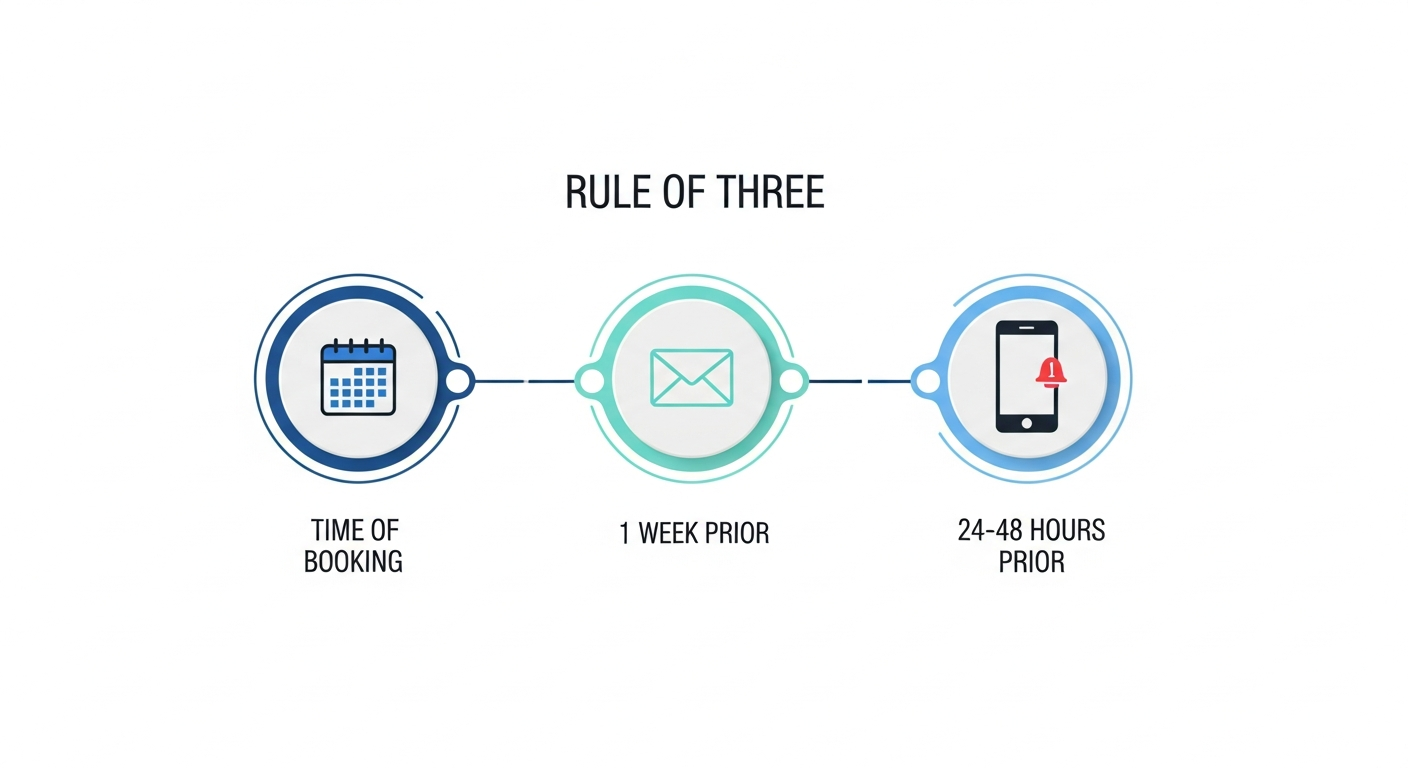 Implementing the 'Rule of Three' reminder cadence keeps the appointment top-of-mind without overwhelming the patient.
Effective communication follows a rhythmic pattern. A single reminder is rarely enough. The "Rule of Three" suggests three distinct touchpoints: the initial confirmation at the time of booking, a secondary check-in one week prior, and a final "high-urgency" alert 24 to 48 hours before the visit. This cadence ensures the appointment stays on the patient’s radar without becoming intrusive.
The Power of the "Confirm" Link: Reducing Cognitive Load
Modern practice management software, such as Open Dental, allows you to embed "Confirm" links directly into text messages and emails. Combine that with a patient engagement software, like Flex Dental Solutions, and it can provide even more accessibility. The goal is to minimize friction. If a patient has to call your office to confirm, they might procrastinate. If they can click a button within an SMS, the act of confirmation takes less than three seconds. Always aim to lower the cognitive load for the patient; the easier the response, the higher your compliance rate.
Personalization vs. Professionalism: Finding the Right Tone
Your communication should feel human, not robotic. While automated, templates should utilize placeholders for patient names and specific procedure types. Avoid overly formal language that feels like a collection notice. Instead, adopt a tone that is welcoming, supportive, and professional. You are not just reminding them of an appointment; you are reminding them of their commitment to their own health.
The "First Impression" Suite: New Patient Welcome and Confirmation Templates
The Initial Booking Confirmation (Email)
"Dear [Patient Name], we are excited to see you on [Date] at [Time]. Your health is our priority. Please bring your insurance card and arrive 15 minutes early to complete your intake forms."
The 48-Hour Welcome SMS (Focus on Practice Value)
"Hi [Name]! We’re looking forward to your visit on [Date] at [Time]. We’ve reserved this time just for you to ensure you receive our full attention. See you soon!"
The "Don’t Forget Your Forms" Reminder (Efficiency Focus)
"Hi [Name], help us make your visit seamless! Please complete your digital intake forms here: [Link]. Having these done ahead of time ensures we get you into the chair on time."
The "Relationship Builder" Suite: Routine Hygiene and Recall Templates
The Soft Recall: Scheduling Future Maintenance
"Hi [Name], it’s time for your six-month cleaning! We have openings on [Date] or [Date]. Click here [Link] to grab a spot or reply with your preference."
The Standard 24-Hour Confirmation SMS
"Reminder: You have an appointment at [Practice Name] on [Date] at [Time]. Reply C to confirm or call [Phone Number] to reschedule."
The Same-Day "See You Soon" Nudge
"Hi [Name], we are excited to see you today at [Time]! Please let us know if you have any questions before you arrive."
The "High-Stakes" Suite: Specialized Procedures and Pre-Op Reminders
Surgical Procedure Reminders (Focus on Preparation Instructions)
"Hi [Name], a friendly reminder for your upcoming procedure on [Date]. Please remember to follow your fasting instructions and arrange for a driver, as discussed."
Sedation Reminders (Safety and Transportation Compliance)
"Important: For your sedation appointment on [Date], please ensure you have a designated driver. Safety is our priority. Call us at [Phone] if you have questions."
Large Case Confirmations (Highlighting the Reserved Block of Time)
"Hi [Name], we’ve reserved an extended block of time on [Date] to complete your restorative work. Please confirm your arrival so our team can prepare your clinical setup."
The "Recovery" Suite: Handling Cancellations and No-Shows
The Immediate Follow-Up: The "We Missed You" Template
"Hi [Name], we missed you today! We know life gets busy. Please give us a call at [Phone] to reschedule your appointment and ensure your treatment stays on track."
The Late Cancellation Nudge (Focus on Rescheduling Opportunities)
"Hi [Name], we received your request to cancel. We understand plans change. We have openings available on [Date]—would you like to grab one of those to keep your care current?"
Managing the Chronic No-Show: The Firm but Professional Policy Reminder
"Hi [Name], we missed your appointment again today. As a reminder, our office policy requires 24-hour notice for cancellations to avoid a fee. We’d love to keep seeing you—please call us to discuss how we can help you stay on schedule."
The Psychology of the Nudge: Behavioral Science in Patient Communication
Utilizing Loss Aversion: Highlighting the Value of the Appointment
Psychologically, people are more motivated to avoid a loss than to achieve a gain. Instead of saying "We have an opening," frame it as "We have reserved this time for you." By using the word "reserved," you imply that if they don't show, they are forfeiting a valuable resource that was specifically allocated to them.
Social Proof and Scarcity: Reminding Patients of High Demand
Patients are more likely to honor an appointment if they know the practice is busy. Subtle language like, "We are currently booking out two weeks, so we want to ensure we hold your reserved spot," reinforces the value of the time slot without sounding pushy.
The Power of "Thank You": Building Positive Reinforcement
Always express gratitude. A simple "Thank you for prioritizing your dental health" goes a long way. This validates the patient’s effort to attend, turning the appointment from a chore into a positive health action.
Multi-Channel Strategy: Choosing Between SMS, Email, and Voice
Why SMS Reminders Dominate Patient Response Rates
SMS (text messages) have an extremely high open rate and are typically read within minutes of receipt. For standard confirmations, SMS is your primary tool. Use email for detailed pre-op instructions, intake forms, or post-operative care guides where the patient needs to read and digest information. Voice calls are best reserved for complex case follow-ups or situations where a patient has become a "ghost," meaning they have ignored all digital attempts at communication.
Always ensure your messaging platform is HIPAA-compliant. Never include sensitive protected health information (PHI) in a text message. Stick to simple logistical confirmations. When utilizing practice management software, ensure it integrates seamlessly with your scheduling workflow to prevent double-booking and data silos.
Conclusion
Reducing no-shows is not about finding the perfect script; it is about building a culture of communication. By implementing a structured, multi-channel approach—using the Rule of Three, leveraging psychological nudges, and utilizing technology—you can transform your practice’s scheduling efficiency.
Remember, every appointment reminder is a touchpoint that reinforces your relationship with the patient. When you respect the patient’s time through consistent, clear, and professional reminders, they are far more likely to respect the time you have reserved for them. Start by reviewing your current confirmation workflow today. Audit where your communications might be failing, integrate automated tools to reduce manual friction, and ensure your team is trained to deliver these messages with empathy and authority. By stabilizing your schedule, you not only improve your revenue but also create a more predictable, less stressful environment for your entire team. Take these templates, adapt them to your practice’s unique voice, and begin the journey toward a more reliable, patient-centered schedule. Your bottom line—and your team—will thank you.