Introduction: Unleashing the Potential of Your Dental Practice with Open Dental API
The dental industry is undergoing a profound digital transformation. Gone are the days when paper charts and manual processes dictated the pace of a practice. Today, technology is not just an assistant but a core driver of efficiency, patient experience, and ultimately, profitability. At the heart of this evolution lies practice management software, and for a significant portion of the market, Open Dental stands as a robust, customizable, and widely adopted solution. However, the true power of Open Dental, like many modern software systems, is unlocked through its Application Programming Interface (API). Integrating with the Open Dental API allows dental practices to connect disparate systems, automate workflows, and gain unprecedented control over their operations and patient data.
The dental practice management software market size is valued to increase USD 1.11 billion, at a CAGR of 9.1% from 2024 to 2029 [Technavio, 2025-2029]. This rapid growth underscores the increasing reliance on sophisticated software solutions. This burgeoning market is increasingly driven by the need for interoperability and advanced functionality, which APIs facilitate. This guide is designed to demystify the Open Dental API, providing dental practices with the knowledge to leverage its potential. We will explore its capabilities, security considerations, practical applications, and advanced integration strategies, offering a vendor-agnostic approach to unlocking the full power of your Open Dental system. Whether you are a practice owner, an IT administrator, or a vendor looking to connect, this comprehensive guide will serve as your roadmap to a more efficient, connected, and patient-centric dental practice.
The Evolution of Dental Practice Management
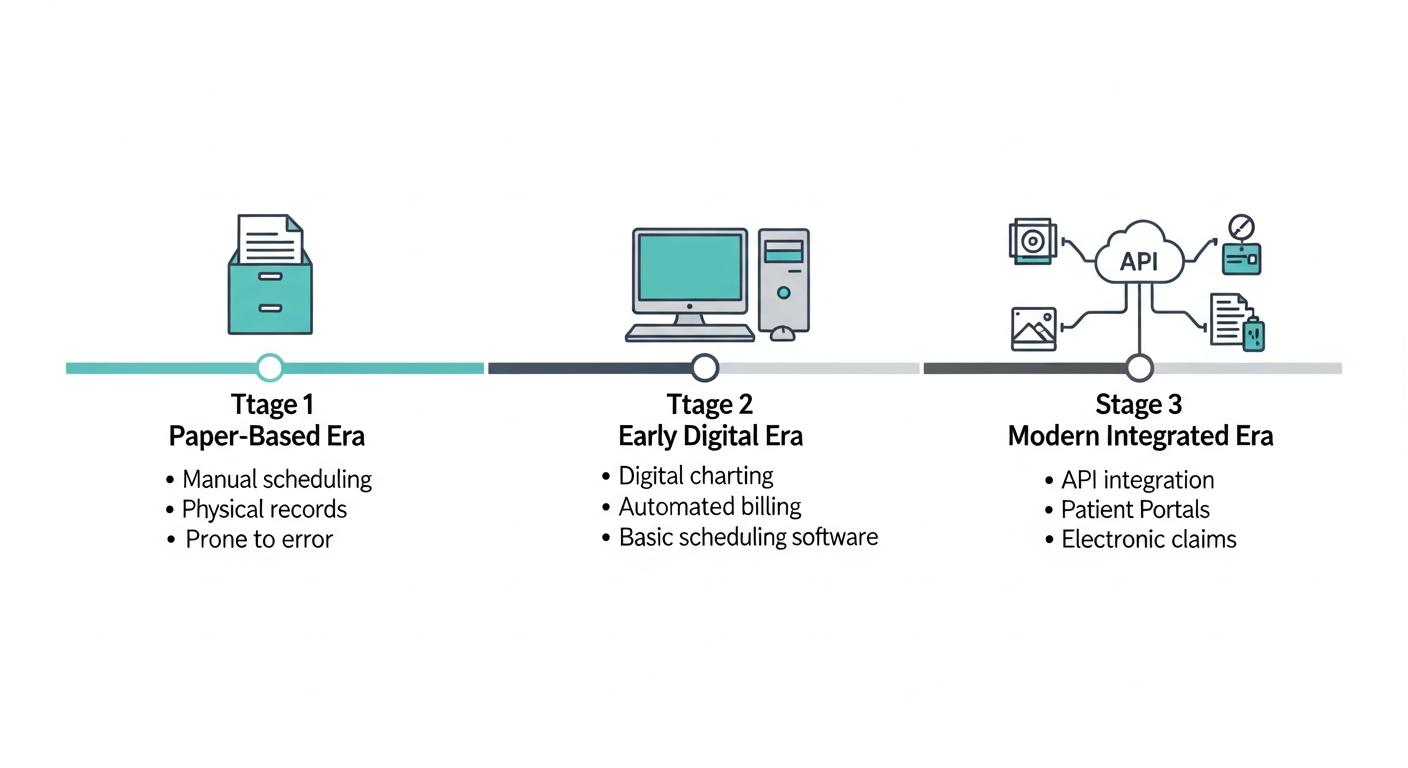 The journey of dental practice management from manual paper systems to today's sophisticated, API-driven integrated platforms.
The journey of dental practice management has been a fascinating one. Initially, practices relied heavily on paper-based systems for patient records, scheduling, and billing. This method, while functional for its time, was inherently inefficient, prone to errors, and lacked the agility required for modern healthcare demands. The advent of computers brought about the first wave of digital practice management software, transitioning patient data to digital formats and automating many administrative tasks. This era saw improvements in charting, appointment scheduling, and billing, laying the groundwork for further technological advancements.
The digital revolution continued, with practice management systems becoming more sophisticated. Features like digital imaging integration, electronic claims submission, and patient portals began to emerge, enhancing both clinical and administrative workflows. This indicates a strong demand for efficient and integrated solutions. Open Dental, with its flexible architecture and broad adoption, has been a significant player in this evolving landscape, offering a powerful on-premise solution that has also adapted to cloud-based possibilities.
Why API Integration is No Longer Optional for Modern Dental Offices
In today's interconnected world, siloed software systems are a significant bottleneck for dental practices. While Open Dental is a comprehensive practice management system, its true potential is realized when it can seamlessly communicate with other specialized applications. This is where Application Programming Interfaces (APIs) become indispensable. An API acts as a bridge, allowing different software systems to exchange data and functionality in a standardized and secure manner. For modern dental offices, API integration is no longer a luxury but a necessity for several critical reasons:
- Enhanced Efficiency and Automation: APIs enable the automation of repetitive tasks, such as appointment confirmations, patient intake, and insurance verification. This frees up valuable staff time, allowing them to focus on patient care and complex administrative duties.
- Improved Patient Experience: Seamless integrations lead to a smoother patient journey. Automated appointment reminders, easy online booking, and consolidated patient communication platforms enhance convenience and satisfaction.
- Data Centralization and Accuracy: APIs allow for the synchronization of patient data across multiple platforms, ensuring consistency and accuracy. This is vital for accurate charting, billing, and communication.
- Access to Specialized Tools: The dental landscape is filled with innovative third-party tools for areas like telehealth, marketing automation, patient financing, and advanced diagnostics. API integrations allow practices to leverage these specialized solutions without compromising their primary practice management system.
- Competitive Advantage: Practices that embrace API integration are better positioned to adapt to technological changes, offer superior patient experiences, and operate more efficiently than their less integrated counterparts. The Dental Practice Management Software Market size is estimated at USD 2.62 billion in 2026, and is expected to reach USD 4.44 billion by 2031, at a CAGR of 11.12% during the forecast period (2026-2031) [Mordor Intelligence, 2026], indicating a strong trend towards advanced software utilization.
What This Guide Will Cover: A Vendor-Agnostic Approach to Open Dental API
This guide is designed to be your definitive resource for understanding and implementing Open Dental API integrations. We will take a vendor-agnostic approach, focusing on the underlying principles and capabilities of the Open Dental API itself, rather than promoting specific third-party solutions. Our goal is to empower you with the knowledge to make informed decisions about integrating your practice management system.
We will begin by demystifying what an API is and how Open Dental specifically utilizes its API to provide access to its extensive features and data. We will delve into the core capabilities and limitations of the API, guiding you on where to find essential developer resources. Crucially, we will dedicate significant attention to the critical aspects of security and HIPAA compliance, outlining best practices for protecting sensitive patient data.
The guide will then transition to practical interactions, explaining how to make API calls, the importance of testing, and the role of real-time data flow mechanisms like webhooks. We will explore common use cases that can immediately enhance practice operations, from patient communication to workflow optimization and multi-practice management. Finally, we will touch upon advanced integration possibilities and the essential setup and maintenance considerations required for successful long-term API utilization. By the end of this guide, you will have a comprehensive understanding of how to "unlock" the full potential of your Open Dental practice management system through strategic API integration.
Understanding the Open Dental API: Your Gateway to Data and Automation
The Open Dental API is not merely a technical feature; it's a strategic enabler for modern dental practices. It represents a standardized way for external applications to interact with the rich data and functionalities housed within your Open Dental database. Understanding its foundational elements is the first step towards leveraging its transformative power.
What is an API and How Does Open Dental Utilize It?
At its core, an API (Application Programming Interface) is a set of rules and protocols that allows different software applications to communicate with each other. Think of it as a universal translator or a waiter in a restaurant: you (one application) tell the waiter (API) what you want from the kitchen (another application), and the waiter brings it back to you. Without the waiter, you would have to go into the kitchen yourself, which is inefficient and potentially disruptive.
Open Dental utilizes its API to provide controlled access to its database and functionalities. Instead of directly manipulating the database, which can be risky and unsupported, third-party vendors and custom applications can interact with Open Dental through its API. This interaction allows for:
- Reading Data: Accessing patient demographics, appointment schedules, treatment history, insurance information, and more.
- Writing Data: Creating new patient records, scheduling appointments, logging payments, updating insurance details, and other modifications.
- Triggering Actions: Initiating specific processes within Open Dental, such as sending recall notifications or updating patient status.
This structured approach ensures data integrity, security, and maintainability, making it the recommended method for any external interaction with the Open Dental system. Open Dental itself emphasizes that its API allows for "safe communication between a third-party software and the Open Dental database. The Open Dental API is the approved method of writing to the database (such as creating an appointment or entering a payment). It is designed by and tested by Open Dental engineers..."
Core Capabilities and Limitations of the Open Dental API
The Open Dental API offers a wide range of capabilities, allowing for deep integration with various third-party systems. These capabilities can be broadly categorized:
- Data Retrieval: The API can fetch detailed patient information, including demographics, medical history, insurance details, appointment history, and treatment plans. It can also retrieve information about providers, clinics, and practice settings.
- Data Creation and Modification: Key functionalities include creating new patients, scheduling and modifying appointments, entering payments and adjustments, updating insurance information, and logging communications.
- Workflow Triggers: Specific API endpoints can be used to trigger automated workflows within Open Dental, such as sending reminders or updating patient status based on external events.
- Reporting Data Access: While direct SQL reads are also possible for complex reporting, the API can provide structured access to data commonly used in custom reports and business intelligence tools.
However, like any API, the Open Dental API has its limitations. It is designed for controlled programmatic access, not for direct user interface replacement. Complex or niche functionalities might not have direct API endpoints. Furthermore, there can be considerations regarding real-time data synchronization for high-transaction operations, which might require specific integration strategies. Understanding these limitations is crucial for setting realistic expectations and designing effective integrations. For example, while the API is excellent for structured data exchange, highly specific clinical charting functionalities might be accessed differently or require custom development.
Accessing the Open Dental Developer Portal and Resources
To effectively utilize the Open Dental API, developers and practice IT staff need access to comprehensive documentation and resources. Open Dental provides these through its official channels. The primary resource is often found on the Open Dental website, under sections dedicated to developers or integration partners. These resources typically include:
- API Documentation: Detailed explanations of available endpoints, request/response formats, authentication methods, and required parameters.
- Developer Guides: Step-by-step instructions, code examples, and best practices for common integration scenarios.
- API Specifications: Technical specifications outlining the structure and behavior of the API.
- Support Forums: Community forums where developers can ask questions, share solutions, and interact with Open Dental staff and other users.
It is essential for anyone planning an integration to thoroughly review these official documents. While this guide provides a conceptual overview, the developer portal will offer the granular technical details necessary for implementation. Staying updated with any API version changes or new features announced by Open Dental is also critical for maintaining successful integrations.
Key Components: API Keys, Access Credentials, and Authorization
Securing access to the Open Dental API is paramount, and this is managed through a system of API keys, access credentials, and authorization mechanisms.
- API Keys: These are unique alphanumeric codes that identify and authenticate your application or service when it makes a request to the Open Dental API. Think of an API key as a password for your application. It proves that you are who you say you are. These keys are typically generated within the Open Dental system or through specific integration partner portals.
- Access Credentials: This term often encompasses API keys but can also include other tokens or secrets required for authentication. For example, an OAuth token might be used for more secure, delegated access.
- Authorization: Once authenticated, authorization determines what actions your application is permitted to perform. The API will check if the authenticated user or application has the necessary permissions to access specific data or perform a requested operation. This ensures that a system designed to only read appointment data, for instance, cannot modify patient medical records.
Proper management of these components is the first line of defense against unauthorized access. Hardcoding API keys directly into application source code is a significant security risk. Instead, they should be stored securely using environment variables, configuration files, or dedicated secrets management systems. Access should be granted on a principle of least privilege, meaning an application only gets the permissions it absolutely needs.
Fortifying Your Practice: Open Dental API Security and HIPAA Compliance
In the healthcare sector, particularly when dealing with sensitive patient data, security and compliance are not optional extras; they are foundational requirements. The Open Dental API, while powerful, must be implemented with robust security measures to protect Protected Health Information (PHI) and comply with regulations like HIPAA.
The Paramount Importance of HIPAA-Compliant Integrations
The Health Insurance Portability and Accountability Act (HIPAA) sets stringent standards for the privacy and security of PHI in the United States. Any integration that involves the transmission, storage, or processing of PHI must adhere to HIPAA guidelines. This includes integrations with the Open Dental API. Failure to comply can result in severe penalties, reputational damage, and loss of patient trust.
When integrating third-party software with Open Dental via its API, it is crucial to ensure that:
- Data Encryption: PHI should be encrypted both in transit (e.g., using TLS/SSL for API calls) and at rest (if stored by the third-party application).
- Access Controls: Robust access controls must be in place to ensure only authorized personnel and systems can access PHI.
- Audit Trails: Systems should maintain detailed logs of who accessed what data, when, and why. This is crucial for accountability and forensic analysis in case of a breach.
- Data Minimization: Only the minimum necessary PHI should be accessed or transmitted for a given integration's purpose.
The global Dental Software Market shows a projected CAGR of approximately 10.6% [Data Insights Market, 2026], highlighting the rapid growth of digital solutions.
Securing Your API Keys and Access Credentials
As discussed earlier, API keys and other access credentials are the gatekeepers to your Open Dental data. Their security is paramount.
- Avoid Hardcoding: Never embed API keys directly into your application's source code. Use secure methods for storing and retrieving them, such as environment variables, secure configuration files, or dedicated secrets management tools.
- Least Privilege Principle: Grant API keys only the minimum permissions necessary for the integration to function. If an application only needs to read appointment data, it should not have permissions to modify patient records or access billing information.
- Regular Rotation: Periodically rotate your API keys. If a key is compromised, rotating it limits the window of vulnerability.
- Monitoring and Auditing: Implement monitoring to detect suspicious API activity. Regularly review audit logs to identify any unauthorized access attempts or unusual usage patterns.
- Environment-Specific Keys: Use different API keys for development, staging, and production environments. This prevents accidental access to live patient data during development or testing.
Understanding Business Associate Agreements (BAAs) for Third-Party Integrations
Under HIPAA, any entity that handles PHI on behalf of a covered entity (like a dental practice) is considered a Business Associate. This includes vendors providing software that integrates with your Open Dental system and therefore accesses PHI.
- What is a BAA? A Business Associate Agreement is a legally binding contract between a covered entity and a business associate. It outlines the responsibilities of the business associate regarding the safeguarding of PHI.
- When is a BAA Required? If a third-party vendor, through their integration with your Open Dental API, will create, receive, maintain, or transmit PHI, a BAA is almost certainly required.
- Due Diligence: It is the responsibility of the dental practice to ensure that all vendors handling PHI have a BAA in place and are themselves compliant with HIPAA regulations. Always ask for and review BAAs with your integration vendors. API developers should have a Business Associate Agreement (BAA) in place with their clients.
Implementing Robust Authorization and Audit Trails
Beyond securing the credentials themselves, the system must ensure that only authorized actions are performed and that these actions are logged for accountability.
- Role-Based Access Control (RBAC): Implement RBAC within your integrated applications and ensure that the API interactions align with the roles and permissions assigned to users within Open Dental. The API should respect these defined roles.
- OAuth 2.0: For modern integrations, consider using OAuth 2.0. This framework allows users to grant third-party applications limited access to their data without sharing their primary login credentials, enhancing security and user control.
- Comprehensive Audit Trails: Every API interaction should be logged. This log should include:
- Timestamp of the request.
- The identity of the application or user making the request.
- The specific endpoint or function accessed.
- The type of operation performed (GET, POST, PUT, DELETE).
- The outcome of the operation (success or failure, including error codes).
- The data affected (e.g., patient ID, appointment ID).
These audit trails are crucial for monitoring, troubleshooting, and demonstrating compliance during a HIPAA audit.
Best Practices for Data Protection and Safer Integration Types
When planning integrations, prioritizing data protection should be at the forefront.
- Prefer Read-Only Access: If an integration only needs to read data, configure it for read-only access to minimize the risk of accidental data modification.
- Minimize PHI Exposure: Design integrations to access and transmit only the minimum amount of PHI necessary for their intended function. For example, a patient recall system might only need the patient's name, contact information, and last appointment date, not their full medical history.
- Data Masking: Where feasible, consider data masking techniques if certain sensitive fields are not strictly required for the integration's logic.
- Secure Development Practices: For custom integrations, adhere to secure coding standards, regularly scan for vulnerabilities, and conduct thorough security testing.
- Integration Types:
- Direct API Integration: The most common and recommended method for real-time data exchange. Requires careful security implementation.
- Program Links: Open Dental's mechanism for launching external applications from within the Open Dental interface, often passing limited context. Generally safer as it doesn't typically involve direct data exchange unless the launched app then uses the API.
- eConnector: A key component that facilitates secure communication between Open Dental and external services. Its role is crucial for many integrations.
- External SQL Reads: While powerful for custom reporting, direct database access should be heavily restricted and used judiciously, primarily for read-only reporting purposes. The API is generally preferred for transactional operations.
By meticulously applying these security principles, dental practices can confidently leverage the Open Dental API to enhance their operations without compromising patient privacy or regulatory compliance.
Practical API Interactions: Connecting and Communicating with Open Dental
Understanding the theoretical aspects of the Open Dental API is one thing; knowing how to interact with it is another. This section focuses on the practical steps and tools involved in making API calls and establishing communication with your Open Dental system.
Making Your First API Calls: An Overview of HTTP Methods
APIs, including the Open Dental API, typically operate over the HTTP protocol. This means interactions are structured around standard web requests. The primary HTTP methods used in API interactions are:
- GET: Used to retrieve data from the server. For example, a GET request might be used to fetch a list of all patients or the details of a specific appointment.
- POST: Used to submit new data to the server to create a resource. For instance, a POST request would be used to add a new patient to the Open Dental database.
- PUT: Used to update an existing resource on the server. A PUT request could be used to modify a patient's contact information.
- DELETE: Used to remove a resource from the server. For example, a DELETE request might be used to remove a test appointment record.
Each API call will involve specifying the endpoint (the specific URL for the resource you want to interact with), the HTTP method, and often a request body containing data (for POST and PUT requests) or parameters. Headers are also used to provide authentication credentials (like API keys) and specify the format of the data being sent (e.g., JSON).
Testing Your Integrations: Tools and Techniques
Thorough testing is critical to ensure your API integrations function correctly and securely before deploying them into a live production environment.
- Development and Staging Environments: It is highly recommended to have separate development and staging environments that mirror your production Open Dental setup but contain anonymized or test data. This allows you to experiment and test without risking live patient information.
- API Testing Tools: Tools like Postman, Insomnia, or curl are invaluable for manually testing API endpoints. They allow you to construct HTTP requests with different methods, headers, and body payloads, and then inspect the server's responses. You can save common requests, organize them into collections, and automate testing workflows.
- Using Postman: With Postman, you can easily:
- Set up your Open Dental API endpoint URL.
- Choose the appropriate HTTP method (GET, POST, etc.).
- Add authorization headers containing your API key.
- Construct the request body (e.g., in JSON format) with the data you want to send.
- Send the request and analyze the status code and response body to verify the result.
- Automated Testing: For more complex integrations, consider incorporating API tests into your development pipeline using scripting languages and testing frameworks. This ensures that integrations remain functional as Open Dental or your integrated application is updated.
Real-Time Data Flow: Understanding Webhooks and FHIR Subscriptions
While making direct API calls is essential, many modern integrations require a way for Open Dental to proactively notify external systems when certain events occur. This is achieved through mechanisms like webhooks or, in broader healthcare contexts, FHIR subscriptions.
- Webhooks: A webhook is a user-defined HTTP callback that occurs when a specific event happens. Instead of your application constantly polling the Open Dental API to check for updates (which is inefficient), Open Dental can be configured to send an HTTP POST request to a pre-defined URL on your server whenever a specific event occurs (e.g., a new appointment is booked, a patient record is updated). This provides near real-time data synchronization.
- FHIR Subscriptions (Future Consideration): FHIR (Fast Healthcare Interoperability Resources) is a standard for exchanging healthcare information electronically. While Open Dental may not natively support all FHIR capabilities, understanding FHIR subscriptions is relevant for broader interoperability goals. FHIR subscriptions allow a client application to subscribe to notifications about changes to specific FHIR resources.
Choosing between polling and webhooks depends on the specific integration's requirements for real-time data. For most transactional use cases and event-driven updates, webhooks are the more efficient and scalable solution.
Bridging the Gap: Program Links and eConnector
Open Dental offers specific mechanisms to facilitate integration:
- Program Links: These are shortcuts configured within Open Dental that launch external applications. When a user clicks a program link, Open Dental can pass relevant data (like a patient ID) to the launched application. This is useful for integrating with tools that don't necessarily need continuous real-time data exchange but rather context-specific actions. For example, clicking a program link could launch an external patient communication tool with the selected patient's details pre-filled.
- eConnector: The eConnector is a critical piece of middleware that manages communication between Open Dental and various external services, including many API integrations. It acts as a secure gateway, ensuring that data is transmitted reliably and efficiently between your Open Dental database and the integrated applications. Proper installation and configuration of the eConnector are often prerequisites for successful API integrations.
Exploring External SQL Data Reads for Custom Reporting
While the Open Dental API is the primary method for transactional data manipulation and retrieval, direct SQL data reads from the Open Dental database can be a powerful tool for complex custom reporting and business intelligence.
- When to Use SQL Reads: If you need to perform highly complex analytical queries that involve joining multiple tables in ways not directly exposed by the API, or if you are building sophisticated business intelligence dashboards that require direct access to the raw data, external SQL reads might be considered.
- Risks and Precautions: Direct SQL access bypasses the API's built-in checks and balances. It carries significant risks:
- Data Integrity: Incorrect queries can corrupt data.
- Performance Impact: Poorly optimized queries can slow down the entire Open Dental server.
- Security: Direct database credentials can be a target if not managed extremely carefully.
- Unsupported: Open Dental strongly advises against direct database manipulation outside of the API. Updates to the database schema may break direct queries.
- Best Practices for SQL Reads: If used, it should strictly be for read-only operations. Access should be limited to specific read-only user accounts. Queries should be thoroughly tested and optimized. Ideally, data should be replicated to a separate reporting database rather than accessing the live production database directly.
Understanding these practical aspects will equip you to start building or evaluating Open Dental API integrations for your practice.
Streamlining Operations: Common Open Dental API Integration Use Cases
The true value of the Open Dental API lies in its ability to transform daily operations. By connecting Open Dental with specialized software, like Flex Dental Solutions, practices can automate tasks, improve patient engagement, and gain greater operational efficiency.
Enhancing Patient Communication and Engagement
Effective patient communication is vital for retention and practice growth. The Open Dental API facilitates numerous integrations in this area:
- Appointment Reminders and Confirmations: Integrate with services that automatically send SMS, email, or voice reminders for upcoming appointments. The API allows these services to fetch appointment details and update the patient's record with confirmation status. This can significantly reduce no-shows.
- Recall Management: Automate the sending of recall messages to patients who are due for their next check-up or cleaning. The API can provide lists of eligible patients based on their last appointment date and treatment plan.
- Patient Portals and Online Scheduling: Connect Open Dental to patient portal software that allows patients to view their upcoming appointments, access their health records, and schedule new appointments online. The API ensures these actions are reflected in the Open Dental schedule in real-time.
- Post-Appointment Surveys and Feedback: Automate the sending of patient satisfaction surveys after appointments. The API can trigger these surveys and log the feedback, providing valuable insights into patient experience.
- Targeted Marketing Campaigns: Integrate with marketing platforms to send targeted communications based on patient demographics, treatment history, or recall status.
Optimizing Practice Workflows
Beyond patient communication, API integrations can streamline a multitude of internal practice workflows:
- Automated Patient Check-in/Check-out: Integrate with digital check-in kiosks or tablets that pull patient information from Open Dental and update their status upon arrival and departure.
- Insurance Verification: Connect with real-time insurance eligibility verification services. These services can pull patient insurance details via the API, check eligibility, and report back, saving administrative staff significant time and reducing claim rejections.
- Digital Forms and Intake: Integrate with electronic form solutions. New patients can fill out intake forms online or on a tablet, with the data automatically populated into their Open Dental record via the API.
- Lab Case Management: Connect with dental labs to streamline the ordering process, track case status, and receive notifications, all synced with patient treatment plans in Open Dental.
- Payment Processing and Patient Financing: Integrate with payment gateways and patient financing providers to ensure seamless processing of payments and applications, with transaction data updated in Open Dental.
Centralizing Patient Data: Synchronizing Patient Records and Charting
Maintaining accurate and consistent patient data across all systems is a cornerstone of efficient practice management.
- Demographic and Insurance Sync: Ensure that patient demographic information and insurance details entered in one system (e.g., a patient portal or billing service) are automatically updated in Open Dental, and vice-versa, reducing manual data entry errors.
- Charting Integration: While Open Dental has robust charting capabilities, integrations can bring in data from specialized charting software or external diagnostic tools, ensuring all relevant clinical information is accessible.
- Radiology/Imaging Integration: Many imaging systems can integrate with Open Dental, allowing images to be linked directly to patient charts. The API can facilitate the creation of these links or the transfer of metadata.
Leveraging API Integrations for Multi-Practice Management (Dental Support Organizations)
Dental Support Organizations (DSOs) manage multiple dental practices, each operating with its own instance of Open Dental or a centralized system. API integrations are crucial for their centralized operations:
- Centralized Reporting and Analytics: DSOs can aggregate data from multiple practice locations via their respective Open Dental APIs into a central data warehouse or business intelligence platform. This allows for comprehensive analysis of practice performance, patient trends, and operational metrics across the entire organization.
- Unified Patient Experience: APIs can help ensure a consistent patient experience across all affiliated practices, from scheduling and communication to data access and billing.
- Streamlined Administration: Centralized administrative tasks, such as credentialing, marketing, and compliance monitoring, can be automated by integrating specialized DSO management software with each practice's Open Dental system.
- Resource Management: APIs can facilitate better management of shared resources, such as equipment or specialized staff, across multiple locations.
These use cases demonstrate the tangible benefits of Open Dental API integrations, enabling practices to operate more efficiently, enhance patient care, and achieve greater growth. Underscoring how practice management systems and their integrations can improve patient care and practice performance.
Advanced Integrations: Unlocking Deeper Insights and Interoperability
Moving beyond standard operational enhancements, Open Dental API integrations can pave the way for more sophisticated applications, enabling deeper insights and broader interoperability within the healthcare ecosystem.
Business Intelligence and Advanced Reporting Tools
While Open Dental provides reporting capabilities, integrating with specialized Business Intelligence (BI) platforms can unlock advanced analytics for dental practices and DSOs.
- Data Warehousing: API integrations can feed data from one or multiple Open Dental instances into a dedicated data warehouse. This centralized repository allows for complex querying and analysis without impacting the performance of the live practice management system.
- Advanced Dashboards: BI tools like Tableau, Power BI, or specialized healthcare analytics platforms can connect to the data warehouse (fed by Open Dental APIs) to create interactive dashboards. These dashboards can visualize key performance indicators (KPIs) such as patient acquisition costs, treatment plan acceptance rates, chair utilization, revenue per patient, and operational efficiency metrics across multiple practices.
- Predictive Analytics: By analyzing historical data pulled via APIs, practices can leverage machine learning models for predictive analytics. This could include forecasting patient no-show rates, predicting demand for specific services, or identifying patients at risk for certain dental conditions.
- Benchmarking: DSOs can use aggregated data to benchmark the performance of individual practices against organizational averages or industry standards, identifying areas for improvement.
Bi-Directional Data Sync with Third-Party Systems
Many integrations focus on one-way data flow (e.g., Open Dental to an external system). However, true interoperability often requires bi-directional synchronization, where data changes in one system are reflected in the other, and vice-versa.
- Real-Time Updates: Bi-directional sync ensures that if a patient updates their contact information in a patient portal, that change is immediately reflected in Open Dental, and vice-versa. Similarly, if an appointment is scheduled or cancelled via an external system, Open Dental should be updated instantaneously.
- Complex Workflows: This is crucial for advanced workflows, such as synchronizing treatment plans between Open Dental and specialized clinical software, or updating inventory levels in practice management software based on sales in a retail point-of-sale system.
- Data Consistency: Bi-directional sync is the most effective way to maintain data consistency across disparate systems, minimizing discrepancies and the need for manual reconciliation.
- Collision Management: Implementing bi-directional sync requires careful consideration of potential data conflicts (e.g., if the same record is updated in two systems simultaneously). Robust logic is needed to manage these scenarios gracefully.
Interoperability with Broader Healthcare Systems
As the healthcare industry moves towards greater interoperability, Open Dental integrations can play a role in connecting dental practices to the wider healthcare ecosystem.
- Health Information Exchanges (HIEs): APIs can be used to facilitate the secure exchange of dental information with HIEs, allowing medical providers to access relevant dental records (e.g., for patients with systemic conditions like diabetes that impact oral health) and vice-versa.
- Electronic Health Records (EHR) Integration: While dental records are distinct, there are increasing overlaps and needs for coordination with general EHR systems, especially for patients with complex health needs. API integrations can help share relevant data points between Open Dental and an EHR.
- Public Health Reporting: APIs can enable the automated reporting of public health data (e.g., disease surveillance) to relevant authorities, as required by law.
Workflow Automation: Harnessing AI and Efficiency Platforms
The integration of Artificial Intelligence (AI) and specialized workflow automation platforms with Open Dental is revolutionizing how dental practices operate. These platforms leverage the Open Dental API to automate complex, multi-step processes, freeing up human resources and enhancing patient and staff experiences.
Introduction to Healthcare Automation Platforms
Dedicated healthcare automation solutions are designed to understand the nuances of healthcare workflows and are built to integrate with practice management systems like Open Dental. These platforms typically offer a visual interface for designing and managing automated workflows without requiring extensive coding knowledge. They connect to Open Dental via its API to read data, trigger actions, and update records, acting as intelligent orchestrators for various practice tasks.
Implementing AI Receptionists and Automated Patient Triage
One of the most impactful applications of API integration is the deployment of AI receptionists. These systems can handle a significant volume of patient interactions:
- Intelligent Appointment Booking: AI receptionists can interact with patients via chat or voice, understand their needs, check availability in Open Dental via the API, and book appointments directly into the schedule.
- Automated Patient Intake and Triage: Patients can interact with an AI to answer initial screening questions, provide symptoms, or fill out pre-appointment forms. The AI can then triage the patient, determine urgency, and guide them to the appropriate next steps (e.g., schedule an emergency appointment, wait for human intervention, or book a routine visit).
- Answering FAQs: AI systems can be trained to answer common patient questions regarding office hours, services, insurance, and directions, reducing the burden on front-desk staff.