Introduction: Why Dental Eligibility Verification is Non-Negotiable
With the landscape of modern dental care, efficiency and financial stability are paramount for any thriving practice. Amidst the intricate web of insurance policies, patient responsibilities, and administrative tasks, one process stands out as a non-negotiable pillar: dental eligibility verification. This crucial step, often handled by the front desk team, forms the bedrock of accurate billing, predictable revenue, and a seamless patient experience. Failing to prioritize dental insurance verification can lead to a cascade of issues, from frustrating claim denials to strained patient relationships. This comprehensive guide will walk dental practices through a structured, step-by-step approach to mastering eligibility verification, transforming it from a potentially cumbersome task into a strategic advantage.
Defining Dental Eligibility Verification
At its core, dental eligibility verification is the proactive process of confirming a patient's dental insurance coverage and understanding the specifics of their benefits before treatment is rendered. It involves checking if the patient has an active policy, what services are covered under their plan, and what their financial obligations will be. This isn't merely about ticking a box; it's about gaining essential insight into the details of a patient's dental insurance.
The Critical Role in Modern Dental Practices
In today's healthcare environment, where insurance complexities are the norm, insurance verification is no longer an optional administrative chore but a fundamental operational necessity for any dental practice. Approximately 72 million adults in the US do not have dental insurance, highlighting the significant portion of the population that does. For those who are insured, accurately understanding their coverage is vital. Over 79% of American adults have dental insurance, underscoring the pervasive need for practices to effectively manage these plans. Without thorough verification, practices risk significant financial losses and administrative headaches. Utilizing a patient engagement software, such as Flex Dental Solutions, creates a seamless insurance verification experience for practices.
Benefits of Proactive Verification: Preventing Surprises and Boosting Practice Health
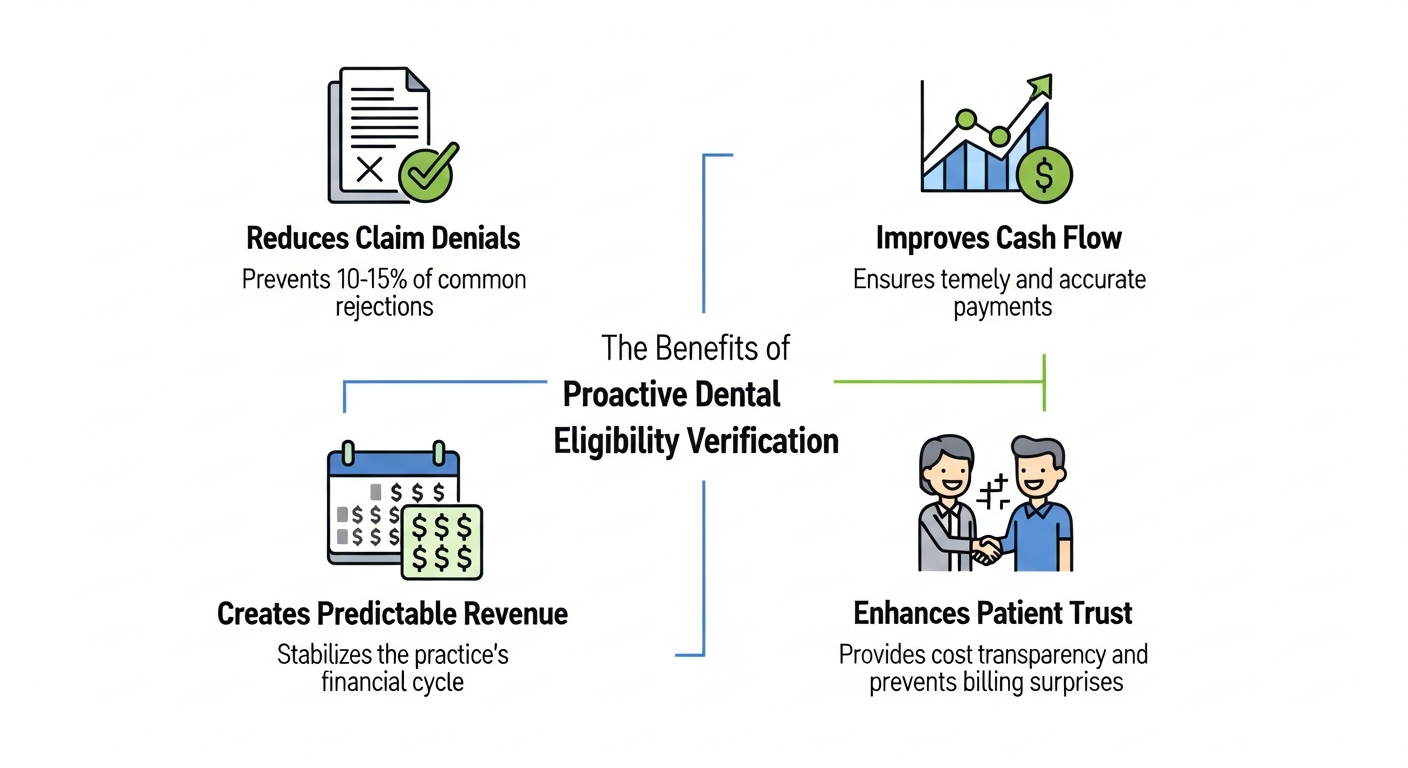 Proactive verification safeguards a practice's financial health and improves the patient experience by ensuring clarity and accuracy upfront.
The advantages of implementing a robust eligibility verification process extend far beyond simply reducing claim rejections. Proactive verification acts as a powerful preventive measure that safeguards both the practice and the patient. By understanding a patient's benefits and financial responsibilities upfront, practices can significantly reduce the likelihood of claim denials, which affect roughly 10% to 15% of submissions nationwide. This proactive approach directly contributes to improved cash flow and a more predictable revenue cycle. Furthermore, transparent communication regarding costs, empowered by accurate eligibility information, fosters patient trust and enhances their overall experience, potentially reducing the number of skipped appointments, a concern amplified by events like the COVID-19 pandemic where nearly 40% of Americans skipped dental visits.
Step 1: Proactive Patient Intake & Initial Information Gathering
The foundation of effective eligibility verification begins the moment a new patient contacts the dental practice, or even before an existing patient schedules their next appointment. This initial phase is critical for collecting accurate and complete information necessary for the subsequent verification steps.
Capturing Essential Patient and Insurance Information
When a patient calls to schedule, or upon their arrival for their first visit, the front desk staff plays a crucial role. They must meticulously gather comprehensive details. This includes the patient's full name, date of birth, address, and contact information. Crucially, they need to collect the primary policyholder's information if the patient is covered under someone else's plan, along with the group number and policy number associated with their dental insurance. Having these details readily available is the first step in navigating the complexities of patient insurance.
The Appointment Book: First Point of Data Collection
The appointment book or scheduling software serves as the initial repository for patient information. As appointments are made, the relevant insurance details provided by the patient should be logged accurately. This includes the name of the insurance carrier, the type of plan (e.g., PPO, HMO, indemnity), and any member identification numbers. This early capture ensures that the insurance verification task is initiated promptly, rather than being an afterthought.
Identifying the Insurance Provider and Dental Plan
A key element during intake is correctly identifying the insurance company and the specific dental plan the patient holds. Many patients may have multiple insurance policies, or their employer may offer different plans. The front desk team needs to be adept at asking clarifying questions to pinpoint the correct insurance carrier and plan that will be used for billing. Misidentification at this stage can lead to significant downstream errors in the verification process.
Educating Patients on Their Role in Providing Accurate Details
It's also vital to educate patients on the importance of providing accurate insurance information. Explaining that accurate details facilitate smoother processing and clearer understanding of their benefits can encourage patients to be more diligent. Empowering patients with the knowledge that precise information helps the practice provide them with accurate cost estimates can foster a collaborative approach.
Step 2: Executing the Core Verification Process
Once the foundational patient and insurance information is gathered, the next phase involves actively verifying this data with the insurance company. This step requires a methodical approach, whether through manual outreach or leveraging technological solutions.
Methods of Verification: Manual vs. Automated
Dental practices have two primary avenues for conducting insurance verification: manual processes and automated systems. Each method has its own set of advantages and challenges, and many practices opt for a hybrid approach. The choice often depends on practice size, resources, and technological infrastructure.
Manual Verification: Calling Insurance Companies and Using Payor Portals
Manual insurance verification involves direct contact with the insurance company. This can be done via phone calls to the provider's customer service or claims department, or by logging into the insurance company's online portal for providers. When calling, staff will need to provide patient identifiers, policy numbers, and group numbers to inquire about coverage details. Payor portals often offer a more immediate way to check active eligibility and general benefits, but require staff to navigate multiple websites, which can be time-consuming.
Automated Insurance Verification: Leveraging Practice Management Systems and Specialized Tools
Automated dental insurance verification significantly streamlines the process. Many modern practice management systems (PMS) have built-in modules that can automatically check patient eligibility. Alternatively, specialized third-party verification services and software, such as Flex Dental Solutions, can be integrated. These systems often connect directly to insurance payors' databases, allowing for rapid, real-time checks of coverage and benefits. This automation drastically reduces the time spent on manual calls and data entry, freeing up front desk staff for other patient-facing responsibilities.
Key Elements to Verify During the Process
Regardless of the method employed, several key pieces of information must be verified to ensure comprehensive understanding:
- Active Eligibility: Confirm that the patient's insurance coverage is active on the date of service.
- Plan Type: Identify the specific type of plan (e.g., PPO, HMO, indemnity) as this affects coverage and billing procedures.
- Benefit Period: Understand if the verification is for the current calendar year, a specific plan year, or if the patient has utilized their benefits already within that period.
- Deductibles: Determine the patient's remaining deductibles and if they have been met for the benefit period.
- Copayments and Coinsurance: Ascertain the patient's financial responsibility in the form of copays (a fixed amount) or coinsurance (a percentage of the service cost).
- Annual Maximums: Verify the patient's annual benefit maximum and how much of it has been used. For instance, 73% of consumers enrolled in dental PPOs have an annual maximum of $1,500 or more, a figure that has been steadily increasing.
- Procedure Codes: Where possible, verify if specific procedure codes are covered under the patient's plan and at what percentage.
Step 3: Interpreting Eligibility Responses and Communicating with Patients
Once the verification data is obtained, the next critical step involves accurately interpreting the information and, most importantly, communicating it clearly and transparently to the patient.
Deciphering Common Eligibility Responses
Insurance companies provide responses in various formats, and understanding them is crucial. A "covered" response indicates that the service is generally within the plan's scope, but still subject to deductibles, copays, or maximums. "Not covered" means the plan explicitly excludes the service. Responses regarding deductibles, copays, and maximums provide the quantitative details for calculating patient responsibility. For example, understanding the specifics of annual maximums is essential, as noted by the NADP.
Handling Complex Scenarios
Some situations are more complex. Patients might have multiple insurance plans (primary and secondary), requiring coordination of benefits. Coverage might be dependent on specific network providers, or pre-authorization might be needed for certain procedures. In such cases, the practice's front desk staff must exercise diligence and, if necessary, seek assistance from the insurance company or a dedicated dental insurance verification service.
Transparent Patient Communication: Setting Clear Expectations
The cornerstone of excellent patient care and financial management is clear, upfront communication. Once the eligibility verification has been completed and the patient's financial responsibility is estimated, this information must be conveyed to the patient. Practices should explain the patient's estimated out-of-pocket costs, including deductibles, copays, and coinsurance, before the procedure begins. This transparency builds trust, reduces surprises, and minimizes the chances of disputes or outstanding balances later. Explaining the estimated coverage based on the verification helps manage patient expectations effectively.
Step 4: Verification for Scheduled Treatments & Pre-Authorizations
Beyond general eligibility, specific verification is required for planned dental treatments, especially for more complex or costly procedures. This detailed check ensures accurate benefit application and avoids unexpected financial burdens.
Procedure-Specific Benefit Checks for Planned Treatments
For routine treatments, general eligibility verification might suffice. However, for procedures like crowns, bridges, implants, or orthodontic work, it's essential to verify coverage for the specific dental procedure codes. This ensures that the dental practice has an accurate understanding of what the insurance plan will contribute towards that particular service. This level of detail prevents surprises for both the patient and the practice and directly impacts the accuracy of the claim.
The Importance of Pre-Authorizations for Major Services
For extensive or high-cost treatments, obtaining pre-authorization (also known as prior authorization or pre-determination) from the insurance company is often mandatory and highly recommended. This process involves submitting a treatment plan to the insurer for review before the work is completed. Pre-authorization confirms that the proposed treatment is medically necessary and will be covered, outlining the exact benefit amount. This step is critical for managing patient expectations and securing payment for major services, thereby preventing potential claim denials.
Updating the Patient Record in Practice Management Systems
Every piece of information gathered and every verification performed must be meticulously documented within the practice management system (PMS), like Open Dental. This includes the date of verification, the representative spoken to (if by phone), the details of the patient's coverage, estimated patient responsibility, and any pre-authorization numbers. A well-maintained patient record is essential for accurate billing, tracking outstanding balances, and for future reference during subsequent appointments.
Step 5: Leveraging Technology and Optimizing Workflows for Efficiency
To truly excel in dental eligibility verification, practices must embrace technology and refine their workflows. This involves adopting efficient tools and establishing clear operational procedures.
Embracing Automated Insurance Verification Systems
Automated systems have revolutionized the verification process. By integrating with insurance payor databases, these tools can verify eligibility for multiple patients simultaneously, often in minutes. This significantly reduces the administrative burden on the front desk team, allowing them to focus on patient interaction and care. Many systems can also flag patients with upcoming benefit resets or expiring coverage, enabling proactive outreach.
Integrating with Your Practice Management System (PMS)
The most effective approach to automation is often through integration with your existing Practice Management System (PMS). Many PMS platforms offer built-in eligibility checking tools or allow seamless integration with third-party insurance verification services. This integration ensures that verified eligibility information is automatically updated in the patient's record, creating a single source of truth and reducing manual data entry errors. This synergy between your PMS and verification tools is key to optimizing your practice operations.
Considering a Dental Insurance Verification Service
For practices that lack the resources or desire to manage verification in-house, outsourcing to a specialized dental insurance verification service is a viable option. These services employ dedicated teams and advanced technology to handle the verification process, providing practices with timely and accurate eligibility information. This can be particularly beneficial for practices with a high volume of insured patients or those experiencing frequent staff turnover. The CAQH Index indicates that administrative tasks, including verification, are increasing in cost, making outsourcing a potentially cost-effective solution.
Empowering Your Front Desk Team: The Human Element in Verification
While technology is indispensable, the human element remains critical. The front desk team is the first point of contact and plays a pivotal role in ensuring accurate data capture and effective patient communication. Empowering this team with the right training and resources is essential for a robust verification process.
Essential Training for Front Desk Staff
Comprehensive training is paramount. Staff must be educated on:
- Understanding different types of dental insurance plans.
- Navigating verification software and payor portals.
- Asking pertinent questions to gather accurate information.
- Interpreting eligibility responses, including deductibles, copays, and maximums.
- Clearly communicating estimated patient financial responsibilities.
- Troubleshooting common verification issues.
Developing Standard Operating Procedures (SOPs) for Verification
Establishing clear Standard Operating Procedures (SOPs) for eligibility verification is vital for consistency and efficiency. These SOPs should detail every step of the process, from initial patient contact to documenting information in the PMS. They should outline when verification should occur (e.g., 48-72 hours before the appointment), who is responsible for each task, and how to handle exceptions or complex cases. Well-defined SOPs ensure that every patient receives the same level of meticulous verification, regardless of who is handling the task.
Conclusion
Dental eligibility verification is not merely a task to be completed; it is a strategic imperative for any modern dental practice aiming for financial health, operational efficiency, and exceptional patient care. By implementing a structured, step-by-step approach—from meticulous initial intake and proactive verification to clear patient communication and leveraging technology—practices can transform this essential process. Mastering eligibility verification is foundational to reducing claim denials, improving cash flow, and building lasting patient trust. Empowering your front desk team with thorough training and well-defined procedures, combined with the judicious use of automated systems and verification services, creates a synergy that drives practice success. Making dental insurance verification a non-negotiable priority is an investment that yields significant returns in practice stability and patient satisfaction.