What is a Dental Copay? Your Complete Guide to Understanding Costs
Navigating the world of dental care often involves deciphering a landscape of costs, plans, and coverage details. For many, the term "copay" is a familiar yet sometimes confusing element of their dental insurance. Understanding what a dental copay is, how it functions, and how it impacts your financial responsibility is crucial for making informed decisions about your oral health and budget. This guide aims to demystify dental copays, providing you with a clear and comprehensive understanding of these essential costs. We'll explore how they differ from other insurance terms, how they work in practice, and how to manage them effectively to ensure you receive the dental care you need without unexpected financial burdens.
Understanding Dental Insurance and Your Financial Responsibility
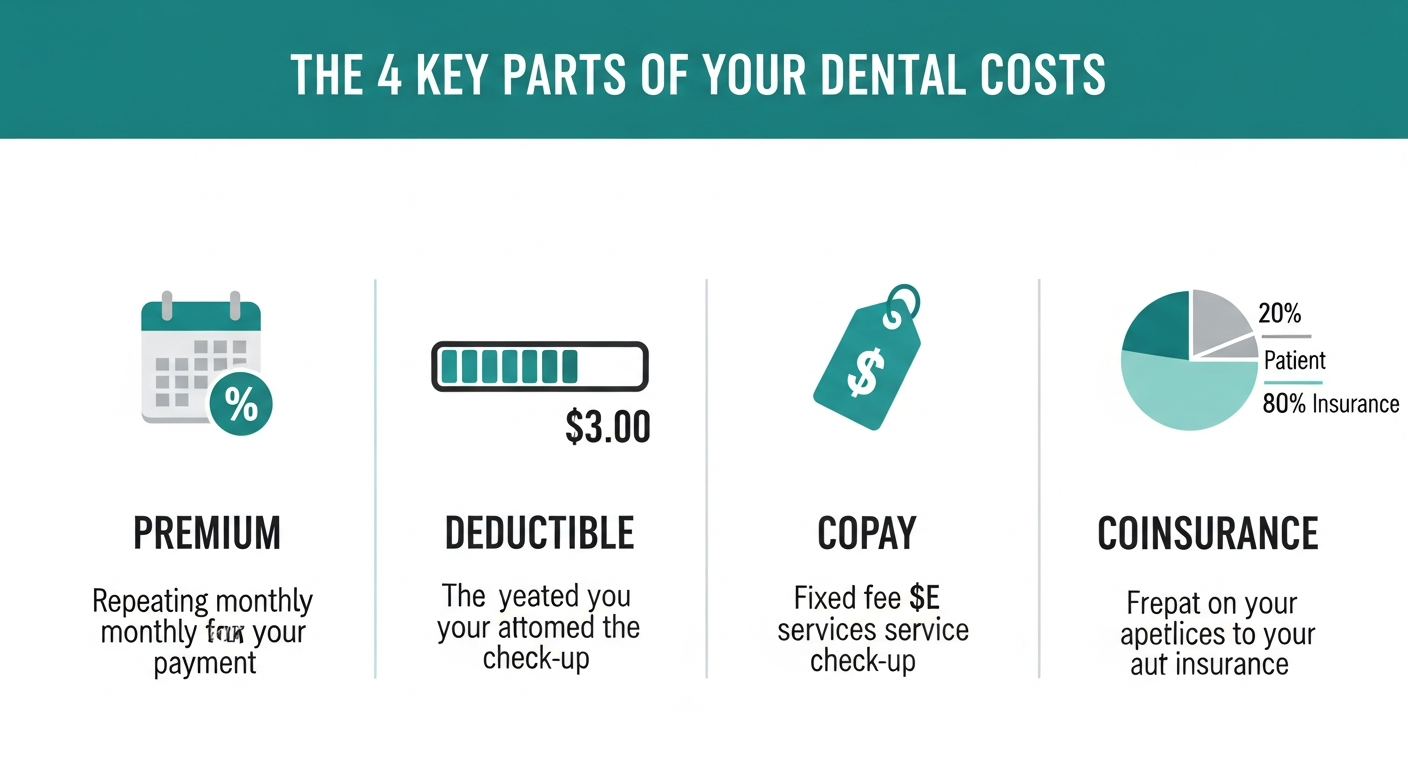 Your total out-of-pocket cost for dental care is a combination of different components. This visual breaks down the key terms you'll encounter.
Dental insurance acts as a vital tool for managing the often significant costs associated with maintaining good oral health. While approximately 65% of adults currently have dental insurance, representing a five-year high Delta Dental, 2024, it's important to remember that insurance is typically a cost-sharing mechanism. This means that while your dental insurance plan helps cover a portion of your dental care expenses, you will usually still be responsible for a part of the overall costs. This responsibility can manifest in several ways, including premiums (the regular payments you make to keep your insurance active), deductibles (an amount you pay before your insurance begins to cover services), coinsurance (a percentage of costs you share with your insurer after meeting a deductible), and copayments. Understanding these components is key to appreciating how your dental insurance plan works and what your financial obligations will be for various dental services. This financial structure is designed to make dental care more accessible, but it requires a clear understanding from the patient's perspective.
Why Understanding Your Dental Copay is Essential
The financial aspect of dental care can be a significant barrier for many individuals. In fact, in 2023, a substantial 13% of Americans cited cost as a barrier to receiving dental care, a figure significantly higher than the 4% to 5% reporting cost issues for other healthcare services ADA Health Policy Institute, 2025. This disparity highlights the critical need to understand how dental insurance, and specifically copays, influence out-of-pocket expenses. A copay represents a predictable, fixed cost for specific dental services. By knowing your copay amounts in advance, you can better budget for routine check-ups, necessary treatments, and unexpected dental needs. This clarity helps demystify the overall costs of dental care and empowers you to make proactive decisions about your oral health, potentially avoiding larger, more complex issues that can arise from deferred treatment due to financial uncertainty.
What Exactly is a Dental Copay? The Foundation
Defining a Dental Copayment: Your Fixed Share
At its core, a dental copayment, commonly referred to as a copay, is a fixed dollar amount that you pay directly to your dentist or dental provider each time you receive a specific covered dental service. Unlike coinsurance, which involves a percentage of the service cost, a copay is a set fee. For example, your dental insurance plan might state that you have a $25 copay for a routine dental exam or a $50 copay for a filling. This predictable amount is your share of the cost for that particular service, and it is typically paid at the time of your appointment. This system is a fundamental part of how many dental insurance plans manage costs and encourage members to utilize services.
How a Dental Copay Differs from a Deductible
Understanding the distinction between a dental copay and a deductible is crucial for managing your dental expenses. A deductible is the amount you must pay out-of-pocket for covered dental services before your dental insurance plan begins to pay its share. For instance, you might have a $50 annual deductible. This means you would pay the first $50 of any non-preventive services yourself. Once you've met that $50, your insurance plan's cost-sharing (like coinsurance or copays for certain services) will kick in. In contrast, a copay is often paid at each visit for a specific service, regardless of whether you have met your deductible, especially for preventive services. Some plans apply copays only after the deductible is met for certain procedures. It's essential to check your specific dental plan details to understand this interaction, as it can vary significantly.
Clarifying Copay vs. Coinsurance: A Key Distinction
While both copays and coinsurance are forms of cost-sharing within dental insurance plans, they function differently. As established, a copay is a fixed dollar amount you pay per service. For example, $30 for a specific procedure. Coinsurance, on the other hand, is a percentage of the cost of a covered service that you are responsible for after you have met your deductible. If your plan has 20% coinsurance for a procedure, and the allowed amount for that procedure is $200 after your deductible is met, you would pay $40 (20% of $200), and your insurance would pay the remaining $160. It's important to note that most dental benefit plans typically involve either a copay or coinsurance for a given service, but not usually both for the same procedure.
The Purpose of Copays: How They Help Manage Dental Costs for Insurers and Patients
Copays serve a dual purpose in the realm of dental insurance. For dental insurance providers, copays help manage overall plan costs by having patients share in the expense of each service. This shared responsibility can encourage more judicious use of dental services, potentially reducing the overall demand for care and thus controlling the insurer's payout. For patients, copays offer predictability. Knowing you will pay a fixed amount, such as $25 for a routine cleaning, allows for better budgeting compared to the uncertainty of percentage-based coinsurance or uncovered costs. This predictability can make it easier to access regular dental care, including preventive services like exams and cleanings, which are vital for long-term oral health and can help avoid more costly procedures down the line.
How Dental Copays Work in Practice: Your Dental Visit
Fixed Fees for Specific Dental Services
Your dental copay amount is not a one-size-fits-all figure; it is typically tied to the type of dental service you receive. This means that different procedures will have different associated copays. For instance, a routine dental cleaning, which is considered preventive care, might have a low copay or no copay at all. However, more complex procedures like a filling, root canal, or crown will generally have higher copays, or they may be subject to coinsurance after a deductible has been met. Understanding these service-specific copays is key to anticipating your financial responsibility for various types of dental care.
When You Pay Your Copay: Typically at the Time of Your Appointment
In most cases, you will be expected to pay your dental copay at the time of your appointment. When you check in at the dentist's office, the administrative staff will typically review your dental insurance information and determine the applicable copay for the service you are scheduled to receive. This payment is usually collected before you see the dentist or hygienist. If your plan requires you to meet a deductible before certain services are covered, or if the service involves coinsurance, there may be a different payment structure or a follow-up billing process. However, for services with a defined copay, paying it at the time of service is the standard procedure.
The Influence of Your Dental Network: In-network vs. Out-of-network Dentists
The dental network associated with your insurance plan significantly influences your copay and overall out-of-pocket costs. Dentists who are in-network have a contract with your dental insurance company, agreeing to provide services at pre-negotiated rates. When you visit an in-network dentist, you will pay your plan's specified copay or coinsurance for covered services. If you choose to see a dentist out-of-network, you will likely incur higher costs. While your insurance plan might still cover a portion of the service, the reimbursement amount may be lower, and you could be responsible for the difference between the dentist's full fee and what your insurance pays, in addition to your copay or coinsurance. For example, if you choose to see a dentist outside the network, you are responsible for any charges above the discounted plan payment. Staying within your dental network is one of the most effective ways to manage your dental care costs.
Locating Your Copay Information: Reviewing Your Coverage Documents and Fee Schedule
To effectively manage your dental expenses, it's essential to know the specific copay amounts for various services under your plan. Your dental insurance provider will have detailed documentation outlining this information. You can typically find your copay details by reviewing your dental insurance plan documents, which often include a summary of benefits or a policy booklet. Many insurance companies also provide online portals where you can log in to view your specific coverage details, including copays for different procedures. Additionally, you can contact your dental insurance provider's customer service directly to inquire about copay amounts. Some dentists' offices may also provide a fee schedule, especially if you are considering a procedure with a substantial cost, and they can often help you understand your estimated out-of-pocket expenses based on your insurance coverage. Always refer to your specific plan information for the most accurate details, as coverage specifics can vary.
Dental Copay in Action: Real-World Scenarios for Common Procedures
Scenario 1: Routine Preventive Dental Care
Let's consider a common scenario: a routine dental check-up and cleaning. Many dental insurance plans cover preventive services like these at a high level, often with a low copay or no copay at all, and typically without requiring you to meet your deductible first. For example, your plan might stipend a $10 copay for an exam and a $15 copay for a cleaning. If these are considered preventive services under your dental insurance, you would pay a total of $25 at the dentist's office for this appointment. This highlights how your insurance helps minimize out-of-pocket costs for essential preventive dental care.
Scenario 2: Basic Restorative Care
Imagine you need a filling for a small cavity. This falls under basic restorative care. If your dental insurance plan has a $30 copay for basic restorative services and you have a $50 annual deductible that you have not yet met, you would likely pay the full $50 deductible first. After meeting the deductible, if the plan then applies a $30 copay for the filling, your total out-of-pocket cost for this procedure would be $80 ($50 deductible + $30 copay). Alternatively, if your plan has coinsurance for this service, you would pay a percentage of the cost after meeting the deductible. Understanding how your specific plan applies deductibles and copays for restorative work is crucial.
Scenario 3: Major Restorative Care
For more extensive procedures, such as a root canal, the financial implications can be more significant. Major restorative services are typically subject to a deductible and often involve coinsurance rather than a fixed copay. For example, if your plan has a $100 annual deductible and 50% coinsurance for major procedures, and the allowed amount for a root canal is $1,000, you would first pay your $100 deductible. Then, you would pay 50% of the remaining $900, which is $450. Your total out-of-pocket cost for this root canal would be $550 ($100 deductible + $450 coinsurance). While there might not be a direct "copay" in the traditional sense for this procedure, these higher costs demonstrate the importance of having robust dental care coverage.
Copays Across Different Dental Plan Structures
Copays in PPO Plans (Preferred Provider Organization)
In a Preferred Provider Organization (PPO) dental plan, copays are common for various services. PPO plans offer flexibility, allowing you to see both in-network and out-of-network Providers. When you visit an in-network dentist, you'll pay a predetermined copay for services like check-ups, cleanings, fillings, and more complex procedures, depending on the plan's structure. Visiting an out-of-network dentist usually results in higher out-of-pocket expenses, as your copay might be different, or you might face higher coinsurance rates. PPO plans often involve a deductible that must be met before coinsurance applies to certain services.
Copays in DHMO Plans (Dental Health Maintenance Organization)
Dental Health Maintenance Organization (DHMO) plans typically operate differently from PPOs. Instead of copays for a wide range of services, DHMOs often assign a specific, fixed copayment for each procedure. A key characteristic of DHMOs is that they usually have no annual deductible and no annual maximum benefit. You are typically assigned to a specific dentist or dental office within the plan's network. While the convenience of no deductible and fixed copays is appealing, the choice of dentists is more limited. For example, a DHMO might have a $10 copay for a cleaning and a $50 copay for a filling, and these are the amounts you pay regardless of the service cost.
How Copays Impact Overall Premiums in Various Dental Plans
The structure of copays within a dental plan can influence the Premiums you pay. Plans with lower copays and more comprehensive coverage for a wide range of services, especially preventive and basic care, tend to have higher monthly premiums. This is because the insurer is taking on a larger portion of the financial risk. Conversely, plans with higher copays, higher deductibles, or a greater reliance on coinsurance for services may offer lower premiums. This trade-off means individuals who anticipate needing extensive dental work might prefer a plan with lower copays and higher premiums, while those who are healthy and expect minimal dental care might opt for a plan with higher copays and lower premiums to manage their monthly costs.
Maximizing Your Dental Benefits and Managing Copay Costs
Thoroughly Reviewing Your Dental Benefit Plan and Policy Forms
The most effective way to manage your copay costs and maximize your dental benefits is to thoroughly understand your specific dental insurance plan. This involves carefully reading your policy documents, including the summary of benefits and any associated fee schedules. Pay close attention to the copay amounts for different services, understand how your deductible works, and note any limitations or waiting periods. Knowing these details upfront will prevent surprises when you visit the dentist and allow you to make informed decisions about your dental care. Remember, your plan details are the definitive source for your specific coverage and costs [For full coverage specifics on any of these plans, including frequencies and limitations, refer to the appropriate plan booklet].
The Advantage of Choosing In-Network Dental Providers
As previously discussed, selecting in-network Providers is a cornerstone of managing your dental care costs. When you visit a dentist who is part of your insurance network, you benefit from pre-negotiated rates. This means your copay and any subsequent coinsurance amounts will be based on these lower, contracted fees, significantly reducing your out-of-pocket costs. For instance, an in-network dentist might have a $20 copay for a specific service, while an out-of-network dentist might charge a full price that, even after applying your plan's coverage, still leaves you paying substantially more than the copay amount. Always verify that your chosen dentist is within your network before your appointment.
Requesting a Pre-Treatment Estimate for Major Dental Procedures
For significant dental procedures such as crowns, bridges, root canals, or implants, it is highly advisable to request a pre-treatment estimate from your dental insurance provider. This process involves your dentist submitting a treatment plan to your insurer for review before the procedure is performed. The insurance company will then provide an estimate of what they will cover and what your out-of-pocket costs, including any remaining deductible and coinsurance amounts, will be. This proactive step helps you anticipate the financial responsibility and avoid unexpected high bills, allowing you to plan accordingly for these substantial dental care expenses.
Planning Ahead: Understanding Annual Benefit Limits and Waiting Periods
Most dental insurance plans have an annual maximum benefit, which is the total amount your insurance will pay for dental services in a given year. Understanding this limit is crucial, especially if you anticipate needing extensive treatment. For example, if your annual maximum is $1,500 and you've already incurred $1,200 in covered dental costs, your insurance will only cover an additional $300 for the rest of the year. Additionally, many plans have waiting periods for certain services, particularly major restorative care. This means you may need to be enrolled in the plan for a specific duration (e.g., six or twelve months) before coverage for procedures like root canals or implants becomes active. Being aware of these limitations prevents unexpected financial burdens.
Prioritizing Preventive Care to Minimize Future Copays and Costs
Investing in preventive dental care is one of the most effective strategies for minimizing future out-of-pocket costs, including copays and the need for extensive treatments. Services like regular cleanings, exams, and X-rays are designed to detect and address oral health issues in their earliest stages. Catching a cavity early, for instance, allows for a simple filling, which typically incurs a lower copay or coinsurance than a root canal or extraction needed if the cavity progresses. By consistently attending your scheduled check-ups, you not only maintain better oral health but also reduce the likelihood of needing more complex and expensive procedures down the line, thus lowering your long-term dental expenses.
Is a Dental Copay-Centric Plan Right for You? A Decision Guide
Assessing Your Typical Dental Care Needs and Usage Patterns
Deciding if a dental plan with a copay-centric structure is the right fit for you depends largely on your personal dental care needs and how frequently you utilize dental services. If you have a history of good oral health and primarily need routine preventive care, a plan with low copays for cleanings and exams, potentially with a higher deductible or coinsurance for major work, might be cost-effective due to lower monthly premiums. Conversely, if you anticipate needing more restorative work, such as fillings, crowns, or root canals, a plan with lower copays or coinsurance for these services, even if it means higher monthly premiums, could be a better financial choice overall. Consider your past dental visits and any known or suspected future needs.
Conclusion
Understanding the intricacies of dental copays is a vital step toward confidently managing your dental care expenses and ensuring you receive the necessary treatment. A dental copay represents your fixed financial contribution for specific services under your dental insurance plan, playing a key role alongside deductibles and coinsurance in shaping your overall out-of-pocket costs. By familiarizing yourself with how copays apply to different procedures, the impact of your dental network, and the variations across plan types like PPOs and DHMOs, you can make more informed decisions. Prioritizing preventive care, carefully reviewing your plan documents, and choosing in-network providers are strategic actions that empower you to maximize your benefits and control costs. Ultimately, a clear grasp of your dental copay and other associated expenses allows you to approach your dental care journey with greater financial predictability and peace of mind, ensuring your oral health remains a priority without becoming an undue financial burden.